
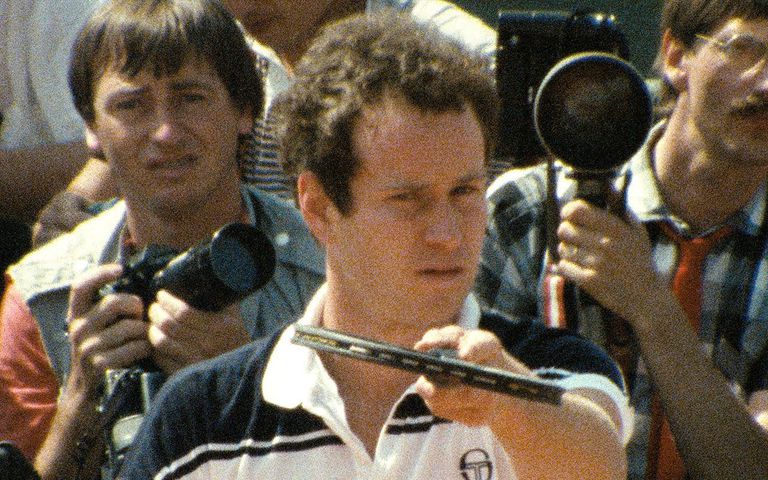
- The Julien Faraut documentary on one of the all time tennis greats is out now
- The film follows John McEnroe during a single Roland Garros tournament
- John McEnroe was on a 42-game winning streak at the time
- The film is narrated by French actor Mathieu Almaric
If it weren’t for the film’s title, it might take a while to realise that John McEnroe: In the Realm of Perfection, the new feature-length documentary from director Julien Faraut, is about John McEnroe at all.
It opens with black-and-white archive of a tanned Frenchman practising ground strokes – a clunky instructional video from the Sixties, it turns out – shot by France’s first national technical director of tennis, Gil de Kermadec.
Ever in the quest of excellence, de Kermadec eventually turned his cameras on players in action at the Roland Garros tournament, to see how they really moved when they were on court. In the mid-Eighties, he found his ultimate subject in the form of the bandana-wearing, umpire-abusing, awe-inspiring American number one.
So the intro is all a preamble, essentially, to explain how Faraut came to be in possession of a bumper bounty of footage that makes up the majority of his film, and shows John McEnroe, in intense focus, doing what he did best: phenomenal shot variety, lightning-quick net approaches, late-reveal drop-shots. Also: curling his lip, eyeballing members of the press, and endless – really, endless – arguing with officials about line calls. “You speak English? Take your glasses off so you can see the ball, all right?” Truly, in case we’d forgotten, the man was a prince.
McEnroe, to be fair, was under considerable pressure at the time, given that he was on his own quest for excellence in 1984. He was in his fourth year as world number one, a 42-match winning streak, had won his first six events of the year, and was soon to play his first ever French Open final. But this, at least initially, and frustratingly, is not what Faraut is interested in or willing to explain.
At first, in fact, he seems to be taking on de Kermadec’s mantle – analysing McEnroe’s technical brilliance in a sultry voiceover delivered by actor Mathieu Almaric (The Diving Bell and the Butterfly). It can all get a bit deep and, well, French. Here’s film critic Serge Daney writing at the time and quoted in the film: “Björn Borg puts the ball in the spot where the other player is not. McEnroe puts it in a place the other player will never reach.” [Insert Gallic shrug here.]
Not that there’s not a place for philosophising and artistic pretension in sports docs. Douglas Gordon and Philippe Parreno’s Zidane: A 21st Century Portrait (2006) kept its cameras trained exclusively on Zizou for the duration of a La Liga match, to surprisingly stirring effect. (This film was itself a nod to Fußball wie noch nie, a German documentary from 1970 focused entirely on George Best in a game against Coventry City.)
The Bafta-winning documentary Senna, the mesmerisingly immersive film about the life and death of Brazilian Formula 1 driver Ayrton Senna, doubtless benefits from the Royal College of Art schooling received by its British director, Asif Kapadia (whose doc about Diego Maradona debuts in June – hold onto your hats!).
Actually, though you have to wait for it, John McEnroe: In the Realm of Perfection does deliver some emotional punch. Because, like Kapadia’s documentaries, it is made up of archive, no talking heads, it has some of the absorbing qualities of Senna; all the shots of McEnroe prowling up and down the red clay between points, absorbing the jeers from the crowd, thrashing his racquet in frustration, do make it feel at times like you’re watching a wounded bull snorting and pawing the sand.
And the film does have a thesis. In contrast to the playing style of today, where showing emotion is considered a sign of weakness (let’s not forget that perennial smoothichops Roger Federer was known for his temper as a young player), McEnroe’s strength, it argues, was in harnessing his sense of persecution – by the crowd, by the officials, by the system – and turning it into a unquenchable desire to win. As Serge Danay wrote, more coherently this time: “McEnroe only plays well if he feels that everyone is against him. Hostility is his addiction.”
McEnroe: In the Realm of Perfection is out now.


