
I’m sitting in the very swish Aston Martin Racing lounge at the 24 Hour Le Mans – surely, the world’s most dangerous motor race – and I can’t help but see a familiar face. And not just one, either. I see this particular face everywhere.
It’s strapped to the wrists of well-dressed racing enthusiasts, polo-wearing driving professionals, and even a few off-duty racing crew.
he face is that of the TAG Heuer Monaco – and it’s highly recognisable because in 1969 it was the very first automatic chronograph in existence. That, and its iconic square shape which is highly unusual in a world awash with circular bezels.
For those that know its history, it should come as no surprise that anyone with even a smattering of motor racing interest would be wearing one. The watch was produced for a singular reason: to track lengths of time (the phrase ‘chronograph’ effectively translates to stopwatch), specifically, how long it takes cars to go around one track in particular: the Formula One race in Monaco.
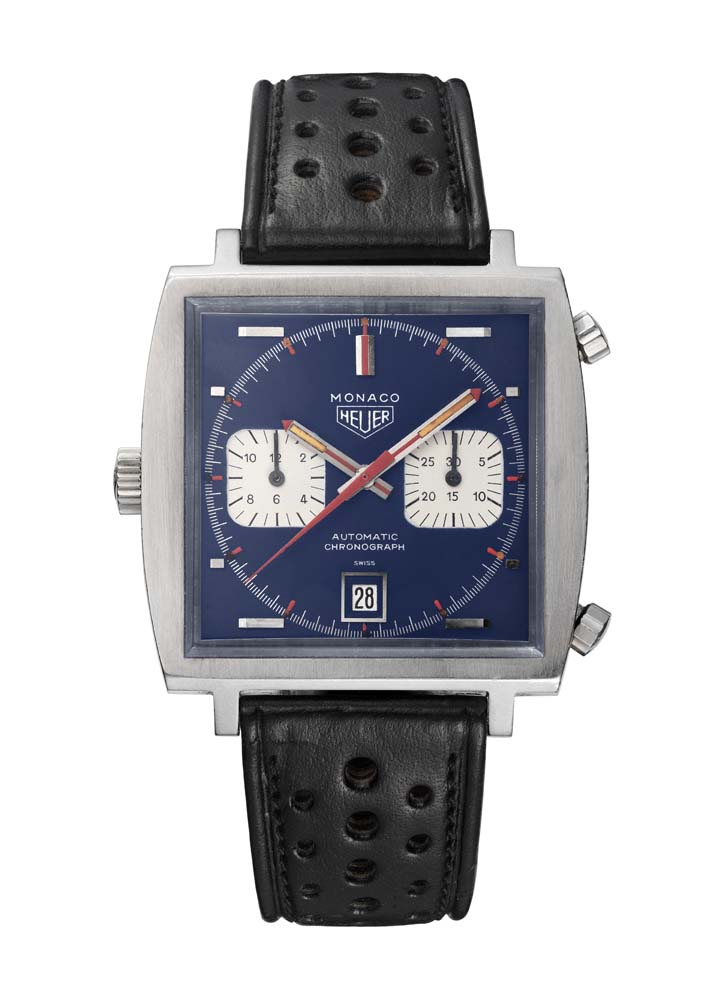
The watch was built 50-years ago by TAG’s namesake, Jack Heuer. It’s powered by a Calibre 11 movement, self-winding with a chronograph function. It was also the first square-cased watch that was water-resistant. Speaking about the unusual case shape, Jack Heuer writes in his biography The Times of My Life that being able to take a bath while wearing it was what originally drew him to the design.
As the story goes, one day he met with a regular case supplier – a company called Piquerez located in the Valley Jura – who wanted to show us some of his latest designs. “He drew our attention in particular to a new patented square case that they had developed, emphasising the fact that it was fully water-resistant,” says Heuer.
“We immediately knew this was something special because, until then, square cases were used only for dress watches because it was impossible to make a square case fully water-resistant. We immediately took a liking to the special square shape and were able to negotiate a deal with Piquerez that secured us exclusive use of the case design for chronographs.”
When it launched, the watch immediately drew raised eyebrows. Then within months, almost all attention for it dwindled, which brings me to why I’m here, in a small town in the French countryside that’s all but legendary to motor fanatics.

During the summer of 1970, a Hollywood production team descended on the town of Le Mans. With it came Hollywood legend Steve McQueen, determined to make a film that straddled his two passions; motor racing and the movies. The eponymous film came out in 1971 and featured McQueen as a top-flight racing driver looking to win the greuling 24-hour race. Production was marred with difficulties – including countless injuries, crashed cars and one amputation – and at the end of it, McQueen confessed: “Le Mans was the toughest picture I ever made, but it was worth it”.
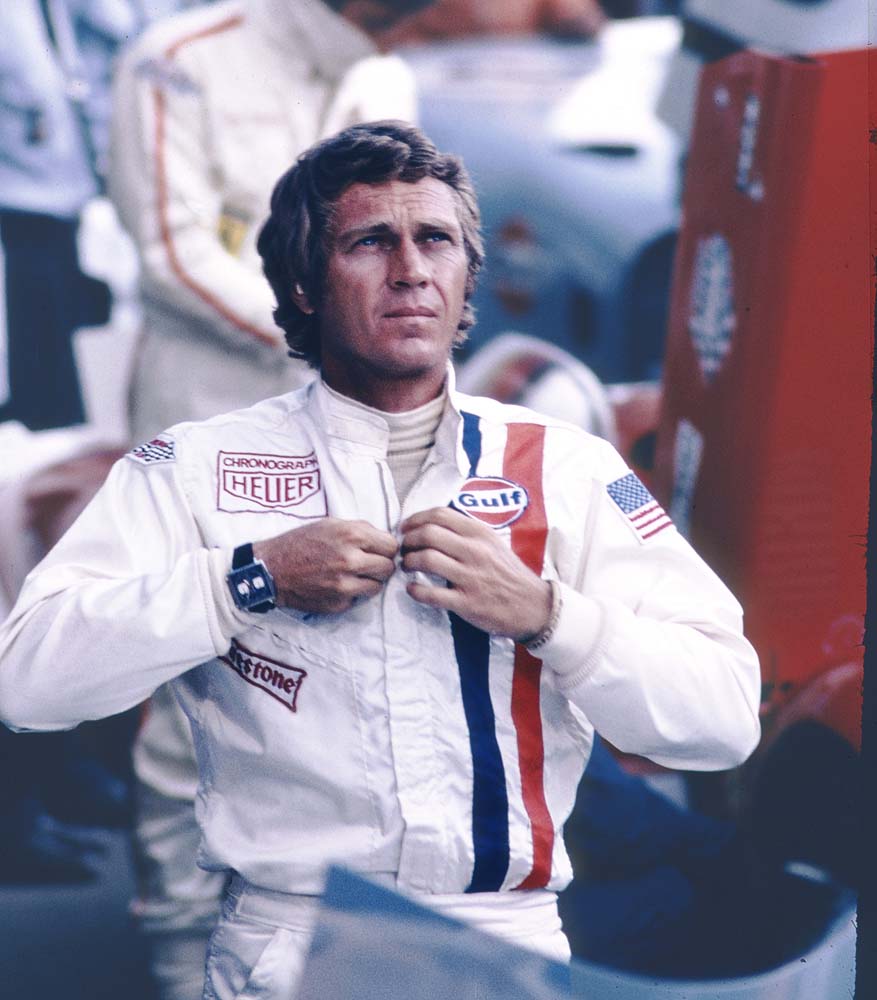
When the film came out in 1971, its posters depicted McQueen dressed in a Heuer-emblazoned driving suit, complete with a square Heuer Monaco strapped to his wrist. According to Jack Heuer, that never would have happened if the Monaco were popular at the time.
“A production master called me from Hollywood and said “Jack, I need a lot of stopwatches for the film Le Mans” so I started putting things together, but we had no watches, all our chronographs had sold out. We could only provide give him the Monaco because it was selling badly, and we had stock.” He had so many in stock that he sent them three.

The day before shooting was due to start, a member of the film’s prop department went up to Steve McQueen and asked him what watch he was going to wear, then offered up an Omega. McQueen refused, saying “Not an Omega, they might use my name”. He then picked up the Heuer Monaco, for two reasons; the first being that he had never heard of the brand before. The second, because it matched the logo on his racing suit, and continuity demanded that a driver should also sport it on his wrist.
According to Heuer, the only reason the prop master was able to offer up the Monaco in the first place, was because he had three identical models. “He needed three because one model would be used in the live racing shots, one would be used in the still photography, and one was needed as a spare in case the others got damaged.”
Production issues aside, the film went on to become a roaring success, and still stands as one of the finest motor racing films on celluloid. Images of Steve McQueen – very much the epitome of cool – and his Heuer Monaco went around the world, and the rest, as they say, is horological history.
Given the many twists and turns this watch has faced over its 50-year history, as well as it’s racing pedigree, it doesn’t surprise me that there are so many here at Le Mans. It was here the TAG Heuer Monaco made its name, and it will continue to be routed in the history of Le Mans for decades to come.


.jpg)