


How different was the evolution of the Yurt from the Peace be the Journey and Water be the Guide 2002Rs? At what point did you get the idea for this?
The silhouette of focus for New Balance, for this period of time, is the 574. They use collaboration as a way to inject energy, momentum and excitement into those silhouettes, right? So the 574 was the silhouette that was given to me, and it was actually designed simultaneously with my first New Balance project, the Peace Be the Journey 2002R. So I’ve actually been staring at it for a while.

I’m really excited to finally see it on the shelf, if you will. The idea was basically to juxtapose the heritage of the 574 with the lifestyle of my brand, the identity of my brand and then the way that I prioritize function, and let function lead design. That’s what created the Yurt.
It does feel like you’ve made a shoe for your own hiking adventures, a shoe for function first and foremost.
When the iPhone was created, we already had a camera, we already had a calculator, we already had the notepad, if you will. The iPhone, put it all into one thing. I think it’s really cool to combine elements that are necessary for the outdoors into a singular product.
What’s the origin of the whistle?
There’s this shoe called the Nike Vomero. My buddy Samuel did a collab with his brand, A-COLD-WALL. I have two pairs sitting behind me, and I wear them often, I always get asked, ‘what is that? what’s that thing on the back?’ And I’m always like ‘nothing’. People always sound disappointed. That taught me that it was usable real estate. I was like, what if I did do something there?
Then it was following the fantasy, maybe it has lights or it tracks your running, and has a bunch of actual tech in it. But then that means your shoe is going to cost $1,000. So I thought to myself, how could I alter the plastic so that it does something without actually injecting true technology? And in comes a whistle.
The first time I actually brought it up was my first New Balance meeting. I glued a whistle into—I believe it was actually a 574, coincidentally. I told this whole story of hiking and losing your friends and it being almost dark. And then I raised the New Balance to my face and blew it, and everyone’s face in the room dropped.
I’m so sad we didn’t record that moment because everyone’s brain just started churning. I have definitely become attracted to introducing things in the footwear space. To the best of my knowledge, there has never been a whistle in a pair of shoes. I enjoy those moments of surprising the consumer.
Tell me more about the functionality—what else did you imbue in it to make it more functional?
I wouldn’t want to devalue the shoe by calling it a Mr. Potato Head, but the outsole is actually inspired by New Balance 755, which is actually not even a Google-able New Balance. I don’t know if that speaks to its rarity, or maybe it was created in such scarcity. It had a really organic, articulated outsole. I was really inspired by that, given my track record of organic, articulated outsoles, I wanted to honor the heritage of the brand, but then also put it through my lens. When you see that shoe, it’ll bring it together and make a little bit more sense.
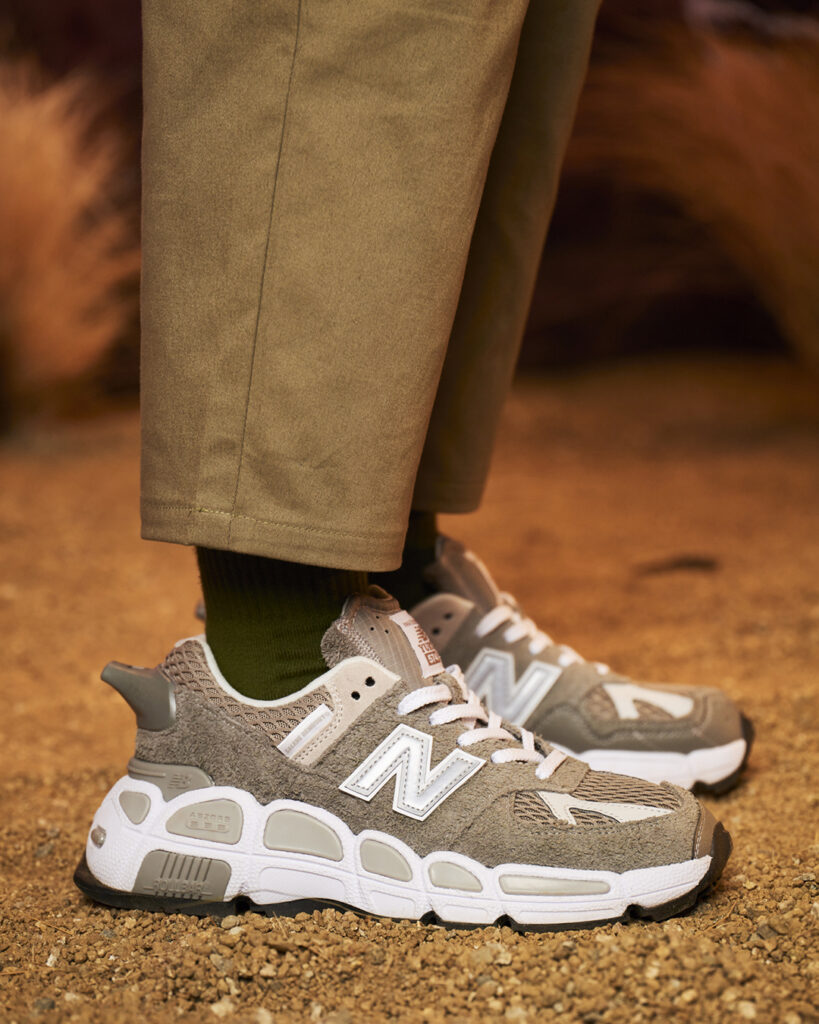
In terms of diving into the New Balance catalogue, did that start once you were given the keys to the Chocolate Factory, so to speak, or is this something you did primarily on your own?
I think it’s both. I got to go to the office and see the archives and see what they’re working on and have worked on. And then additionally, I’m just a lifelong sneaker enthusiast I have a lot of knowledge myself. Google Images is every designer’s mood board. I definitely did a lot of Google Image researching for my personal knowledge, I have some vintage enthusiast friends. Sean Wotherspoon gave me a little education.
The thing about New Balance is that it requires a bit more effort and community to get into the history, whereas a brand like Nike is obsessively catalogued. As a sneakerhead, getting into New Balance is more difficult, but ultimately more rewarding, as a result.
Absolutely, and there’s definitely a heritage consumer that has a high taste level and as a brand they have a very specific design ethos. When it comes to introducing new product you have to make sure that you both respect the design lines and history of their product but then also balance that with some of your thoughts, your personal sauce.
Let’s talk about your personal sauce. What are the personal emotions you wanted to convey with these?
Any time I’ve discussed emotion in the past when it came to shoes, it was this intangible thing where you feel a certain way, you feel like Kawhi Leonard. With the Yurts, it’s actually a tangible function. It’s beyond intangible emotion, you’re actually going to be found, or you’re going to alert someone, or maybe you’ll like, be able to communicate with a bird. It actually gives you a function that otherwise was not there. I think that’s the opportunity.

But also, when people take out of the box, they’re going to be blowing it a bunch and whistling and recording themselves whistling it, but then I think it’ll stop and they’ll just wear the shoe. But it’s always nice to know that that’s there. Maybe friends will ask them to take it off and say like, oh, does it really work? Blah, blah, blah. But I think it’s more. The fact that it can be used for its intended purpose is really special. Five years down the road, 10 years down the road, the shoe may look horrible. But the whistle will still function exactly the same.
Yeah, it may turn 127 Hours in to Two Hours.
Exactly.
Read the full conversation here.