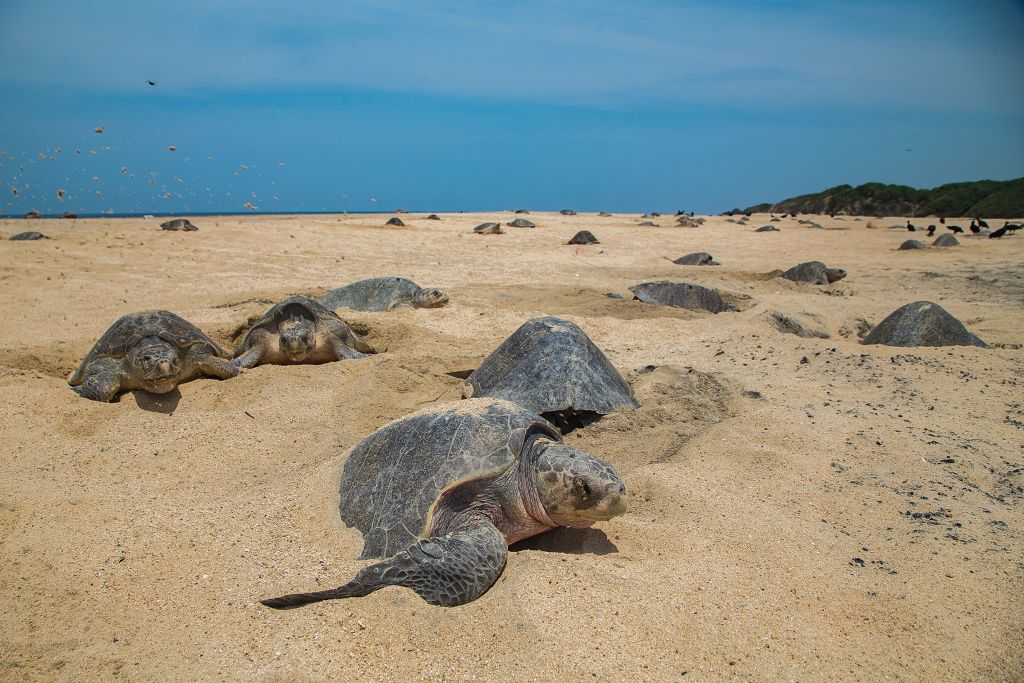

T’is the season! No, we don’t mean Christmas. It’s the turtle nesting season around the world and we have some more good news from the environmentalists. It seems,that while we’ve all been socially isolating ourselves, the Olive Ridley Sea turtles in India and the Hawksbill Sea Turtle in Brazil have been making the most of the deserted beaches to nest in peace.
Less people out in their nesting zone also means more hatchlings.
The Guardian reports that in Brazil, photographs taken by government workers, the only people to witness the event, showed the tiny creatures making their way down the beach and into the Atlantic waves. About 97 Hawksbill turtles hatched.
Wildlife officials were the only humans whenthe endangered hawksbill sea turtles hatched in front of their eyes, according to a news release from the city.
 Hawksbill sea turtle hatchlings crawl toward the surf on Janga Beach in Paulista, Brazil, on March 22, 2020. Paulista City Hall.
On the other hand in India, 407,194 turtles laid eggs in the marine sanctuary in the country’s eastern state of Orissa from March 14 to 21, 2020.
Thousands of olive ridley turtles nesting on the beaches of Odisha.
Their normal predators (humans) are in quarantine.
This season, their numbers will explode in the oceans.
There is a silver lining in this dark cloud after all. pic.twitter.com/l0DMLbGp4l— Dr. Ashley Jacob (@DrAshJac) March 26, 2020
However in 2016, The Guardian reported that also one-fourth of the number in 2020, up to 150,000 females turned up and, laying 120 eggs each.
The coast of Odisha in India is one the largest mass nesting site for the olive ridley, along with the coasts of Mexico and Costa Rica. But due to predators, survival rates can be as low as two per 1,000 hatchlings.
While this is their usual nesting season, it’s actually interesting to note that the mass turtle nesting took place during the day after nearly seven years. The last time, India saw day time nesting of olive ridleys along this site was in 2013.
This is not directly related to the current Covid-19 lockdown in India. Usually flocks of tourist visit the sight to witness the breathtaking event. But this year with no tourists, there has been little to no human interference to the nesting site.
.jpg) During February and March every year female olive ridley turtles head to the beaches of the Ganjam district in Odisha, India.
During February and March every year female olive ridley turtles head to the beaches of the Ganjam district in Odisha, India.
“The female turtles take about 20 years to sexually mature and produce eggs. We hope that one reason we are seeing this increase is because the baby turtles that were born on this same beach two decades back, are now old enough to come back and lay their eggs,” Bikash Ranjan Dash, the divisional forest officer of the park, said to the local newspapers.
So why are the turtles endangered?

The World Wildlife Fund classifies nearly all turtles as endangered. Many are killed for their eggs, meat, skin, and shells, and have to face added stressors from the destruction of their natural habitat to fishing activities and climate change.
For years, scientists were baffled as to why female sea turtles would go to the exact same beach where they were born to lay eggs.
National Geographic wrote in 2015 that it was because the turtles rely on Earth’s magnetic field to find their egg-laying beach. Each part of the coastline has its own magnetic signature, which the animals remember and later use as an internal compass.

Mass tourist beach destinations in Brazil are now completely tourist free. Coronavirus has dispersed the crowds that usually greet hatching of hawksbill turtles.
For now at least, the sea turtles around the world will be able to nest and hatch far away from the crowds of humans.