


It’s early-evening in Abu Dhabi, and Tim Cook is about to do something that most CEOs can only dream of—step onto a retail floor and receive a rock star’s welcome. The Apple Al Maryah Island store, with its sweeping glass walls and pristine lines, has already drawn a crowd. They have been promised a “special guest” and as soon as Cook emerges, an initial hush turns into a collective hum of excitement. A ripple of camera phones rise in the sea of shoppers. Within seconds, the head of one of the world’s most influential companies is swamped by people angling for a selfie, a quick handshake, or just a moment of eye contact. Cook handles it graciously, posing with a calm confidence.
Such scenes are rare in the corporate world. Executives usually slip in and out of offices, hidden behind tinted glass and security detail. But Cook is a different kind of CEO, leading a company that resides at a cultural crossroads. Apple is as much a lifestyle brand as a tech giant, and Cook’s persona—steady, thoughtful, and approachable—embodies the company’s current direction.
As he moves through the store, he’s not hustling for a sale. Instead, as Cook pauses for selfies on the shop floor, he’s here on a mission: to reaffirm that the devices Apple sells aren’t just gadgets—they’re carefully crafted tools meant to nurture creativity and sit as naturally in our hands as a pen or brush.
“Since the beginning of the company, we’ve been a tool maker. We make tools for creative people to express themselves and to make their art even better.”
This philosophy harks back to the earliest days of Apple, when Steve Jobs famously studied calligraphy in a college classroom. That class, seemingly useless at the time, inspired the elegant typography of the original Macintosh and shaped decades of digital design. Now, under Cook, Apple is extending that legacy into new domains. The question is far beyond just about fonts on a screen—it’s about how iPads, Apple Pencils, and even “Apple Intelligence” can preserve, challenge, and transform the art of creation itself.

“Since the beginning of the company, we’ve been a tool maker,” Cook says, his voice firm yet even, as if stating a simple truth. During our lengthy conversation—one that stretches well beyond the quick sound bites he often gives to media—we return repeatedly to Apple’s self-image as a craftsperson’s workshop. “We make tools for creative people to express themselves and to make their art even better,” he explains. “We’ve always viewed that we stood at the intersection of the liberal arts and technology.” From the original Mac, which revolutionized desktop publishing, to the iPad, which turned the entire computing metaphor into something you hold and touch, Apple has positioned itself as the instrument maker to an entire generation of creators.
This approach isn’t incidental; it’s deeply rooted in the company’s DNA. Apple’s greatest successes—the iPod reshaping music consumption, the iPhone reinventing mobile computing, the iPad unlocking a tactile new digital canvas—have always involved understanding human desires and cultural nuances as much as engineering specs. Cook emphasizes that Apple’s mission is to give artists, filmmakers, writers, and calligraphers new kinds of creative freedom, by refining complex technology until it becomes almost invisible.
Today, Apple’s role goes beyond hardware and software. The company has embarked on what it calls “Apple Intelligence.” While the world might tag it as AI, Apple frames it differently. “It’s built on creativity,” says Cook. “It’s built to extend your creativity, not to replace it.” In an era when generative AI can conjure images or compose text at a keystroke, Apple wants its intelligence layer seen as a collaborator. “I’ve been using it for writing tools,” Cook admits. “For smart replies, for seeding an idea that I can then take further.” He highlights features like Image Playground and “Genmoji,” designed to give users a creative springboard. “You can create anything with an iPad,” he adds. “It’s essentially a blank canvas that allows you to create anything you would like.”
“Apple Intelligence is built to extend your creativity, not replace it.”
This measured embrace of AI reflects Apple’s broader philosophy. Cook isn’t announcing a revolution or scrambling to outdo competitors. Instead, he talks about bringing “clarity and utility” to a “cacophonous field” of first-movers. It’s the same logic that guided Apple’s previous successes: wait until the technology and the moment align, then present a refined, human-centered approach.
Cook’s emphasis on “feel” is crucial. For art to flourish digitally, the tools must be as responsive as their analog counterparts. “People are used to drawing,” he says, “and you want it to have the latency of a pencil.” The Apple Pencil embodies this. Its newest iteration supports a “barrel roll”—thanks to an integrated gyroscope—letting creators rotate it for precise control of shaped pen and brush tools. “That’s incredibly important,” Cook says, “because when you put different pressures on it, you want it to come across differently on canvas.”
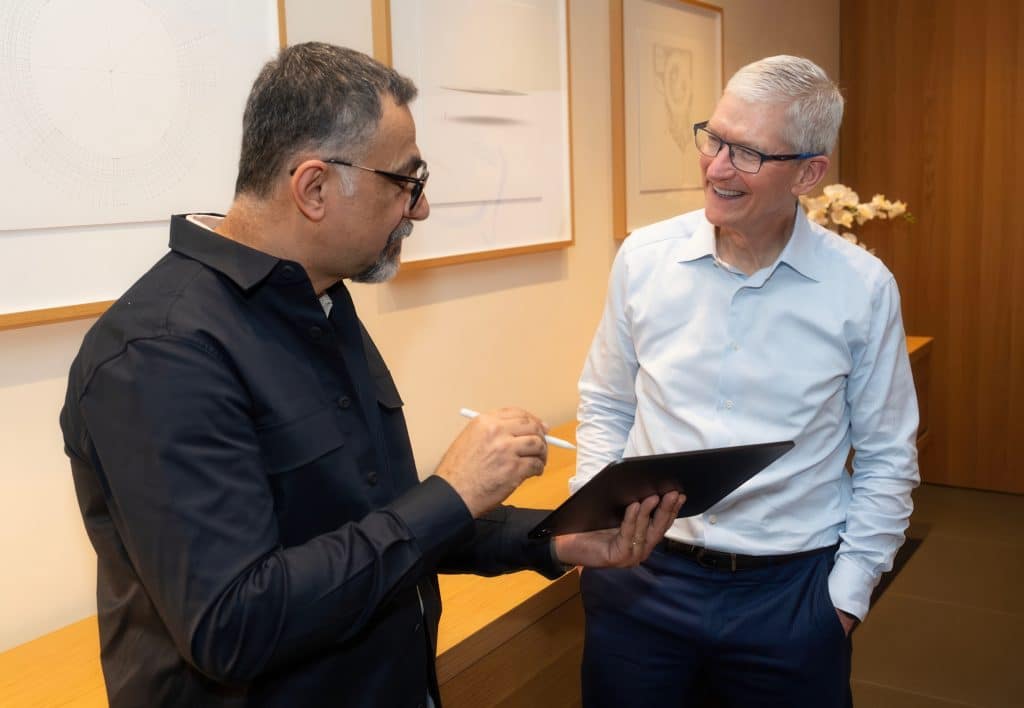
With me in the store is Wissam Shawkat, a calligrapher from Basra, Iraq, who has come to show Cook how he uses the iPad and Apple Pencil to blend centuries-old Arabic scripts with modern aesthetics. As a child, he practiced letters while aerial bombardments rattled the walls of underground shelters. Over time, that refuge grew into a lifelong craft. “When you know the rules, you know where to break them,” Shawkat says, describing how he merges tradition with innovation in his “Calligraform” style.
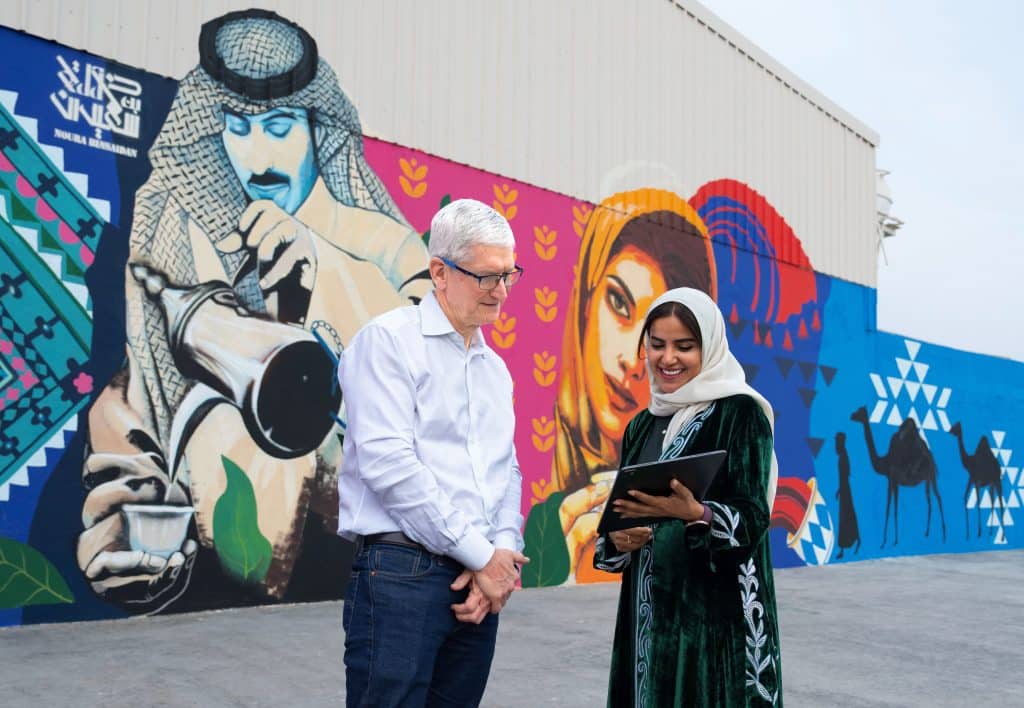
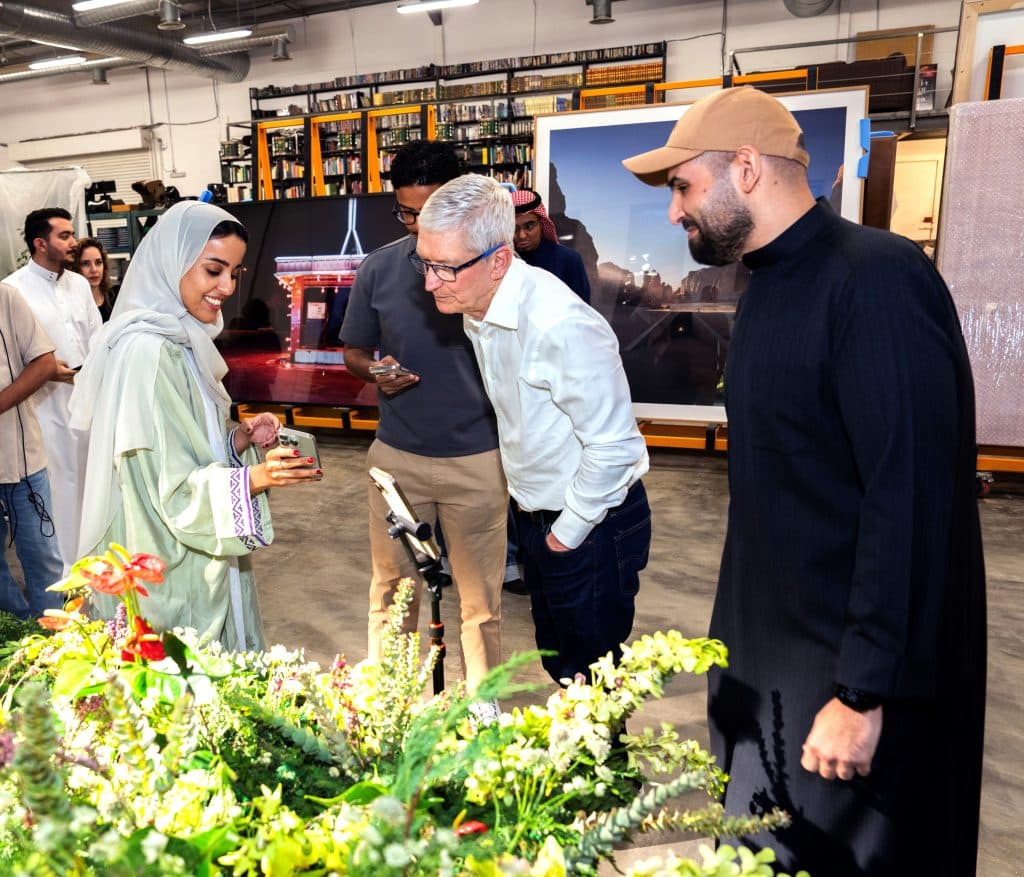
Cook’s visit to the region isn’t limited to Abu Dhabi. Alongside the announcement of new official Apple stores in Saudi Arabia and the UAE, he is here to meet with other creatives and innovators, showcasing how Apple’s tools empower artists to reinterpret tradition in a rapidly modernizing world.
“You want it to have the latency of a pencil. When you put different pressures on it, you want it to come across differently on canvas.”
As Shawkat demonstrates his process—zooming in to refine a stroke, experimenting with transparency, adding layers that would be tedious to achieve with ink—Cook watches closely. He leans in to examine a particular piece that Shawkat has been refining, admiring how the digital medium lets old art forms evolve. “I really like that one,” Cook says, genuinely impressed. Shawkat smiles and replies, “I will send it to you.”
This interplay of old and new is not confined to calligraphy. Filmmakers can shoot an entire feature on the iPhone, edit it in Final Cut Pro, and score it in Logic Pro. “You have all of these creative tools,” Cook says, “and the hardware and the software integration that bring them to life.” The synergy is deliberate: each tool is aware of the others, forming a cohesive ecosystem that supports creators at every stage.
Apple’s worldview resonates with the cultural fabric of Abu Dhabi. “Abu Dhabi is kind of an interesting place,” Cook notes. “Because it’s, everywhere you look, there’s a juxtaposition of the tradition and the modern… you’re standing there and you’re looking at what was probably a 200 maybe plus year old castle [Qasr Al Hosn] right in the middle of modern skyscrapers.” Just as ancient calligraphic traditions find renewed life on a digital canvas, old and new architectural forms coexist, offering a richer narrative than either could alone.

As our conversation continues, Cook returns to Apple Intelligence. He points out that while it can handle certain tasks, it never aims to supplant human judgment. Instead, it frees up time for deeper thinking. “It’s built to extend your creativity,” he says yet again, making sure the mantra is clear. The technology is a catalyst, not a puppet master.
In the end, it all comes back to the human hand guiding these tools. Shawkat’s journey—from a shelter in Basra to a digital studio in Abu Dhabi—illustrates how technology, done right, amplifies rather than dilutes an artist’s intent. The Apple Pencil’s barrel roll or the quiet prompts of Apple Intelligence may seem like small features, but they embody a larger philosophy: empower creators, let the tools fade into the background, and keep humanity at the center.
This patience and thoughtfulness stand in stark contrast to companies that rushed chatbots to market. Cook’s approach is shaped by the conviction that artistry needs room to breathe. When Jobs took that calligraphy class decades ago, he had no idea how it would shape the future. Similarly, Apple is now giving its AI-driven tools time to mature, ensuring they serve genuine artistic expression, rather than simply chasing headlines.