Don Cheadle has long been one of the most versatile actors in Hollywood. Hopping between genres and tones, from indies to big budget blockbusters, Cheadle has proven he can do it all, while always remaining unassuming and approachable.
As he continues his Showtimes series Black Monday and gears up for his own Disney+ Marvel series Armor Wars, in which he will reprise the role of War Machine James Rhodes, Cheadle stars opposite multi-time NBA champion and GOAT contender LeBron James in Space Jam: A New Legacy, the sequel to the beloved 1996 children’s classic starring Michael Jordan and Bugs Bunny.
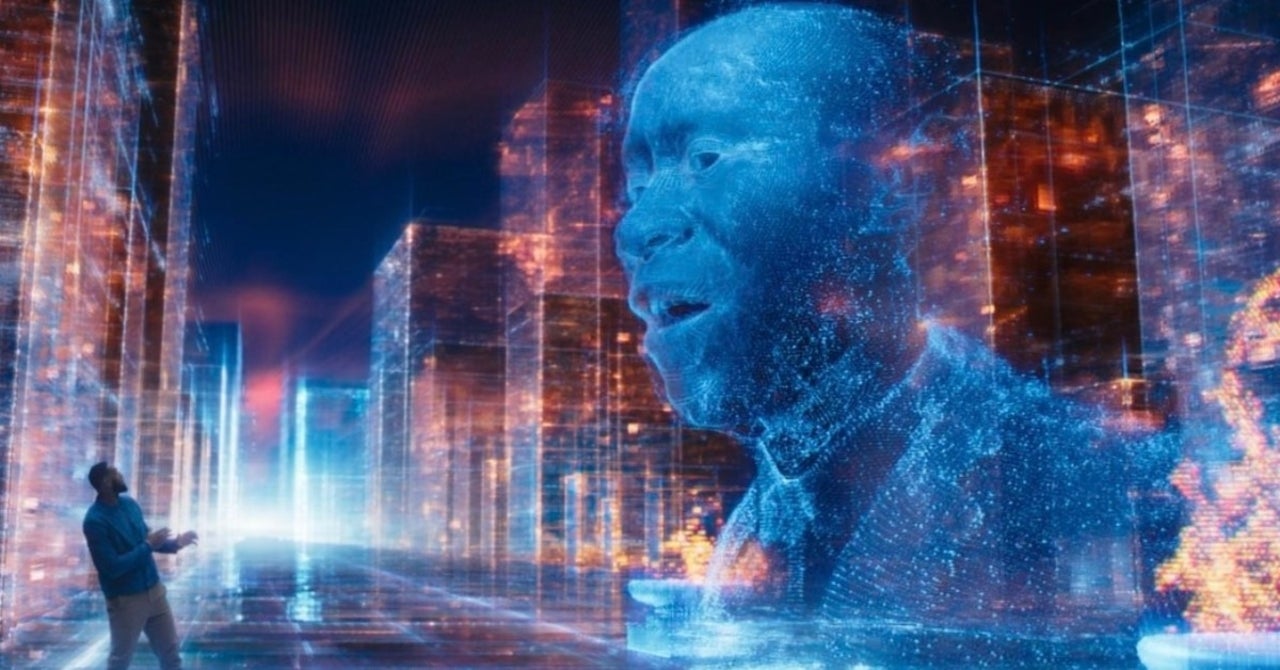
Cheadle plays Al G. Rhythm, the villain of the piece, a sentient algorithm resentful of LeBron who pulls he and his son into the Warner Bros. servers in an attempt to turn his son against the LeBron, harnessing the entirety of the Warner Bros. archives to beat him in a virtual basketball game.
Esquire Middle East caught up with the actor ahead of the release of the film.
Read the full conversatoin below:
How do you calibrate a performance for a character like Al G Rhythm? How do you find the right balance between cartoonish and serious?
It was constant conversation with Malcolm D. Lee, who directed it, to find exactly what you’re saying. We asked ourselves, where is the right tone? What is our pocket? Are we trying to be scary in this moment? It’s important that if he’s the antagonist, and he’s the “villain”, that you have to feel bhis formidable nature. But at the same time, byou need him to be an entertainer at some points, he has to be a constantly there for the kid, he has to be a best friend. There were a lot of colors that that had to work for this. At the end of the day, it was something that was a constant calibration, to use your word, that Malcolm and I were doing throughout from very first.
What did you find in this in this film that you really hadn’t found anywhere else? What was it that brought you into this?
I think it gave me opportunity to do something that was very different, being able to take that classic movie and bring it hopefully up to a modern standard and add to it. And it didn’t hurt to be able to hang out with LeBron all day. That was a lot of fun. I’ve been a big fan of his forever, and to get to know him and be as impressed with him as somebody who is dedicated to his gig, whatever that happens to be. And in this kind of a world, to play this character did check the boxes for me.
What surprised you about LeBron? Was he a different guy than you imagined?
I don’t know that he was much different. I imagined he would be a hard worker. And I imagined that he would be somebody who was dedicated and wanted to get it right. Knowing everything that he had to deal with was impressive. He was nursing an injury. During the time we were shooting, he was also putting together the Lakers team when he was first coming in. He would go to workouts before we started shooting and sometimes go to practice after we started shooting, and and on-set, dayscan go for 12 to 14 hours. That’s just regular, how it happens. That level of commitment was demonstrated every day by him. And I was really impressed by that.
What were your guys’ discussions about the craft?
We rehearsed a lot, but I wouldn’t say that he leaned on me in any way, shape, or form. But we definitely always wanted to talk through the scenes and understand what it is that we were trying to do. And we chop it up in the trailer before we went on set. And then he and Malcolm and I would always talk about, what was the dynamic? What was the arc?
It wasn’t his first foray into it. You know, he was in Trainwreck. He got it a little bit before he got to us and then once he got to us he was thrown in the deep end, so he was just there for all of it. And it was really exciting to be a part of.
Were you connected to the Looney Tunes as a kid? Is that something that you connected to, in a way? How did you kind of reconnect with that as an adult?
For sure, as a kid that was always background entertainment, always something that was on before we had to go to school, eating breakfast, watching them before we ran out the door. And Bugs is just the best writing. He was always clever and interesting and funny, and he could be magic at times.
I think everybody’s vicariously live through Bugs, his irreverent devil. But rebooting it this time and having the Looney Tunes more on their back foot and not running everything was kind of cool. To give them an arc, ultimately, to where they end up in the movie.
What part of his story made you fall in love with the storytelling when you were a kid?
I don’t even know if I was watching the storytelling as much as watching the wish fulfillment. Bugs Bunny always won, who got to clown everybody, and against all adversity was always the one who’s coming out on top. I think every kid wants to feel the powerful part of being invincible, and being hilarious and always having the right comeback line. It doesn’t exist. I think that was everything that we will connect to, and it always had great animation. And then coming to the modern version of it, doing a reboot of the original Space Jam, finding the new version of it that still has heart, that’s still interesting, it’s still funny. At the end of the day, you know, you just want it to be entertaining.

This movie does have a lot of heart. Going back to your point about Bugs Bunny, where you have Bugs as this wish fulfillment character who can do anything, LeBron does have a weaknesses, he does have this relationship with his son that’s a bit fraught. There’s layers to it. What do you make of that development from one to the other?
I think that’s what was one of the most attractive parts of the movie to me. There’s a story going on with the father and son, and as you said, LeBron’s vulnerable in it. He’s not just a world beater, and it’s not clear if he’s going to actually be successful, and there’s a real cost. The cost isn’t just ‘are you going to win this game or not?’ The cost is, ‘are you going to have a good relationship with your son, or not?’ My character gets to exploit that and manipulate that.
There was a lot of different things going on then there where in the first one it was just more fantastical than set up to be good versus evil. This is bad guy going to beat the good guy. This is like how are we supposed to be a family? How are parents supposed to treat their kids? How are we supposed to express ourselves and are we you allowed to be who we want to be? All of those kinds of things to be in this movie that could be seen as popcorn. I thought was pretty cool.
How have you developed in working in a green screen environment? Do you feel at this point is second nature?
It’s all make believe, honestly. No matter what you’re in, you’re trying to fulfill a story that’s been laid out, and you know where it’s going. Sometimes you just have to use more imagination than others. You’re looking at a green screen with an X on it, you’re not looking at a person, but you’re still trying to understand the dynamic between you and whoever that other character is, you’re still trying to tell a story, you’re still trying to make sure that you are serving the beginning and middle end, and know how this fits in the overall. Those kinds of things don’t change.
We’re always coming up with a different tool to use. That stuff is fun to do. But at the end of the day, you’re just trying to be a storyteller and be honest, and serve the script and the story in general.
What sort of power do you think stories have, especially in this particular age, and this particular moment of the world?
I think we put the things out from our perspective, and from our point of view, ultimately to entertain. I don’t think entertain has to be some empty word that just means you turn your brain off and don’t have to participate in any way as a thoughtful audience member. We’re servicing more than just giving you something that’s escapism. I’m always a fan of trying to smuggle deeper themes in and if we’re going to talk about what’s happening during the present day, and we’re going to talk about lessons that we can we can impart that will hopefully live beyond the film. That’s cool.
We’re always trying to do versions of that, but especially in a movie like this, we just want people to be able to have fun and be entertained and then if they want to think on deeper things about family, if they want to think about the impact of social media, the impact of artificial intelligence, and us sort of giving up our autonomy to something that’s going to determine what’s better for us than we get to determine for ourselves, you can think about things on those along those lines, but it’s not required. It’s great to be in a movie that’s working on a lot of different levels for people that want to check in to those different levels.

How do you feel you approach the craft differently than you did when you started your career? Do you feel like that it fulfills you in a different way? Or do you feel that it’s always been kind of a through line throughout your entire career?
Probably more the latter. I don’t know that I work that much differently than I did before. Whether it’s no sudden move that just came out with a complete different movie genre, noir, thriller, you’re still playing a character. I’m still playing a character that has goals, and has desires, and I’m still trying to figure out how you plug into that in a real way, and have stakes in what they’re going after. That is all matters. Whether you’re trying to live or whether you’re trying to destroy the world, or create the world as you want it to be. Whatever these characters are going after. It’s not much different from that standpoint. They have a desire to impact the world in a certain way, and you’re always looking to tell the truth, you’re always wanting to not be caught acting, you’re actually trying to embody the character and go after the things that they want. No matter what you’re playing.
What sort of stories would you like to see in the future?
I think we need to be surprised. I think that there are so many platforms now, and there’s so many different types of storytelling that are available in all of these different ways that we get this product across now. It’s great from a creative standpoint. There’s places where all of it can exist. From TikTok, all the way to a four-quadrant blockbuster movie, these are all different versions of people’s expression.
It can all be pablum, and thrown away, but I’m always hoping that in whatever form it takes, that we’re trying to scratch the back of people’s heads a little bit and create something that’s, in some ways thoughtful. And we’ll have people walking away from the experience with questions and ideas about their own lives. That’s a lofty ambition. It’s much more clear when you’re doing something that is dramatic, or if it’s a documentary that you’re trying to get people to think.
I think it’s fun when you have something that looks like it’s just a comedy, if we can always smuggle in things to think about. I know we do it on our show a lot on Black Monday, our Showtime show. It’s a farce in many ways. But we’re always trying to ring another bell about society, to give people something to talk about, some fodder that isn’t just disposable, but something that resonates and goes beyond your experience of however long it is that you’re sitting in front of the thing, watching it.

You’ve always had a very strong moral drive in terms of what you want to get out in the world. What are the things that you feel now? Are there conversations you most want to explore? And how are you trying to explore that and how’s that changed?
Well, I think if we’re not talking about the environment, which is the under which every other issue that we have is not going to be relevant if it’s 300 degrees on the planet. I think we have to be talking about how to be stewards of this planet that we live on.
People often think that we’re talking about it from an individual standpoint. I think that’s kind of a misdirect, that’s intentional from corporations, and from business interests that are contributing the most to the terrible effects that we’re seeing happening on this planet. We all have to be involved politically. We have to try to make our voices heard, however that has to be.
I think we have to really take stock in every way that we show up in our communities and our schools and businesses, places of worship, however you show up to try to move us toward a more just world, to try to move us to a world where there’s more equity. The disparity between the haves and the have nots has never been larger, and we’re seeing it on steroids now. The trend is not our friend in many ways. I think we all need to take stock in how we participate in all of these experiences and show up and try to get us all moving toward more justice or war.
Space Jam: A New Legacy is in theaters now across the Middle East