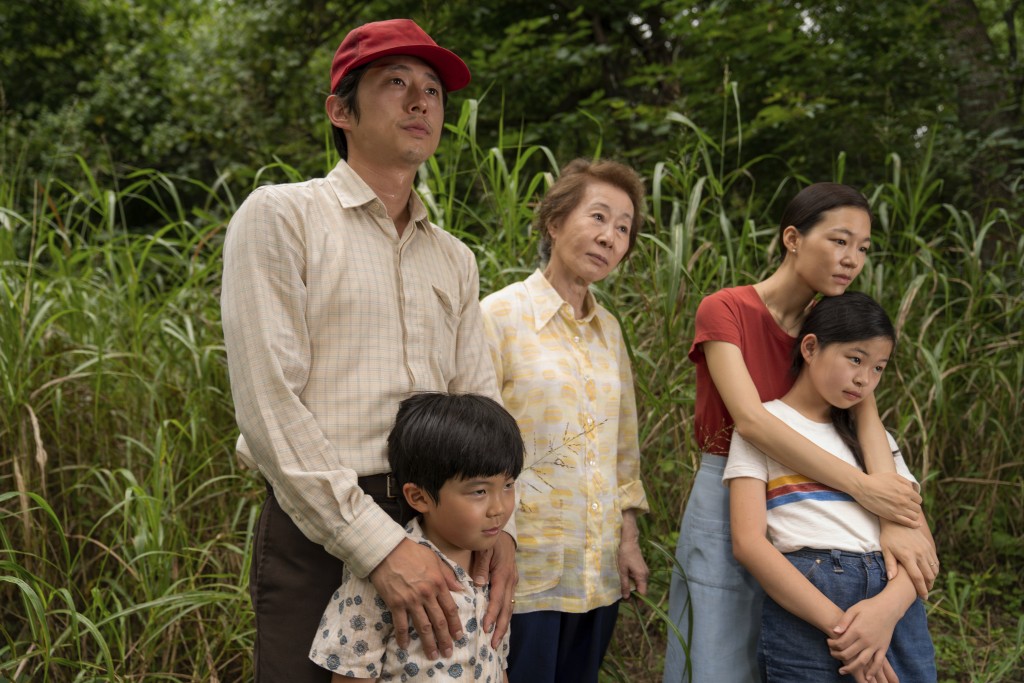

The easiest way to summarize Minari, a Korean-American family saga from director Lee Isaac Chung, is to pitch the father’s story—Jacob Yi (Steven Yuen), an immigrant who worked himself to the bone in a low-level high-pressure job in California in order to earn enough money to buy a farm in Arkansas and make something more of himself. To tell it that way, however, is to sell short the fact that Minari really has four leading characters whose stories are all equally important and rich.
There’s the mother, Jacob’s wife Monica (Han-Ye Ri), who is forced to contend with a new life far from the support system she had built for herself that her husband lied to her about—he said he wanted a garden, and really he was building a farm. He said they would have a big farm house, instead they have a glorified trailer, complete with wheels still attached to the bottom. While her loneliness and emotional isolation plague her, it is at the end of the day her children whose fate she cares about most, and her mother who she brings to live with them from Korea after years of guilt for having left her back there alone.
Enter Monica’ mother Soon-ja (Youn Yuh-jung) a grandmother with rougher edges than her grandchildren are expecting, who uses foul language, plays cards aggressively, steals from the collection plate at church and shows off her handiwork, and then screams at the television while watching pro wrestling, mountain dew in hand. She’s lived for more than a decade alone and lost her husband in the Korean War decades earlier, and in moving to America to live with her daughter’s family, she experiences the joys of unconditional love once again, and through her struggles learns to accept that she is loved and needed even when she feels most like a burden.
And then there’s David, played by 8-year-old Alan Kim, struggling with bedwetting and friend-making, who has always been told he is too weak to do much of anything, who is learns through the help of his grandmother that he has strength that he didn’t now he had, and that he is worthy of love as a person and not just as a brother or son.
Minari is a film bursting of empathy, that shows compassion and understanding for each of its characters. It will make you laugh more than any film of the last year, and make you cry not at the film’s saddest moments, but at the moments that its heart opens up fully until the love within the film overwhelms you.
Families can so often be siloed, with each person dealing with things that the others do not understand, that they may not be able to speak about or struggle to articulate. Ultimately, this becomes a film about these people learning to open up to each other and think about each other ahead of themselves, the only way, quite literally in this case, that they can keep living.
Read our breakdown of every Best Picture nominee here.

Esquire now has a newsletter – sign up to get it sent straight to your inbox.
Want up-to-the-minute entertainment news and features? Just hit 'Like' on our Esquire Facebook page and 'Follow' on our @esquiremiddleeast Instagram and Twitter account.