Lucien Bourjeily is a one-man film unit. Director, producer, scriptwriter, editor: he turned his hand to everything in order to make his debut feature film. About the only thing he didn’t do was shoot it or star in it.
“It started out purely as a financial necessity since it’s a very personal project, but then I began to appreciate the artistic freedom it gave me to experiment,” explains Bourjeily, whose Heaven Without People will have its world premiere at the Dubai International Film Festival this month. If nothing else, his multi-tasking enabled him to remove any issues over funding.
Best known in Lebanon as a theatre director, Bourjeily is used to being in the public eye. His theatrical productions have been banned, his passport confiscated, his body battered by security forces during protests in Beirut in 2015.
He’s even brought together ex-fighters from the warring neighbourhoods of Bab Al Tabbaneh and Jabal Mohsen in Tripoli for a play called Love and War on the Rooftop.
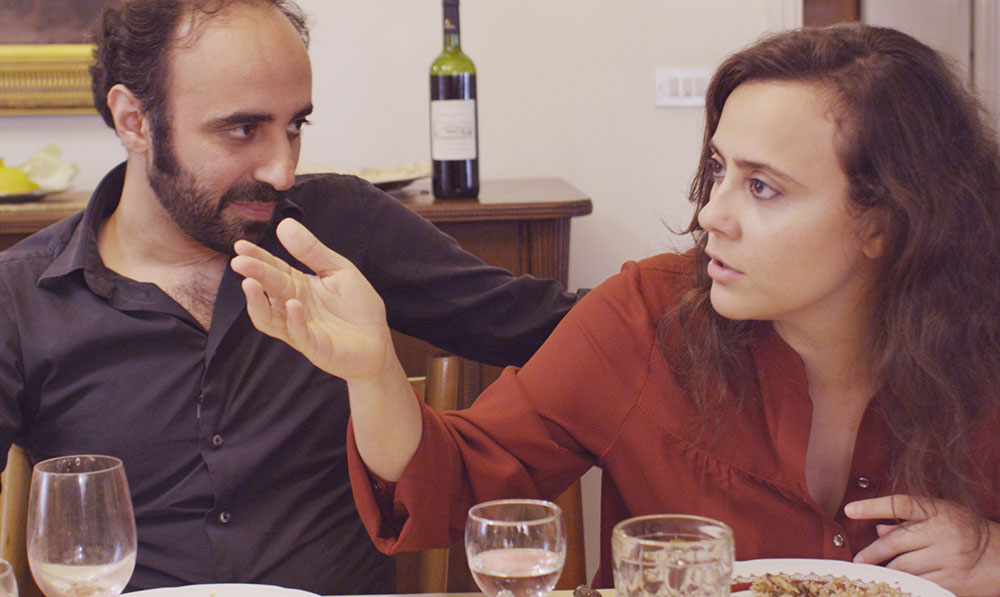
Now, however, he’s focussed solely on Heaven Without People. Centred on a family gathering that slowly descends into acrimony, the film has emerged from “a mix of stories
I heard and personal experiences”. But mostly it is based on detailed observations of daily life and familial socio-political dynamics in Lebanon.
“There is an anatomical dysfunction in today’s Lebanon and we have been stuck in a socio-political vicious circle for decades,” says Bourjeily, whose only previous film was the 22-minute short Ariel in Beirut. “This is directly affecting our lives and livelihoods and leading the country into periodic flare-ups of violence. I wanted to understand this better and dig deeper into this structural malfunction [by looking] inside the entity that is widely considered to be the nucleus of any society – the family.
“If you have ever passed by neighbours’ doors, heard loud conversations and wondered what they are laughing or shouting about, this film gives you intimate access to such a home. Practically a seat at their family table. It’s a slice of the daily life of a Lebanese family, without pretension or masks, and at times brutally honest and impulsive.”
Bourjeily worked entirely with unknown or amateur actors on Heaven Without People. It was a decision that may have reaped rewards in terms of authenticity, but caused huge logistical headaches.
“The biggest challenge was first to find first-time actors and actresses who would fit the parts,” he admits. “Then to train and thoroughly rehearse with them, since most of them had no or very limited previous acting experience.
“When we first announced in the casting call that we were also looking for non-actors, we were pleasantly surprised to receive more than 2,000 applications. Nevertheless, the effort and time it took to review, access and audition each potential applicant was much more challenging than we originally expected.”

How the Lebanese authorities will react to the film is, of course, unknown. Although the theatrical work of Bourjeily has been censored in the past, there is no indication that Heaven Without People will fall foul of the Lebanese Censorship Bureau.
The movie does, however, continue Bourjeily’s mission of merging theatre and film with social commentary, with the goal of encouraging both dialogue and freedom of expression. He directed the immersive play 66 Minutes in Damascus for the London International Festival of Theatre in 2012 and Vanishing State for the same festival in 2014, while his most recent play, Beirut Syndrome, explored political corruption in Lebanon and was banned from public performance in 2015.
“I truly believe that art can be an agent of change and has been, throughout history, a tool to enlighten the individual and society,” he says. “Censorship constrains art and limits its impact as much as it does with all free thought. Therefore, even if censorship might encourage creative ways to circumvent it, it still slows down progress and our ability to realise our full creative potential. And that is why I vehemently fight against it.”
Bourjeily is far from being alone, of course, when it comes to social commentary, political critique and adventurous cinema in the region. There’s Ziad Doueiri, whose courtroom thriller The Insult garnered worldwide attention upon its release in August; Mounia Akl and her brief but immediate Submarine, which won a special jury prize at DIFF last year; and Mir-Jean Bou Chaaya, the director of 2015’s black comedy Very Big Shot.
There are also the likes of Annemarie Jacir, who is at the forefront of Palestinian cinema, and Muayad Alayan, whose Love, Theft and Other Entanglements was a festival circuit hit back in 2015. There’s even Mahmoud Sabbath and his independently financed satirical comedy Barakah Meets Barakah, which did much to shine a light on life inside Saudi Arabia. Jacir’s latest film, Wajib, will have its Middle East premiere at this year’s DIFF.
For Bourjeily, his passion for storytelling began at an early age and was cemented during acting classes with the renowned playwright and director Mounir Abou Debs.
“From that moment on I fell in love with acting as an engaging art form that requires the artist to be the instrument and the creation simultaneously,” he says. “I never made a clear-cut in my mind between theatre and film, as I always felt that at the heart of both of them is storytelling and acting.”
“The form and the medium might differ, as much as it is different to experience a play being played on a stage or an immersive play that takes you (the audience) on a bus ride, but the objective remains the same: a story told in the most creative, thought-provoking, and engaging manner.”
In the past Bourjeily has stated he wishes his work to provoke thought. It is how he personally evaluates his films and plays – to see whether they leave a lasting mark or provide something to reflect upon. With that comes a certain level of risk, especially in relation to socio-political commentary.
“It is dangerous,” he admits. “But I strongly believe that doing nothing and standing aside is even more dangerous.”
Heaven Without People will be premiering at the Dubai International Film Festival. For more visit diff.ae