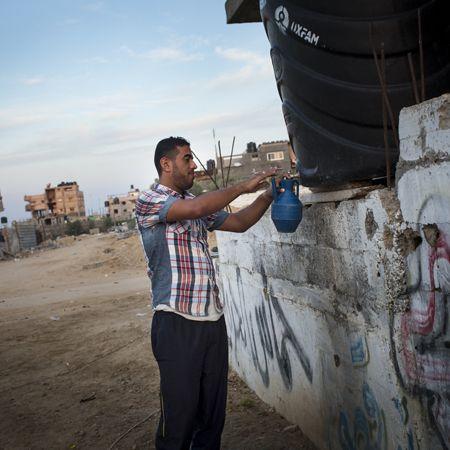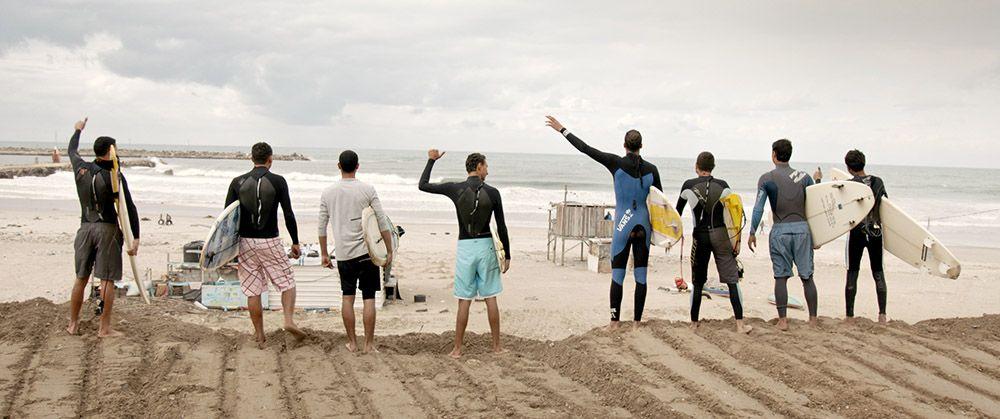

What do most of us know about the Gaza Strip other than it has been a city under siege for decades, its residents the victims of a cruel conflict. And yet these are people like any others, who have dreams, hobbies and distractions, albeit set against a backdrop of incomprehensible struggle. German film directors Philip Gnadt and Mickey Yamine, along with producer Stephanie Yamine, wanted to tell a different story. Not to pretend that life is anything other than desperate, but show that it does somehow go on. So they made a story about surfing. Surfing in Gaza. We spoke to them about how the idea came around, ahead of the documentary screening on January 22nd.
ESQ: Why Gaza? Why surfing?
Philip Gnadt: I was introduced to the topic by a friend at university who was born and raised in Gaza but studied in Germany. I started to read about it and quickly realised that any information is always about the conflict. Although the situation is horrible there, I also heard stories from his childhood about the food, the culture, barbeques on the beach and stuff like that. He told me how the people are special there because they’ve coped with this situation for decades and still they have a positive way of thinking when it comes to everyday life. So I thought there was another story to be told and tried to find something I could start with. I found an article about surfers there and immediately liked it, because surfing stands for personal freedom – and this is one of the most isolated countries in the world.
How did the film come together?
Mickey Yamine: When Philip came to me with the idea, we originally had the idea of expanding it to include break-dancers and kids that do Parkour in the Gaza Strip. We went on a research trip in 2013 to get a feel for the subject, and even though the other groups were fascinating we stuck with the surfers. We found a protagonist, Ibrahim (aged 23), who was initially very quiet, but once we got to know him he turned out to be really interesting. He had a dream of building a clubhouse and travelling to Hawaii. These were just ideas at that point but by the time we started filming he was actively working on making those dreams happen. He’d managed to get a visa to travel to the US, so we scraped together some funding and followed him to Hawaii.
What did you learn about the youth culture there?
Stephanie Yamine: You can learn a lot from these people. They live in a war zone, they’ve never been out of the city, yet what they teach you is that you can still find happiness inside yourself. They think a lot about hope and that’s the best lesson they can give to the world. Their only source of hope and happiness was the sea, and they are using it to the maximum, sailing or surfing, fishing or swimming.
Surfing has very western connotations…
MY: Actually I was corrected the other day. We thought it came from the US, specifically Hawaii, but actually it started as a Peruvian thing. And in Gaza they have something called a Hasaka, which is a traditional flat, wooden fishing boat without sails, sort of like an elongated raft that almost looks like a surfboard and glides on the waves. Also, when surfing became popular in America in the 1960s it was brought to the region and you’d see Israelis and Palestinians surfing the coast.
How did they learn?
SY: They’re adventurous and would take anything they could – a door or plank of wood – and try to stand up on it.
Can they swim?
PG: Water sports in these countries are not generally very popular, so most of the people can’t really swim, even if they live by the sea. They don’t have the western understanding of water. So it was a process that came from the fishermen using the Hasakah. The boards and everything else came later.
What’s each of your favourite moments in the film?
SY: When they are all dancing at the beach after eating fish.
PG: There’s a very simple scene about making tea on the beach. It was very cold and windy that day and the fire was really poor. So one surfer says, “Inshallah the tea will be ready in a year.” It gets a lot of laughs because if you go to see a film about Gaza you’re probably thinking it will be very complicated and difficult, so this is a very nice scene where the audience realises that it’s ok to laugh.
MY: I have two moments. One is more emotional, towards the end where Ibrahim is in Hawaii contemplating about things back home. He tries to compare Hawaii to Gaza and he’s wondering Hawaii is so clean and beautiful and well cared for. The other one is when Matthew, the guy who hosts Ibrahim in Hawaii, is shaving with Ibrahim in the bathroom together. Matt unpacks this razor blade that has green packaging and he asks, “Is the colour okay for you sir?” And Ibrahim replies: “Oh yeah, I love it.” And for people who know that green is the colour of Hamas and understand that the moment is very sarcastic it’s super powerful. I love that moment.
Gaza Surf Club will be screened at the Reel Palestine Festival, A4 Space, Al Serkal Avenue, Dubai on January 22nd at 7:30pm.