
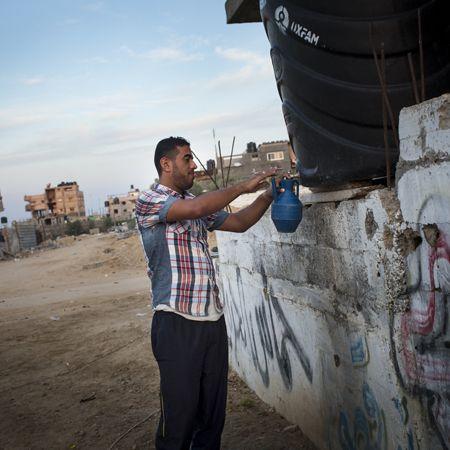

The Gaza Strip is a small area of land of 365 square kilometres with a population of 1.8 million, placing it among the most densely populated areas in the world. Palestinians living here depend on just one natural source of water, the underground Coastal Aquifer. The yield capacity of this aquifer is 55 million cubic metres per year; the demand in Gaza exceeds 190 million cubic metres per year. This stress and over-abstraction from the aquifer directly leads to deterioration of the water quality. As a result, by 2016 the aquifer may be unusable, and by 2020 the damage will be irreversible.
The Consequences of blockade
The various Israeli sieges and blockades over recent years have restricted the flow of vital equipment and materials needed to upscale the water sector. Many vital water infrastructure projects have also been indefinitely parked. As a result of this situation, 95 percent of the water extracted from the coastal aquifer is contaminated with dangerous levels of nitrate and chloride and is unfit for human consumption, posing a huge threat to public health. The high salinity and nitrate level leads to major suffering and diseases, for example, ‘blue baby’ syndrome — a lack of oxygen in the blood — problems in kidneys and the digestive system.
Because the municipal water that comes from the tap is not suitable for human consumption, most families are forced to buy drinking water from private companies at high cost, with some spending as much as a third of their income on water.
The lack of investment and insufficient energy supply leads to another problem: the treatment of waste water. The Palestinian Water Authority (PWA), with the assistance of international aid, is developing three wastewater treatment plants in the North, Middle and the South of Gaza. They are about to finish the northern plant and are in the early stages of production for the central and south. However, the lack of available resources means untreated effluent is still pumped into the sea on a daily basis, with hugely negative impacts on the environment and public health. Gaza’s sandy beaches used to be full of human life, but these days they are mainly empty. The sea smells bad and few fish are available in the three-nautical-mile radius Palestinians are allowed to fish, greatly affecting the fishing industry.
The legacy of Operation Protective Edge
The Gaza Strip already faced a protracted water crisis before Israel’s seven-week Operation Protective Edge bombardment of the territory in July and August last year. The war caused unprecedented destruction of water, sanitation and electricity infrastructure, with Israel destroying Gaza’s only functioning power plant.
Areas such as Shajaya and Beit Hanoun suffered massive damage to their water systems and are still being dealt with on a humanitarian level. Longer term solutions cannot be implemented unless other interventions happen, such as removing the rubble and opening the streets to enable PWA to at least build a temporary water supply structure. The wastewater system is also not functioning in these areas.
Water stations and sewage plants depend on energy for operation. In the aftermath of the war, Gaza relied on four hours of electricity per day and supplies are still intermittent. The PWA tries to compensate with standby generators but these rely on the availability of fuel. These generators cannot cope with operating 24 hours a day even if the fuel is available. The water distribution system in Gaza is not full of water all the time and the water pressures are low.
Electricity is essential for the functioning of water pumps that extract and distribute water to households and businesses, as well as for the operation of wastewater treatment plants. Fuel frequently runs out and only with strong pressure and emergency negotiations with donors and the Israeli authorities can a basic supply of emergency fuel for water and sanitation be secured. Rebhi al-Sheikh, Deputy Chairman of the Palestinian Water Authority says: “Unless the energy issue is resolved, we don’t believe that the water supply and wastewater services in Gaza can be improved, even if we had the investments.”
“Israel’s seven week bombardment of the territory in July and August last year caused unprecedented destruction of water, sanitation and electricity infrastructure in Gaza”
Possible Water Solutions
To prevent Gaza’s taps running dry, it’s vital to limit the abstraction from the aquifer and replace it with alternative water supplies. The PWA has designed a programme of intervention that includes three small desalination plants to counteract the issues with the aquifer in the short term. These plants will collectively produce 13 million cubic metres of drinking water per year until other long term measures are implemented. The first stage of one of the plants is completed.
The second intervention is the construction of a central seawater desalination plant with the national water carrier and power supplier. The Saudi Arabia-based Islamic Development Bank has pledged half of the $450 million costs. However, there are some clarifications needed in order to secure commitment from the international community before work can proceed. These concerns mainly centre on how to overcome Gaza’s sharp deficit in energy supplies, given that desalination plants are extremely power-hungry. The PWA, with the assistance of the European Investment Bank, is assessing the energy needs that will need to be satisfied. Among the decisions to be made is whether to build an energy plant or to increase the energy supply from the Israeli or Egyptian sides, or the feasibility of using renewable energy such as wind or solar powers. The PWA is now internally discussing the first stage of the report, which has suggested a preference for an increase of energy from the Israeli side. This, however, would require a commercial agreement with the Israelis.
The second factor is the security and political situation, and therefore the position of Israel: would such a project be subject to future attacks and destruction?
Ensuring Palestinian water rights
Palestinian water rights are one of the main issues that any eventual settlement with the Israelis will have to resolve. The 1995 Oslo Accords included an agreement to provide Palestine with additional supplies of water every year. Almost 20 years on from those talks, less than 50 percent of that amount has been delivered, while the five percent of this amount allocated specifically for Gaza has still not been received.
There are rich underground water resources beneath the West Bank, the majority of which is formed under Palestinian land, but 90 percent of this water is controlled by the Israelis. The PWA estimates that its share of the Jordan River should be 250 million cubic metres per year, but Gaza currently does not receive a single drop. “Gaza should benefit from the water resources in the West Bank and the Jordan River,” says Rebhi al-Sheikh.
The humanitarian community has shown willingness to rebuild what has been destroyed in Gaza for the third time since 2008. EWASH, a group of Palestinian and International NGOs that work in the water, sanitation and hygiene sector in the occupied Palestinian territories, is among the agencies that are trying to ensure that reconstruction efforts are meaningful and sustainable. Its attempts to raise global awareness include a petition asking for the public to show solidarity with Palestinians in the Gaza Strip over this subject. It has also called upon the international community to insist that Israel guarantees free entry of materials, access to energy and electricity, access to water resources, a viable economy to guarantee sustainability of investment and coverage of operational cost, water and energy infrastructure to be respected and protected in times of war. These are basic rights but in Gaza they are, as ever, far from guaranteed.
For details on the ongoing aid efforts to solve Gaza’s water crisis visit EWASH.org. If you want to take action in solidarity with Palestinians in the Gaza Strip who struggle for access to water, there is a petition issued by EWASH that you can sign online at: bit.ly/1lgpMgx