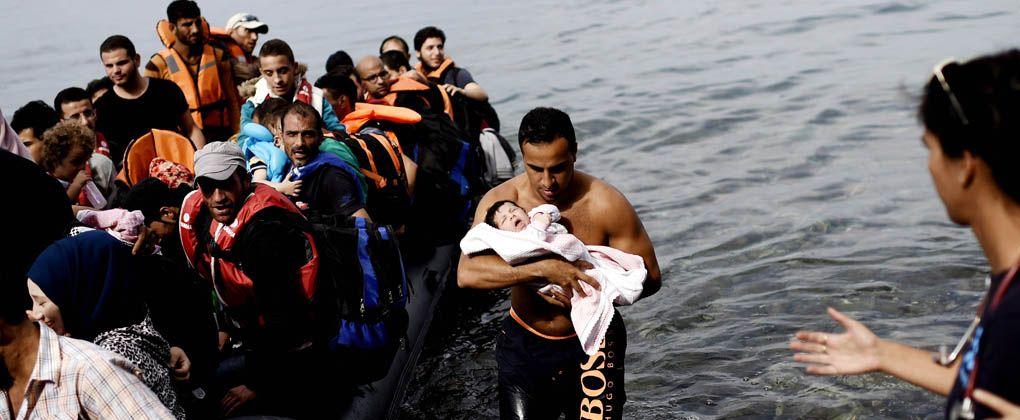

Battle-hardened Syrians are among the many thousands of refugees attempting to reach Europe, in the continent’s biggest influx of people since the end of World War Two. These fighters have spent much of the past five years locked in mortal combat and arrive with harrowing stories of why they left their homeland.
Two such men are Sari and Tareq. They have killed and faced death during the country’s bitter conflict, but took up arms for very different reasons. In Sari’s case it was to defend the government of Bashar al-Assad, while Tareq was on the side trying to dethrone the president. Both have since left their homeland, with Sari having made his way to Austria, while Tareq bides his time in Istanbul where he plans to make the perilous voyage to Europe in the coming months. Though sworn enemies, both seek the same goal: to leave the horrors of the war in Syria behind and forge a new, peaceful, future.
Twenty-five year-old Sari used to spend his days fixing cars and training in a local gym. From the predominantly Christian town of Saidnaya, 30 kilometres north of Damascus, he watched with fear and anger as anti-government protests swept through Syria in 2011. He suspected, as his family and friends also did, that outside forces were trying to recreate in Syria the chaos engulfing Tunisia and Egypt at that time. He mentions Saudi Arabia, Qatar and Al Jazeera as being among those responsible. The Christian communities in Syria feared an Islamist takeover should Assad leave or be forced out; a move that would see their churches regulated and their women forced to cover their hair in public.
Two years later, in September 2013, their fears appeared to be materialising. Rebel fighters, including jihadists linked to al-Qaeda, occupied the neighbouring Christian town of Maaloula, where locals feared for the historic churches and monasteries located above the town. Dozens of Christian men, including Sari, rushed to Maaloula to fight back as part of the voluntary National Defence local militias. Armed by the Syrian regime, they fought off the rebels, with Sari’s hatred of them growing stronger.

But as conscription became an increasing probability early last year, Sari’s thoughts turned to leaving Syria. “The police came to my house and wanted me to join up with the army because I was already a reserve soldier,” he says. “If I joined I could have been away for a year or more.” And of course he could easily have been injured or killed in the process, hence his decision to flee. “Together with my friends we thought about travelling to Europe,” he says. “We heard they give you a house and you could secure your future there. We were all guys, we considered it a holiday.”
Last summer Sari made his way from Lebanon to Turkey, then to Greece by boat and northwards through the Balkans. And it wasn’t just Syrians he met in the process. “When I arrived in Austria on July 17, I found the number of refugees that were Syrian was only around 10 percent. I didn’t know there would be so many people from other countries,” he says.
“I’m not concerned if it’s going to be difficult in Europe, — I’ve faced it all in Syria,”
Sari was housed in a large tented camp for 20 days before being taken to a small, “boring” village where he and dozens of Syrians were set up in a hotel. “Every month someone from the government gives us €150 [Dhs590] for food. You don’t have to answer to anyone, but if you want learn the language you have to cycle 30 minutes in the cold.
I used to drive a car, now I ride a bicycle,” he says of his new circumstances.
These short-term gripes aside, the biggest challenge he and many other Syrians staying at the hotel face is that they are unlikely to ever go home, which means he is thinking about how to begin again. “Life is very slow here, but I think that within a year I’ll learn the language and maybe work in a university,” he says.
A hundred and ninety kilometres north of Saidnaya lies the town of Hama. Twenty-four-year-old Tareq was a first year student there when he joined the demonstrations against the brutal government reaction to what began as a peaceful opposition movement. In 2011 and 2012 he used his camera to document regime attacks on civilians. “Our first protest was to get people to think about the events in Deraa.
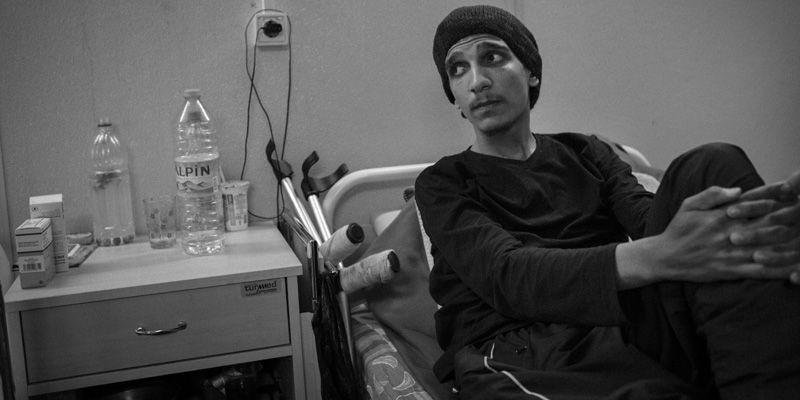
Then the security forces came,” he says from a non-descript apartment in Istanbul while tentatively smoking a cigarette. “After three months I was caught and put in prison. It was the first of three times I was taken in 2011.”
Tareq travelled to other cities in Syria to add his support to what he felt was a historic call for freedom. Later he began volunteering with the Red Crescent to help those beaten or shot. Soon, he says, the security forces came looking for the wounded. “I know at least one injured person they took and murdered in prison,” he says.

The day he joined the powerful rebel Farouk brigades in 2013 and was handed an assault rifle felt no different than holding his camera.
By then he had lost his brother and uncle in clashes with regime forces in Hama. Tareq felt it was his mission and his right to take up arms against those who had destroyed his family. “I was scared, but I felt I had nothing to lose. All my thoughts were on getting my enemy.”
Those enemies soon multiplied. When fighting the barbaric ISIS in Aleppo, a friend was injured. Someone needed to get him to a hospital across the border in Turkey or he would soon die. Tareq volunteered at once.
Today Tareq lives in Istanbul where he is trying to cobble together money to make the trip to Europe. He says he has no preference of where he’d like to settle, but wants to continue the degree in business management he started before the war. “I’m not concerned if it’s going to be difficult in Europe — I’ve faced it all in Syria,” he says. “All I want is to go somewhere I won’t hear about the war; maybe Norway.” Still, Tareq faces huge issues. Much of his family is still inside Syria, which means that leaving the war behind is easier said than done. The absence of a network of contacts and friends — he says he knows a total of six people in all of Europe — is challenging.
Human rights advocates admit the challenges facing freshly arrived single male refugees are varied. “The most important problem remains access to quality reception conditions in the main countries of destination,” says Kris Pollet of the European Council on Refugees and Exiles. “Other nationalities arriving in Greece often take the Balkan route to enter the EU in Croatia. They have to use irregular channels to access the procedure in the EU, which is of course quite absurd.”
Though distanced from the war by thousands of kilometres, Sari and Tareq both give a sense that the divisions between pro- and anti-government Syrians are unbridgeable.
“In three years’ time Europe will be like Saudi Arabia, but I think that’s what Turkey and Saudi want,” says Sari, who remains fervently anti-opposition. He believes that shutting the Turkish-Syrian border would see a victory for Assad “in one month.”
For Tareq, meeting a Syrian government soldier in Europe would be too much to bear. “The fault lies with the regime,” he concludes. “I stayed peaceful for so long — they made me turn to weapons.”
– – –
This feature previously appeared in the February 2016 issue of Esquire Middle East