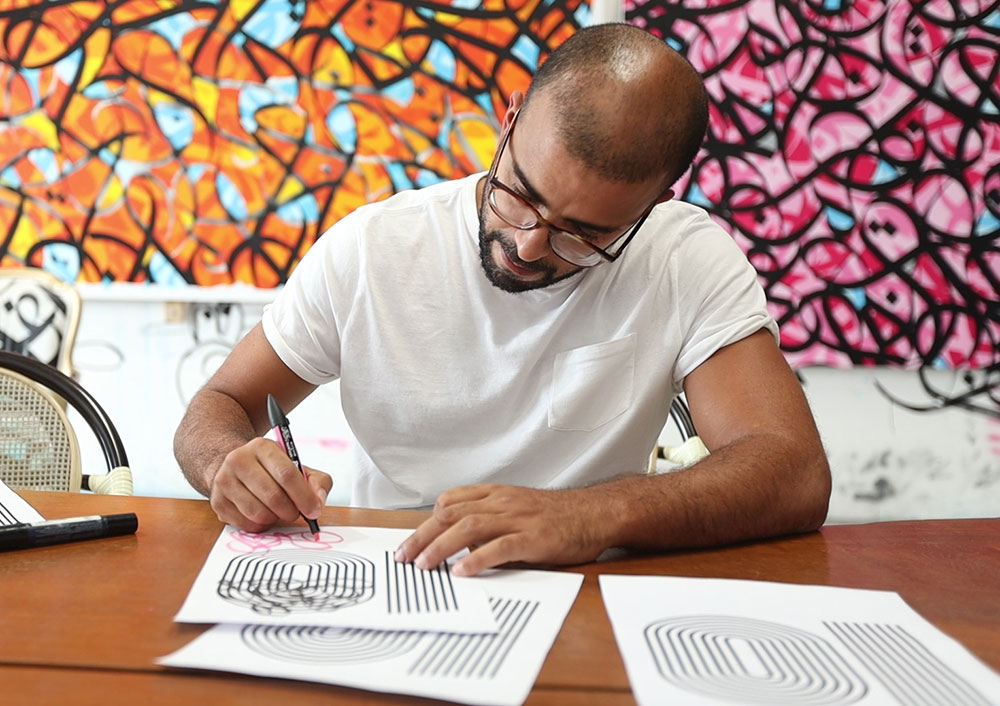
For the past decade the artist, eL Seed, has used his distinctive style of Arabic calligraphy as a way to bridge cultures.
With artwork found all over the world, he wants his medium to unify communities and redress stereotypes from the region. In celebration of Esquire’s tenth anniversary, we spoke the Dubai-based, Tunisian artist about the decade that changed his life.
ESQUIRE: What were you doing ten years ago?
eL Seed: I was living in Paris and getting ready to quit my job as a business consultant. I wanted to leave to pursue my artistic career. It was a complete life-changing moment for me, and it’s crazy to think on all that has happened since then.
ESQ: Has your success surprised you?
ES: It’s not surprise because I see how hard me and my team have worked, but I am certainly grateful to have been able to have accomplished what we have.
ESQ: When you made the decision to become an artist, what was your goal?
ES: I think at first it was quite a selfish thing. I wanted to satisfy my own creativity. But the more I worked and painted in places around the world, meeting different people, the more I realized the power of art and how it can bring people together and create amazing human experiences. That is the goal of what I want to do now, create experiences for people.
 el Seed’s cover of Esquire Middle East’s 10th anniversary
ESQ: What is the most important lesson your work has taught you?
ES: I have learnt to see other people in a different way. To change my perception and not to judge people from first impressions. Through my work over the years I have learnt a lot about humanity, and art has helped me believe in humanity and the human being.
ESQ: What is your biggest achievement?
ES: I look at it as a whole. All the big and the little projects that me and my team have done together, make up the entire body of work, and that compilation is the achievement.
ESQ: How important a role does Arabic culture play in what you do?
ES: All my work is based on Arabic calligraphy, so it is the central part of my medium. What I love about Arabic script is that it has a universal beauty that doesn’t need to be translated to create an emotion. If you have no connection to the Arab world you will still feel something. There is a dynamic and a poetry to the shape of the letters. Arabic script touches your soul before it reaches your eyes, and there are infinite possibilities to create works from only 29 letters.
ESQ: What do your pieces mean?
ES: They are all phrases or poems, but not necessarily from the Arab world. When I do projects in different countries, I always make sure that the phrase behind the art is from the local language, which I then translate into Arabic. When I was in the Korean Demilitarized Zone I used a Korean poem; in the Favelas in Brazil I used a Portuguese poem—I want to use my work as a bridge between my culture and other people’s. I don’t want to use Arabic script to be imposed on others.
ESQ: In the last decade, do you feel that people have opened up more to Arab culture?
ES: I think people were already open, it’s just there is more exposure now. When I paint somewhere where there is little or no connection with Arabic culture it is important to connect with the community. I essentially use Arabic script as a tool to bring people together.