

Pakistan has been shrouded in controversy over the past decade, from political turmoil to government embezzlement and extremist attacks from Islamabad to Lahore and the once flourishing Karachi. Terror attacks, such as the tragic hospital bombing in Quetta, which killed 72 people and wounded a further 128, have left inhabitants feeling shock and abandonment, not just due to the loss of lives but also the subsequent lack of support and interest shown by the world media.
There is an international medical team that knows exactly what is happening inside the country. Interplast UK is a not-for-profit organisation working in the Asia Pacific region to provide surgical treatment for patients and training for local medical staff. A group of 12 doctors, surgeons and nurses worked in Quetta two years ago, where they operated on over 100 patients, most of whom were afflicted by disabling burns and cleft lips and palates (approximately one in 700 babies born is with this deformity worldwide). Now they’re back, this time in the Punjab city of Rawalpindi, just south of Islamabad, where I join with them to see how they give up their own time to help others.
Thanks to an inside contact who bent the rules concerning red tape, we’re staying in a hotel we wouldn’t legally have access to as foreigners, due to it neighbouring the city’s army headquarters. Over the past decade, foreign faces have become an anomaly in this once thriving area. Two years ago a suicide bombing near a bazaar killed 13 people with at least 15 more badly injured in the attack.
We arrive at the hospital security checkpoint, dazed by the heat and previous days of travelling. I think back to working with the same team six years ago in Kumi, Uganda, when we were diverted off the road by armed men in uniform and wondered if we were being ambushed. We weren’t held on that occasion, but the memory surely remains for the Interplast volunteers, as it does for me.

The current climate, in every sense of the word, is different, but the mission stays same — to help as many people as possible with quality care in the short space of two weeks. This time is carved from the holidays that volunteers are able to take from their jobs working in hospitals back home.
Pakistan appears more developed than Uganda, in terms of the infrastructure, equipment and facilities. The 300-bed hospital is an aggressive concrete structure set over three acres and is a far cry from the rural Kumi hospital. In the wing where Interplast is working, patients politely linger in several waiting areas, ready to hand themselves and their families blindly over to the team with the merest sliver of hope. Some have travelled hundreds of miles, but no one complains about the heat and the ageing equipment here. The hospital is relatively progressive, with a burns unit, a whole building dedicated to the education of nurses and a further wing currently in the process of being built.
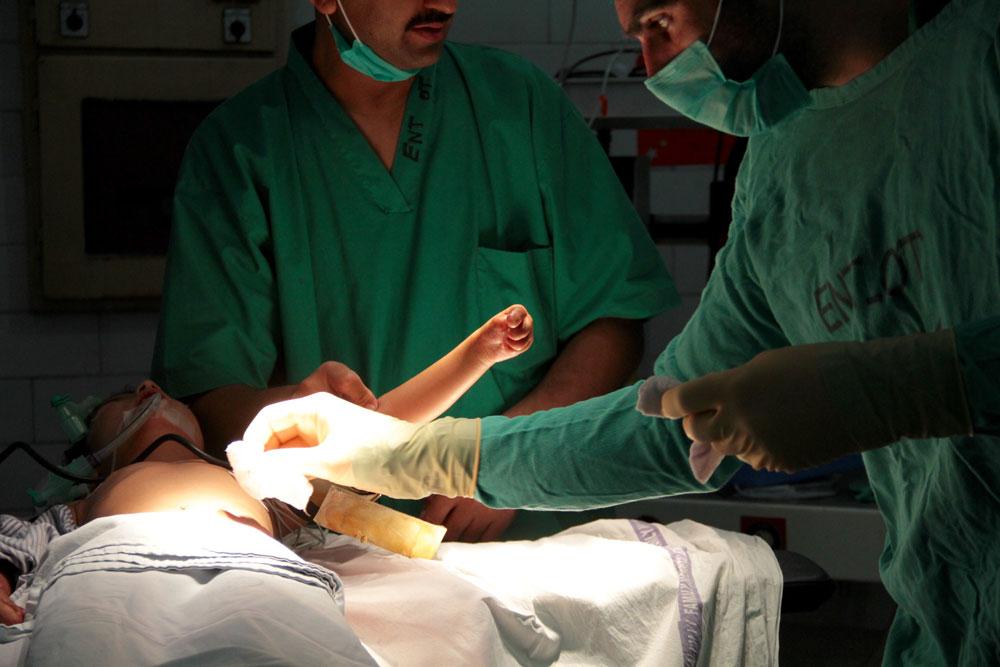
The doctors get ready to work.
***
Ghalib Mukadam is a 40-year-old anaesthetist with a warm smile and quick wit who, when not volunteering for Interplast, works in King’s College Hospital, London. “Developing countries are probably 20 years behind when it comes to anaesthetics,” he tells me. “They’re using techniques we have used in the past, but when you come here you’re actually using those agents and some of those machines today. This equipment can also be poorly maintained, or no one knows how to use it, or there’s a part missing and so on. You go in with the mindset that you might have to do some repairs. That’s just the way it is.”
Other team members agree that it could be worse, as Ivy Boardman, a vivacious British nurse of Mauritian heritage points out. “We have a lot more equipment here than we worked with in Sri Lanka,” she says, buoyantly popping in and out of the room throughout the interview with Dr. Mukadam. I ask him how it feels knowing they don’t have the state-of-the-art equipment they are used to in these situations. “I work with little babies at King’s and I have all the drugs, equipment and backup known to mankind. We’ve done three-month-olds here. You do them and you do them safely but you know that you are limited to how much support you have, so it is a lot more stressful.”

Dangerous locations are often on the agenda, from politically volatile Cuba to unstable African nations and densely populated South Asia. Yet none of the team seems to pay much attention to the potential threats. “The safety has to do with the people who host us,” says Dr. Georgios Pafitanis, a 33-year-old Greek Cypriot, who is carrying out his third aid mission in nine months. “If we’re with someone who knows the area then it doesn’t bother me. My family, on the other hand, aren’t so happy. They asked me, ‘Why Pakistan?’ And I told them, ‘We follow the need and we just go.’”
He explains how a small number of ‘Angels’ — contributors who prefer their support to be anonymous — facilitate the trip, donating funds and making things happen on the ground.
We are then joined by Dr. Raja Shafiq Sarwar, a medical superintendent at Holy Family Hospital in Rawalpindi, who helps with the logistics. “There’s often lots of red tape involved with the transportation of medical equipment and supplies,” says Dr. Sarwar. “Just getting visas can prove difficult sometimes. If it wasn’t for specific individuals in each region, I’m not sure these trips could happen.”
***
The next case illustrates just how much of a difference these missions make to the patients’ lives. A doctor taps me on the shoulder and whispers, “You may want to come and see this”, so I walk into a small room where medical staff are screening patients. A young girl sits at the back of the room, her eyes lowered, with a surgical mask covering her face as several local doctors along with head surgeon and the founder of Interplast UK, Dr. Charles Viva, gather around. The girl’s mask is removed and she instantly recoils at the prospect of the strangers’ reaction to her appearance. Two skeletal holes gape open where once she had a nose.
After the doctor’s assessment of how to proceed with a reconstruction, I ask for a few minutes alone with her. A translator accompanies us, followed by the girl’s brother. Initially she is very shy and guarded, but gradually becomes more relaxed as our interview ensues. She tells me her name is Taiba, she’s 24 and comes from Kashmir. In her teens she was followed by a local gangster who threatened to kill her family if she refused his offer of marriage. One day he sent his parents to ask for her hand. Her family knew of the man’s reputation and didn’t agree with the match. But due to the threats against her family she agreed to marry. She was 18 and throughout five years of marriage the man beat her and kept her as a slave, unable to leave the house, to the extent that when her father died she was forbidden to go to the funeral.
When she found out her mother was also dying she escaped so that she could visit, and refused to return. Her husband kidnapped her at gunpoint, when her family were absent, dragged her to a public place, tied her to a tree, stripped and beat her, cut her hair and eventually severed her entire nose with a knife, feeding the flesh to a nearby dog. There were several witnesses but the young girl’s brother says no one stepped in through fear of repercussions. The police, who were allegedly bribed, refused to act, but the story got out and due to media pressure, Taiba’s husband was detained and is still awaiting his trail. He has since sent word threatening the family, claiming on his release he will kill them all. The girl’s brother explains how he now stays at home, unable to work, to try and protect his sister and family.

When this harrowing tale ends, I discuss the case with Dr. Viva. The retired British surgeon, of Sri Lankan origin, founded the UK branch of Interplast back in 1990 and on a previous occasion was instrumental in the Bangladesh government’s enforcement of maximum penalty for acid attacks. He offers some stern words. “The problem is that a lot of people in authority don’t want to accept that such things happen because they think it is a slight on their country. This is not so, it’s universal. Acid burns, for instance, happen in every country. However, the number of attacks have decreased where the punishment is severe and the people know there will be retribution. The government must act to prevent these crimes from happening. Prevention is always better than cure.”
These acid attacks have lessened since a 2010 government bill, which came in the wake of an international and local outcry after several high-profile incidents, but they do still occur.
We go back to the room where Taiba waits, and see a baby, dressed in a wrinkled vest and denim dungarees, playing on an adjacent hospital bed, which momentarily defuses the despondency. As the surgeon takes pre-op pictures on his iPhone, the flash goes off, causing the boy to laugh and throw his arms in the air. He is observed by his mother, who allows him the freedom to court the room, but every once in a while drags him closer towards her as his giddiness propels him to the edge of the hospital bed. He is here with a severe cleft lip and palate and is next in line for an appointment.
These operations would be widely available, and often free, in the developed world. However, limited resources and a lack of education results in ostracised individuals who are hidden away by their families and unable to earn money to support themselves. Their deformities are sometimes caused by birth defects, but often accidents from cooking or gas explosions and, more troublingly, premeditated attacks.
When the pre-op photos are done, I ask Dr. Viva why he undertakes these often difficult trips. “Many patients come to us who won’t even lift their head because they feel so ashamed by their disfigurements,” he replies. “And then years down the line we are humbled to hear they have businesses and their children have entered the medical profession and so on. That’s what being a doctor is about — helping people. It’s a vocation and so I’ve never said that I’m off duty, because I can’t tell the patient that. It’s a question of duty.”
His optimism wanes a little when I ask what most troubles him about their work. “The saddest thing is if people arrive at the end of our mission. If it’s a big job and the follow-up requires at least a week then we have to tell them to come back next year, but sometimes we don’t know if they will even be alive by then.”
Thankfully this isn’t the case with Taiba. The team has chosen to carry out a nasal reconstruction using a paramedian forehead flap, attaching skin from the forehead over the severed nose.
***
Ten-hour days, in the hospital, with a quick five-minute break and then back into theatre, are standard practice on these trips. The team has transformed 60 lives so far and the post-op gratification — an amalgamation of relief, gratitude and happiness — on each family’s face, is the priceless reward.
Evenings are spent at the hotel huddled around a small table, sometimes nursing a rationed helping of contraband sourced from the local brewery (which states firmly on the label, Export Only). Everyone’s doing their best to shed their tired medical skin, transforming into more candid and carefree individuals when work is over. The ability to detach from the day’s cases and those to come, is harder than it seems. A couple of young nurses attempt to prolong the squad revelry on the odd occasion, but the unit is mostly locked in focus, united day and night, like one big, practical family. “Charles is my surgical father. I can’t say no to him,” jokes Dr. Felix Blake, a 45-year-old accomplished surgeon from Germany, as the team’s mentor, Dr. Viva, graciously pours him a drink.
Each member brings something different and equally valuable. Hierarchy is saved for theatre and doesn’t play out elsewhere. Only one member, the anaesthetist, Dr. Mukadim, seems unable to completely let go of his thoughts, perhaps shackled with the life-or-death responsibility of keeping the patients alive and breathing throughout their operations. I manage to catch a few minutes with him before he disappears off to his room, and I ask him if he feels safe in these troubled surroundings. “I have a feeling that if it is your time, it’s your time,” he answers, after considering the question for a few moments. It’s a sort-of medical mantra that each member of the team seems to agree on. Probably it’s because these individuals’ raw exposure to life and death leaves them with an unwavering, matter-of-fact attitude that could appear somewhat jaded to non-professionals, when the truth is they are realists who refuse to tether themselves with the burden of fear.

“The one thing I remember about our trip to Quetta is that there was an initial opening ceremony and there were all these guys in white robes who were the tribal leaders,” he continues. “We had to go and meet them, and they pretty much said we were under their protection. Only after that point did I think, “I’m pretty secure here.” I press him further on how he explains the risks to his family. “I lie through my teeth to my family when I go on a trip,” he says with a laugh that seems tinged with an element of sadness. “People have a very wrong idea of these countries. What they portray in the Western media is very different to what you see here.”
So what motivates him to continue, despite the reservations of his family? He pauses for a moment and then tells how he once worked for Smile Train, an American charity that provides corrective surgery for children with cleft lips and palates. “We did similar work and I was very lucky with the surgeons I worked with, as they were very good.” But there was one big difference from the Interplast setup: Smile Train pays its volunteers, which in Dr. Mukakadam’s mind altered the motivation for the trip. “I didn’t realise when I joined, so I chose not to accept the money. They transform lives, but I don’t like that financial aspect to it. Unfortunately, you can see that time is money. Some of the people want to get as many cases done because it’s generating income, which, for me, loses the shine of what you are doing. If you’re getting a fee it’s not charity.”
Our discussion is interrupted by a loud moaning. A young woman, aided by two other females, cries in pain as she’s ushered into the hotel lobby. The lady has fresh burns from a gas fire explosion and, having been discharged from a nearby hospital, clearly still in severe pain, has heard that Interplast are here and might be able to help. The team is tired, but immediately switches to a medical demeanour. The woman is examined and scheduled for an appointment the following day.
On the bus the next morning I manage to earn a spot next to Dr. Viva. The very slight, retired surgeon is revered by the team for having dedicated a large part of his life to helping patients feel more comfortable in their own skin. He philosophically strokes his manicured, snowy beard, like a character in an Agatha Christie novel and reflects on 40 years of aid missions, during which time Interplast UK has done around 50 trips. “When I was working for the NHS we only got six weeks’ annual holiday, so I did a two-week mission every year and the other four I had to spend with my family.”
He tells me how the most patients he has ever treated in one trip was here in Pakistan when they visited Abbottabad, Rawalpindi and Kashmir. He and three other surgeons treated 240 patients. “That was hard going,” he admits. “When we went to Mirpur, in Kashmir, the clinic we worked in was private and the doctor had arranged a press meeting. We were pressed for time and already had four patients lined up so I politely refused and we continued with the operations. He was very unhappy about it but sadly our focus was completely different to his.”
Once again he strokes his beard, as though summoning a genie in a lamp that might whisper a memory, among so many that he could be forgiven for having forgotten. “In one country there was a 55-year-old lady and a 60-year-old man, both with cleft lips. I told them that we only operated on children, of which there were so many needing help. But every day they came and after the third day I couldn’t refuse.”
He smiles and pauses. “Another time, when we went to Africa, there was a lady who was 70-years-old. When she found out we were doing operations she took her carrier bag and set off without question, travelling many miles to the hospital. We couldn’t refuse her either!” He recalls the incident with evident fondness. “Two years later I went to the village and left word that we had come to see her. She hopped on the back of a motorbike taxi and came to find us. When we saw her she was a completely different person.”
The usually restrained surgeon, sometimes stern, yet painfully soft-spoken, exhibits an uninhibited glint. His eyes widen and he laughs. “She never stopped talking. She told us her husband wanted to take her on a second honeymoon and in the end she said, ‘I don’t know why I’m speaking so much. I’m just so happy.’”
For more information about Interplast, visit Interplastuk.org


