
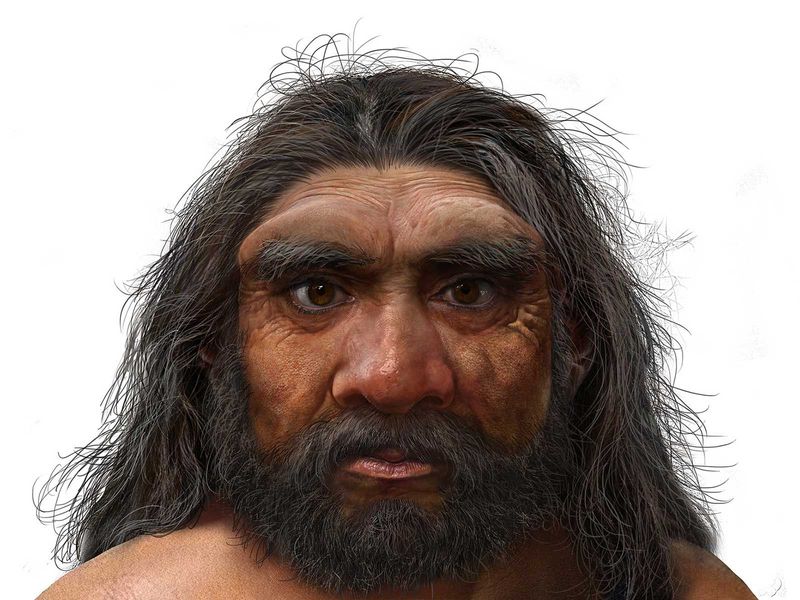
Behold the Dragon Man. We’re calling him Trogdor the Burninator.
Scientists in China have just unveiled an ancient skull that they believe is actually a new species of human—the Dragon Man.
It’s being called one of the most important discoveries in history, and rewrites what we know about our lineage as a species as well as the history of humanity.
The species appears to be the closest evolutionary relative to homo sapiens yet discovered, closer than even Neanderthals and Homo Erectus.

The group appears to have lived in East Asia around 146,000 years ago.
The skull was found in Harbin in Northeast China in 1933, but scientists only became aware of it recently, and started to theorize that it may not be an ancient homo sapien, but something else entirely.
The official name is Homo Longi, Longi being the Chinese word for Dragon.
Why is it called dragon? Because of how it was discovered, in fact. Disappointingly, Trogdor was not a dragon man, nor a dragon. He was a version of a man.
A construction worker found the skull while building a bridge over the Songhua river, which means Black Dragon river, which is where the Dragon Man gets his name.
The story, however, is a good one. The city was under Japanese occupation, and the worker, in an effort to evade his occupiers, smuggled it to his home, recognizing its cultural value. He then hid it at the bottom of his family’s well, and there it stayed for 80 years.
He only told his family about the skull on his death bed, which led to the family finding it and handing it over to scientists.
Honestly, the story is good enough to make up for the lack of an actual dragon person.
The debate is still raging about the actual lineage of the species, as some think that the species is actually a branch of Neandrethals called the Denisovans, who were originally found in the Denisova Cave in Russia but have been too elusive to study further.
There has been a fierce debate about whether these remains represent primitive examples of Homo sapiens, Neanderthals, a human group called the Denisovans, or something else entirely.
The Denisovans were first identified from DNA retrieved from a 50,000-30,000-year-old finger bone discovered in Denisova Cave, Russia. Because the remains associated with this sister lineage to the Neanderthals were so fragmentary, the group has been described as a “genome in search of a fossil record”.
Prof Marta Mirazon Lahr, from the University of Cambridge, believes that Dragon Man was, in fact, a Denisovan.
“The Denisovans are this fascinating mystery population from the past. There is a suggestion (from DNA evidence) that the jawbone found in the Tibetan Plateau might be a Denisovan,” Prof Marta Mirazon Lahr, University of Cambridge, told the BBC. “And now because the jawbone from Tibet and Dragon Man look like each other – now we might actually have the first face of the Denisovan.”
Another group thinks that, because of remains found in the levant, that the Dragon Man may have first come from that region.
The debate is still raging, but Prof Ni, the lead scientist who published the study out of China, is certain of their assessment.
“The results will spark a lot of debate and I am quite sure that a lot of people will disagree with us,” he said to the BBC.
“But that is science and it is because we disagree that science progresses.”

Esquire now has a newsletter – sign up to get it sent straight to your inbox.
Want up-to-the-minute entertainment news and features? Just hit 'Like' on our Esquire Facebook page and 'Follow' on our @esquiremiddleeast Instagram and Twitter account.


