
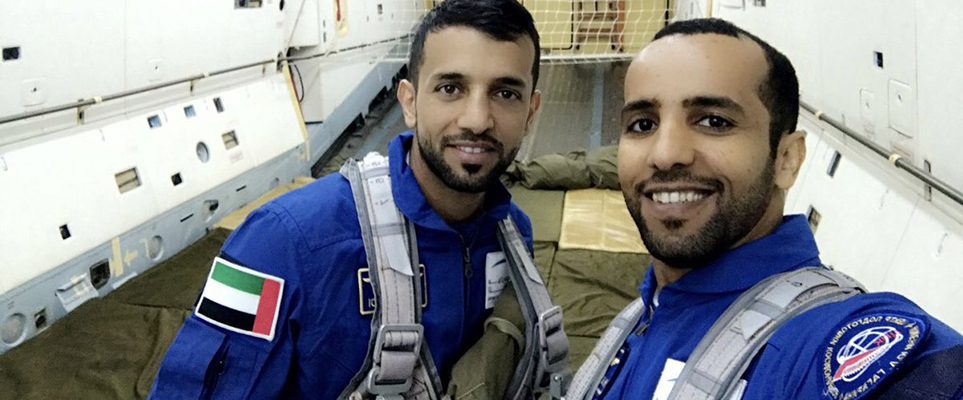
Hazza Al Mansouri, aboard the Soyuz MS-15 recently made history as the world’s first Emirati astronaut.
Every Muslim across the world must perform five prayers throughout the day according to the sunrises and sunsets. Hurtling around the Earth at 27,500 kph, Al Mansouri will witness a new Earth day every 90 minutes and see 16 sunsets and rises. Al Mansouri, and many Muslim astronauts before him have not let this deter them from performing their duties as a Muslim, there’s an interesting solution to this problem.
Back in 2007, Malaysia’s first astronaut, Sheikh Muszaphar Shukor embarked on a similar mission to the ISS. The National Fatwa Council pre-emptively created the “Muslim Obligations in the International Space Station, presented at the ‘Islam and Life in Space’ conference. The booklet outlined the modifications to Islamic rituals during space travel.
Dubai Islamic Affairs and UAE Space Agency also got involved this year for Al Mansouri’s mission and gave him a set of rules.
Instead of attempting to pray at times according to the point of the sun and moon, Al Mansouri will pray within a 24-hour Earth time cycle, regardless of the actual positions he sees in space. Even though previous rules have said to pray at times according to last Earth location, in this case Kazakhstan, Al Mansouri has been instructed to pray according to the timings in Makkah.
Makkah’s timings are more favourable than Kazakhstan because Al Mansouri will not remain above the central Asian country for the duration of his 8-day space mission.
Read more on Al Mansouri’s mission here!
Timing for these prays vary as the months go by, but Al Mansouri will pray at around the following times each day: 04:54 am, 06:10, 12:12, 15:36, 18:14, and 19:44pm, unless his work duties demand otherwise.
The prayers on Earth also dictate that you must always be facing in the direction of Makkah, and place yourself on the ground for religious reasons. Clearly, in microgravity, Al Mansouri will not always have this option.
The ‘Muslim Obligations in the International Space Station’ tackles both these issues. In regards to facing Makkah, there are a series of options given to Al Mansouri. The options begin with the most favourable, to the least, taking into account the difficulties of space travel.
If Al Mansouri is able, he must face Makkah, failing that he must face a projection of Makkah, failing that he must face the Earth, and failing that he must pray in any direction he can.
Similarly, the specific set of movements in praying is prioritised for Al Mansouri. First is standing if possible, then sitting, then lying down while facing Makkah, then lying flat any direction, then using the eye lids as indicators for changing position, and then imagining the changing movements in his head.
“As a professional pilot, I’m used to praying while flying at high speed,” UAE’s first Emirati astronaut said at a news conference in Baikonur when asked about praying.
“Of course in space it will look a little different. I plan to record a prayer as I go down to earth,” he added.


