

Rest easy—if the time comes, NASA will be ready to stop an asteroid from colliding with earth.
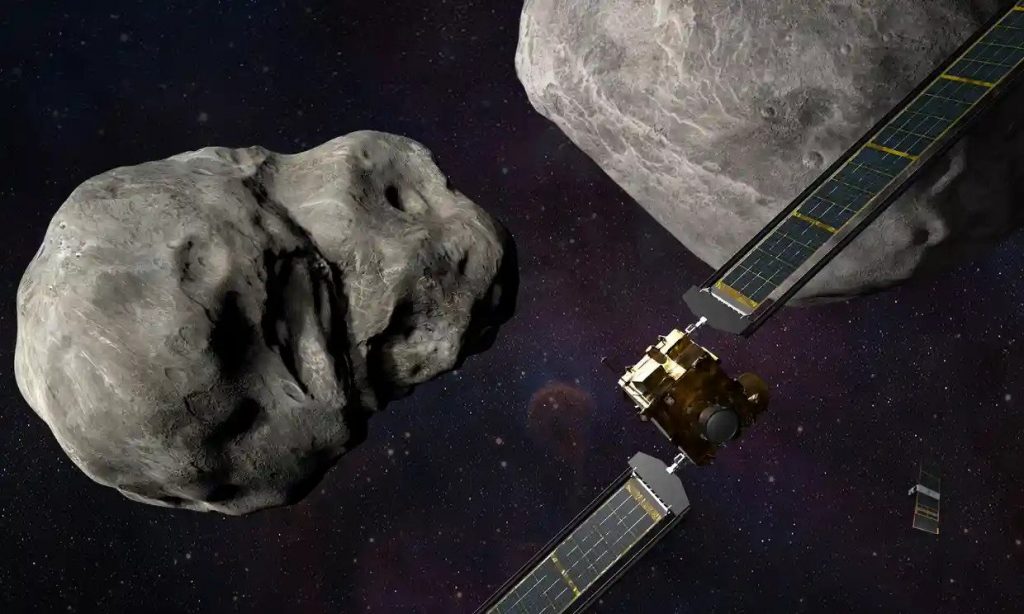
NASA successfully crashed into the asteroid Dimorphos 10.9 million km from earth last night, hitting it with a multi-million dollar space craft on a $325 million mission and successfully knocked it off course.
The mission was known as the Double Asteroid Redirection Test, and was the first attempt in history to move a celestial body.
The spacecraft hit the asteroid going 24,000 kmph at 7:14 pm EDT, with NASA lives treaming the video showing the asteroid being hit, as well as cheers erupting in mission control.
Scientists from Johns Hopkins University as well as NASA teams hugged after the impact was confirmed to be successful.
This is a huge moment. In the words of Lori Glaze, NASA’s planetary science division director, it’s a “new era for humankind.”
“[It’s] an era in which we potentially have the capability to protect ourselves from something like a dangerous hazardous asteroid impact,” said Glaze. “What an amazing thing. We’ve never had that capability before.”
Samson Reony, the Johns Hopkins applied physics laboratory mission commentator,called it game changing.
“This is when science, engineering and a great purpose, planetary defense, come together, and, you know, it makes a magical moment like this,” he said.
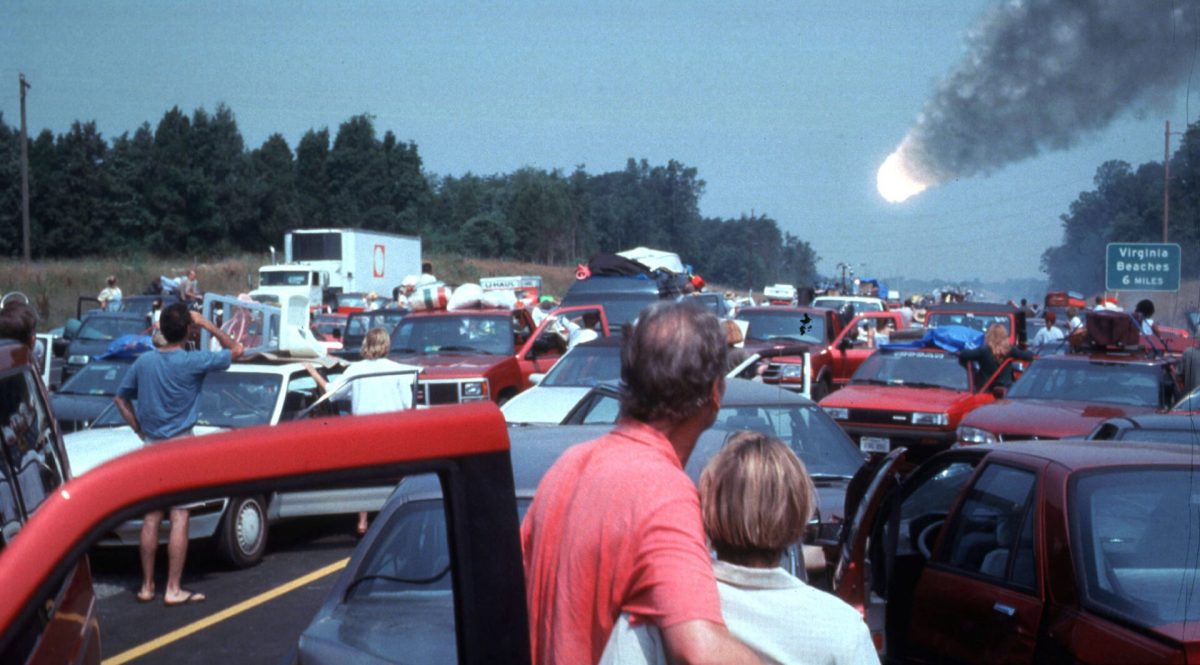
If this all seems familiar, yep, you’ve already seen this in movies. A similar strategy was used in the movie Deep Impact, pictured above, in which Morgan Freeman, the fictional president in the 1998 disaster film,, senet an unmanned spacecraft to do the same. Of course, in that movie, they failed.
So we’re better than our wildest imaginations at this point—pretty impressive.
In fact, it was the “ideal outcome,” Dart deputy program manager Elena Adams said.
“We knew we were going to hit. All of us were holding our breath. I’m kind of surprised none of us passed out,” Adams said after it hit 17 meters from the target, which makes it a complete success.
“It was basically a bullseye. I think, as far as we can tell, the first planetary defense test was a success, and we can clap to that.”
Whether the impact had enough force to move the it remains to be seen, and scientists will spend the next weeks monitoring its speed and movements, and making calculations. Even so, Adams said:
Next, they will measure the asteroid’s trajectory to see if it had enough force to move it in the initial test, but the fact that we could hit it at all should prove that we have the capability.
“Earthlings should sleep better, and I definitely will.”
This is only the first of a series of “planetary protection missions,” according to NASA spokesperson Glen Nagle.
“We want to have a better chance than the dinosaurs had 65m years ago,” Nagle said. “All they could do is look up and go, ‘Oh asteroid.’”
And an asteroid striking earth is definitely possible. While none is predicted to hit earth over the next 100 years, only 40% of asteroids that may come close have been identified.
Hopefully, however, we’ll be able to see it when it’s coming.
A huge asteroid almost hit earth but NASA didn’t detect it until a day later
If you heard a whooshing noise last year, you weren’t imagining it—there was indeed a gigantic asteroid that almost hit earth last fall. And NASA didn’t see it coming.
The asteroid, named 2021 SG, has a diameter of around 42 to 94 m, with a diameter or around 68 m, which makes it around half the size of the great pyramids.
The asteroid tracker EarthSky has it listed for September 16, but NASA only detected it a day later.
Yep, we almost got hit by an asteroid that we didn’t even notice.
How? It’s because it was coming from the direction of the sun, a blind-spot for scientists.
Almost all asteroids that are detected by NASA and others come from the other direction of the solar system, coming towards the earth and the sun. This is known as coming from the “front”.
Rarely do asteroids come from the “back” but it does happen, but because they’re coming from the direction of the sun and head outwards in the solar system, they are very difficult to see, due to the sun’s bright rays blocking our view.
Quite literally, the sun was in our eyes.
The asteroid got super close to us, according to EarthSky. It was around half the distance between the earth and the moon—that’s how close. It passed Greenland and Canada at just past midnight GST on the 17th, an extremely close call.
This has happened before, and will happen again. One came from the sun that was smaller on September 7 that was only around 3.5m, just 15 thousand km from the earth.
“One of the reasons why it is hard to achieve the goal of finding 100% of all Near-Earth objects (NEO)… is because some have orbits that help ‘hide’ them from Earth-based observers,” said University of Hawaii astronomer Dave Tholen.
With all of the fancy tools that scientists have to detect asteroids, NASA currently has no way of detecting asteroids that are close to the sun. However, there is a new telescope called the Near-Earth Object Surveyor space telescope that is being launched in 2026 that will try to better detect these objects.
In the mean time, just keep an ear out for that whooshing sound.