Bespoke Tailors is almost an underground lair.
Buried beneath Dubai’s International Finance Centre and set on a busy thoroughfare, its windows of suits in various stages of completion draws more than a lingering glance from bankers walking by. Its owner, Mr Prakash Parmar, is cool, calm and very collected.
Now sat in front of reams of colourful fabric, he seems almost subdued as he casually explains the history of how he came to set up shop here in the Emirates.
In fact, his tone hardly fluctuates when he talks about his family moving to Dubai in the late 50s, or his life as a tailor, then as master cutter, and now, the as the man behind not one but two tailoring outfits (Bespoke is the upmarket little brother to Parmar tailors here in the UAE). But all that changes when it’s time to talk suits.
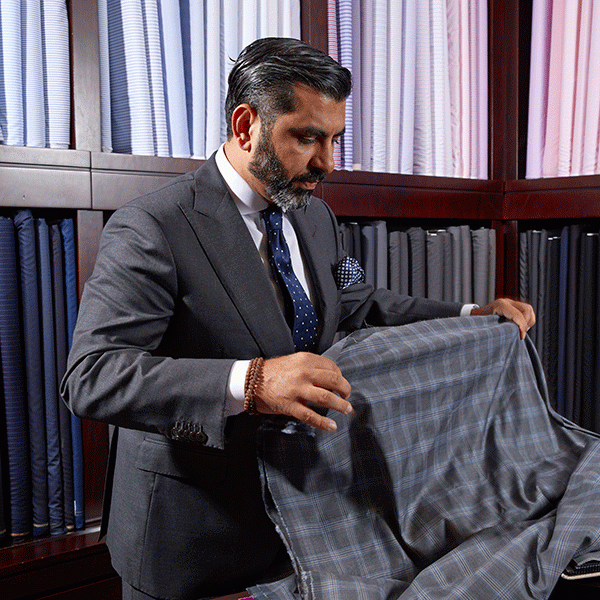
“Look, feel this,” he says, handing me a particularly fine pinstripe cotton swatch, “It’s Zegna. Beautiful isn’t it. And what about this one? And in this colour?” It’s apparent that a totally different Prakash has emerged. Unlike his laid-back counterpart, this Prakash is vibrating with energy. The table we now sit at is strewn with fabric and look books pile up alongside us both.
He points out the hundreds of different colours, patterns and fabrics. Linings, lapels and suit collars. “No, you don’t want this. It won’t suit you, you need more of a tan” he chides, before handing me me a light blue plaid cotton. At this point, I swear I can see a twinkle in his eye.
Prakash comes from a family of tailors that have been in the business for over 300 years. Having left Bombay, it was Prakash’ father who set up the first store in Dubai back in 1956. “There was no electricity here. Imagine. It was a very humble beginning for us” Prakesh remembers, “but at the time the British were here, so my father used to tailor for officers in the British Army.”
Prakash was drafted in to help his father at an early age, more out of necessity than passion. “We had some financial difficulties, and there wasn’t enough for me to go to college. I had seven brothers and sisters, so my father was like, “you’ve finished school, right?” And I had just finished my last exams, so he said, “Okay, come by the shop tomorrow.” I was 16.”
But Prakash obviously learned quickly, “for eight years I was a tailor. And then a master cutter for four years after that. I just cut. That’s all I did. Six years ago I did everything; sales, clients, fittings. And now, I am running the business. I am mature enough. At 44, I can just about handle it” he says, smiling.
He speaks of his past experiences; of his success as a tailor and as a businessman, with an almost laissez-faire attitude. Like someone bored of telling it. Too humble to brag and not wanting to embellish his obvious hard work, Prakash really comes alive when talking about what he loves. In this case, and for lack of a better word, ‘geeking’ out over suits.
“Bespoke tailoring isn’t just about making a garment” he tells me excitedly, “you need to understand everything about it. To know how the fabric will break, how it fits on the body, how it should sit, aesthetically, on a client.”
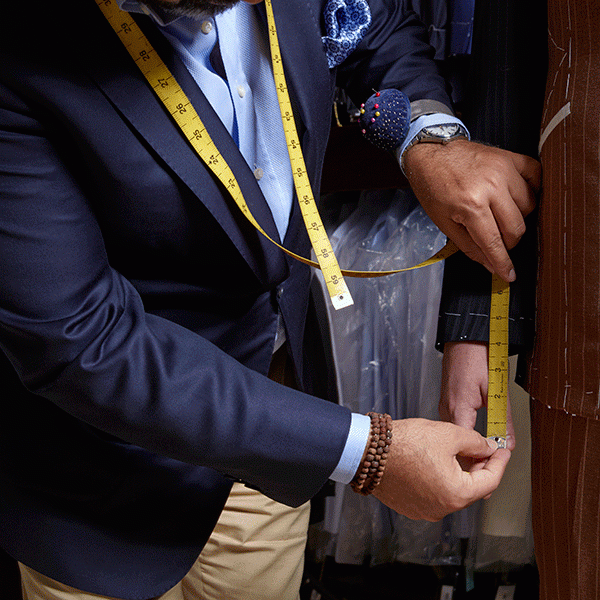
We are in my first fitting, a process which includes several methods I’ve never seen before. “Don’t write about this part” he warns me, “other tailors don’t do this. They don’t know how to measure the body completely. We’ve spent a lot of time and research looking at how it was done in the 20s, the 30s and improving it.”
Indeed, we have just finished looking at a yearbook of the clothing industry from 1952.
It’s obvious this is a trend at Bespoke, taking the age old principles of tailoring and applying them in different ways. “You need to really know our trade, otherwise you cannot take it any further. So what we are trying to do is integrate technology in to the business.”

I’m told that everything from my beverage of choice to favourite colour will be indexed and archived. My measurements, too, “I don’t understand why a client’s details are stored on paper. They could be lost. Instead of paper, we have CAD systems. We scan blocks and templates, so that when a client wants another suit he doesn’t have to come back for so many fittings.”
But technology has given the world something else, a sense that anything can be acquired almost instantly. If you want a designer suit? There’s plenty available at one of the UAE’s many malls. Need a pair of oxford brogues? Buy them online and they’ll be shipped over in days. “It’s true, the internet has spoiled us” admits Prakash, “but it’s creating two things. You get people who are happy with what’s there, and people who won’t accept what’s available. They want it their way.”
“Everything is customised these days. Look at coffee, it’s a classic example. There are hundreds of thousands of combinations. I go in and ask for an espresso, and they’re like, “Sir, do you want milk with that? Caramel? Chocolate sprinkles?” But over time people get used to their specific choices. They won’t accept anything different. And that is translating in to our business very well.”
Prakash talks about one client who is so particular about his jacket pockets that they are designed around the size of his smartphone. “Of course, I am happy to do it” says Prakesh, “we are all about giving a client what he needs, not what we want to give him.”
Indeed, some of the requests he has received have been strange, “We have made special pockets for guns and all sorts. I have one client, he has boxer shorts made to match his shirts. And even his trousers must have the same patterned waistband. It all must match!”
And there are stranger requests still, “We made an army jacket once. Or rather, a bespoke jacket out of army fabric. A military canvas jacket? Bespoke is all about being comfortable. It’s a military fabric? It’s not that light, or that comfy. But we made it.”
Speaking of strange materials, the fabric I’m wearing for my fitting isn’t what was picked out. The suit I’m wearing is made of twall, “it behaves the same way as the final fabric,” says Prakash, “but it is not.” Bespoke is the sole distributor for Zegna, and Prakesh has a special understanding with them,
“They give us end runs, the leftovers. Of course, it’s not good enough to make a whole suit, but good enough to make a first draft. It gives us a better feel of the cut, shape, and dimensions.” Only after a client completely happy with the fit and feel of this trial suit will the final fabric be used.
It’s a tiresome process – building the basics of one suit then scrapping it, all before doing it all over again for the final version – but one Prakesh is proud of. “Now the thing is, the main fabric has limitations. Once you finish stretching and re-sewing, it’s never the same again. That’s why we use twall for the first two stages, to make sure it’s perfect.”
It’s hard to define what motivates the driving force behind Bespoke tailors. Perhaps then, it’s better to use a story from the man himself. Before leaving my fitting, Prakesh tells me about the time he flew Italian master tailor Mario Napolitano to the UAE for a small workshop, “The guy was 80-years old, and he stood there for five hours and just talked. For hours he worked and showed us everything he knew, until I told him to take a break. You know what he said? He said a good tailor never gets tired.”
Having spent the day with Prakesh at Bespoke, I’d have to agree.
Want up-to-the-minute entertainment news and features? Just hit ‘Like’ on our Esquire Facebook page and ‘Follow’ on our @esquiremiddleeast Instagram and Twitter account.