

Twenty-fifteen was a challenging year for watchmaking. A surge in the Swiss franc and China’s slowing economy has the watch industry worried about its prospects for 2016. It’s also had to contend with the emergence of smartwatches, and in particular the Apple Watch, released in April.
I’m often asked if the mechanical watch world should worry about the impact of new technology. While there has been no overnight revolution in people’s choice of wristwear, it has left the industry with something to think about. The highest-profile response has been the Tag Heuer Connected (banner right), which offers a different take on what a smartwatch should look like. Other experimental pieces include the Breitling B55 Connected, Tissot’s smartwatch prototype and the Bulgari Diagono Magnesium concept. But these are first forays into a market that has not yet grabbed the public attention as much as Apple and the other tech firms hoped it might.
From my perspective, it appears that the public’s desire for top-end timepieces hasn’t wavered. The recent auctions held in Geneva are testament to this enduring fascination, as the vintage market, especially for rare and quality pieces, continues to demand high prices.
Yet there has been a slight shift. Not that long ago, most lots would have been sold for above their estimates, with everyone trying to get their hands on the next best investment piece. But it now seems the majority of buyers will only keep raising that paddle if the watch is in really good condition or if it’s very rare. In other words, the market has become more discerning, which is something I have always advocated. My advice has always been to get the very best condition watch you can when buying vintage.
There was another slight shift in the auction world this year. While it’s normally vintage watches that grab the headlines, these were usurped to some extent by modern pieces at the annual Phillips Only Watch auction in Geneva last month. Modern one-off pieces were donated by 44 manufacturers, with all proceeds going towards Duchenne Muscular Dystrophy research. One would expect this event to bring in some very good results due to its charitable cause, but perhaps not quite as much as it did, and especially for a select number of the watches. A unique Patek Philippe classic repeater sold for more than $7 million. This is highest price ever paid for a wristwatch sold at auction, and the total sale bought in more than $11 million for the charity, which is nothing short of amazing.
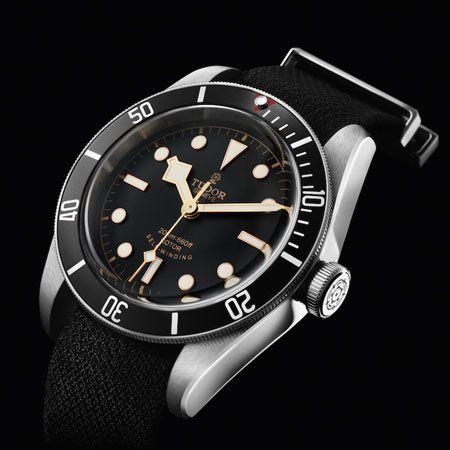
The Patek was always going to do well, but what really interested me was the result for the Tudor Heritage Black Bay (banner middle). This watch has the DNA of the original 1950s Tudor Submariner, reference 7923, and it sold for a staggering $375,000 — more than 100 times its low estimate. This is a great result for a brand that has always stood in the shadows of its big brother, Rolex.
It’s also nice for watch collectors who aren’t millionaires. The Patek is a fantastic watch, but I very much doubt I will be ever able to afford one, as even a similar non-limited version still costs a small fortune. Tudor, which has released a non-limited and very similar-looking watch to the one sold at auction, is a much more obtainable $3,500. I think it’s a great move by Tudor — it’s a really good all-rounder and well worth a look at.
So if 2015 has been about smartwatches, auction records, and worries about global slowdowns, what can we expect from 2016? My personal mission is to look for a late 1960s Omega Speedmaster with a calibre 321 movement. Given the appreciation of the Rolex Daytona in recent years, this is still a well-priced chronograph that looks as good as when it was released but is substantially cheaper (roughly $8,000 compared with $30,000 or $40,000 for the Rolex). Ultimately, the Speedmaster was the watch that went to the Moon, so you’d think there is room for future price rises.
And speaking of Rolex, I still have my eye on a late 1970s Great White Sea-Dweller, ref 1665. This is an all-time classic tool watch, but I’d expect to pay about $16,000 for a good-quality model, so I might have to keep dreaming — or sell my car.
2016 will see a continuation of refined designs. Customers will also gravitate towards brand that offer good value
More generally, January 2016 will bring us the SIHH exhibition, and I hope Vacheron Constantin will release a new Overseas Sports model. The current version is a bit long in the tooth and has never escaped the shadow of the Audemars Piguet Royal Oak Offshore, which remains unchallenged as the de facto luxury sports watch. I would love to see this release from what is a top-tier manufacturer with a proud history.
Next year will likely see a continuation of the refined designs from the industry, with more 40mm and 42mm designs and fewer of the 48mm monsters that briefly ruled the roost a few years ago. Customers will also gravitate towards brands that offer good value. Montblanc will be successful because it offers great quality at reasonable prices. Jaeger-LeCoultre should do well if its recent World Timer release — which looks as good as a Vacheron but is much cheaper — is anything to go by.
Finally, I’ve heard a lot of talk about how the Swiss CEOs should be worried about their profit forecasts for next year. However, I still take an optimistic view. There will be enough of an audience for quality products, as this region demonstrates. In 2015 we saw a great response to the inaugural Dubai Watch Week, as well as the Salon de Grandes Complications and the Christie’s auction, which featured its best selection of pieces to date. More events will follow and there is no reason to think they won’t be a success.
My point is that the industry doesn’t rely on a mass market, and there will always be people who want to own beautiful new or vintage timepieces. So roll on 2016 with everything that it brings us!
– – –
Sam Truman is a watch specialist and contributor to Esquire Middle East. You can read his ‘Confessions of a Watch Addict’ column every month.