


‘Wandering hours’ is one of the more playful phrases in a watch industry that is built on exacting, highly-technical jargon. But just because a name is playful, it doesn’t make it any less technical. Renamed ‘Starwheel’ – another fun name – by Audemars Piguet in 1991, the revered Swiss Manufacture has reignited that sense of joy by releasing its latest iteration, the Code 11:59 by Audemars Piguet Starwheel.
Reimagined in AP’s increasingly popular Code 11:59 by Audemars Piguet case, the Starwheel timepiece is a time-only watch that comes in an 18-karat white gold case with a black ceramic case middle. Made up of three disks that spin (or “wander”) across the dial, with the current hour pointing to the current minute along the 120-degree minute track at the top of the dial. Once the hour reaches the end of the track, it will spin off and the following hour will start at the beginning of the track. Clever, huh?

But first, the backstory.
The original wandering hours complication can be traced back to the 17th century when Italian clockmakers the Campani Brothers developed it for Pope Alexander XII who suffered from insomnia that was exacerbated by the ticking of his clock. Not only did the invention remove the constant ticking noise, but it introduced a novel and technically fascinating way to display time.
Unlike the much more traditional two-hands complication, wandering hours are a type of horological complication that display the time using a system of satellites that gravitate along a minute scale arranged in the form of an arc.
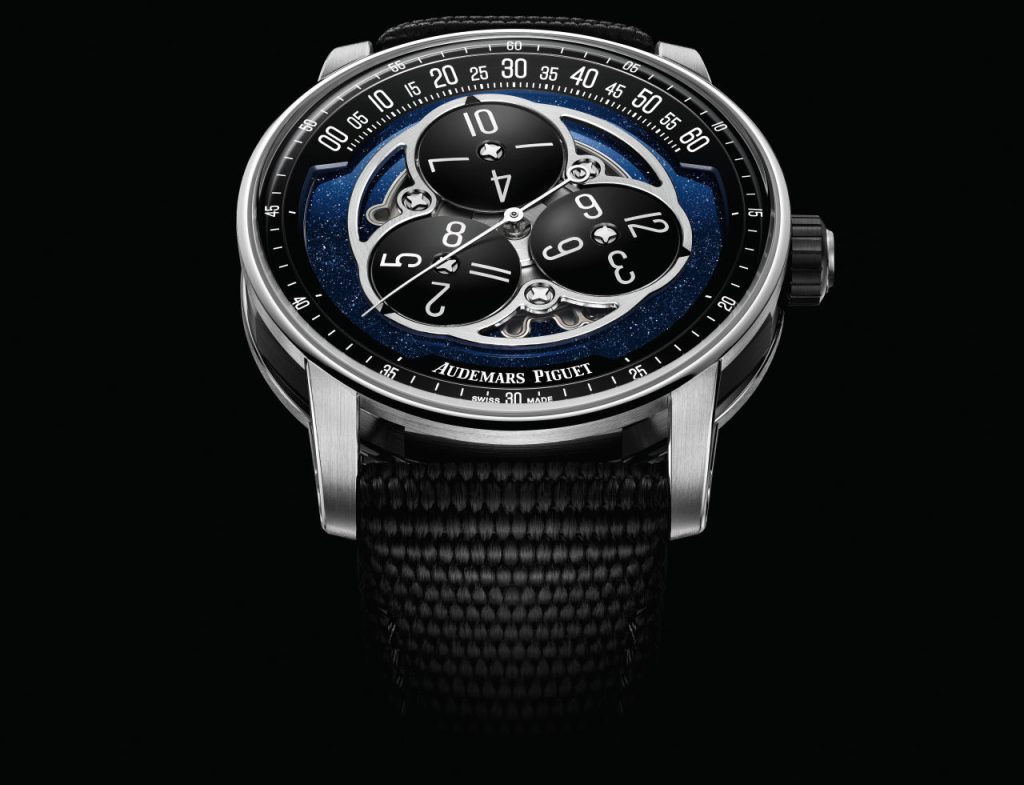
While the use of this unusual mechanism fell out of favour in the 20th century, the system was rediscovered and reintroduced by Audemars Piguet in 1991 when it introduced the Starwheel.
The original Audemars Piguet Starwheel was a dressy watch that had more in common with the brand’s ultra-thin perpetual calendar, as it was housed in a traditional 36mm case. Today, however, with it housed in the Code 11:59 by Audemars Piguet case – the ultra-contemporary case that is very much considered to be the bedrock in which the famed watchmaker’s creative future will be built upon.
This next-generation hours, minutse and seconds movement is powered by the self-winding Calibre 4310, which combines watchmaking technology, traditional know-how and refined decorations.
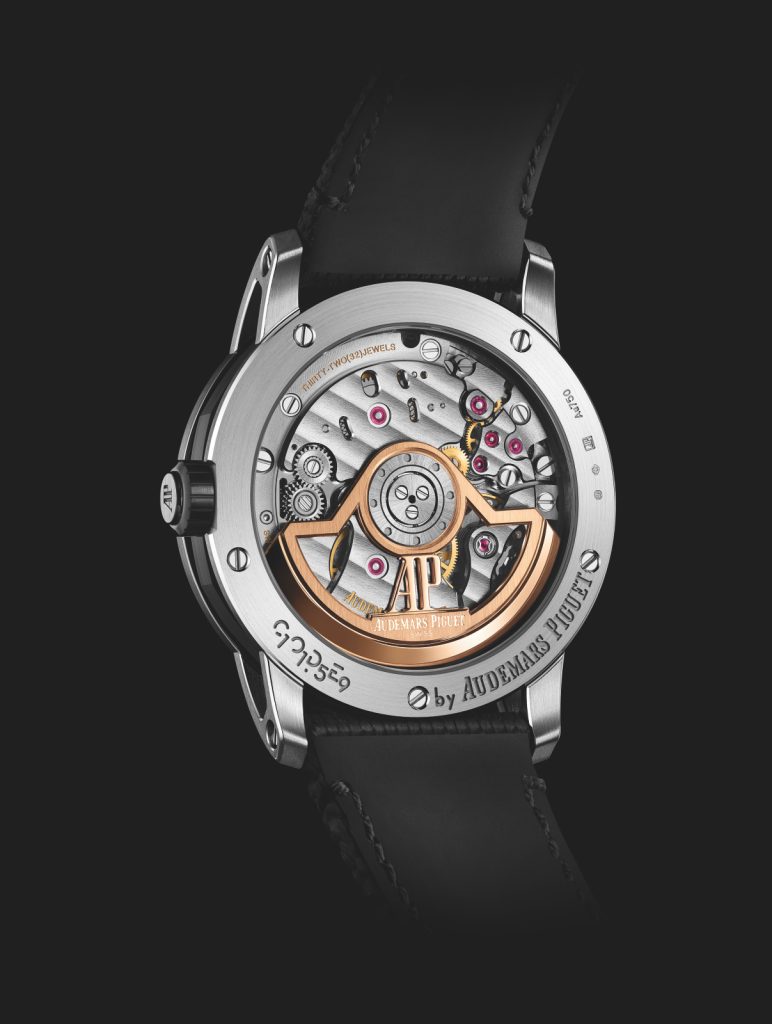
The time display is achieved thanks to a central rotor operating a complete revolution in three hours and on which are fixed three aluminium discs that turn on their own axes. Each disc has four digits from 1 to 12 that take turns in pointing to the arched sector at the top of the dial on which the minute scale is printed. The 18-carat white gold trotteuse is slightly curved at the tip to follow the relief of the discs, indicating the seconds like in a traditional timepiece. Blue aventurine serves as a shimmering backdrop for the rotating discs, like planets in the tiny universe of the dial.

But whether you use the term Starwheel or wandering hours, both are testament that even technical watchmaking can, ultimately, be fun.