
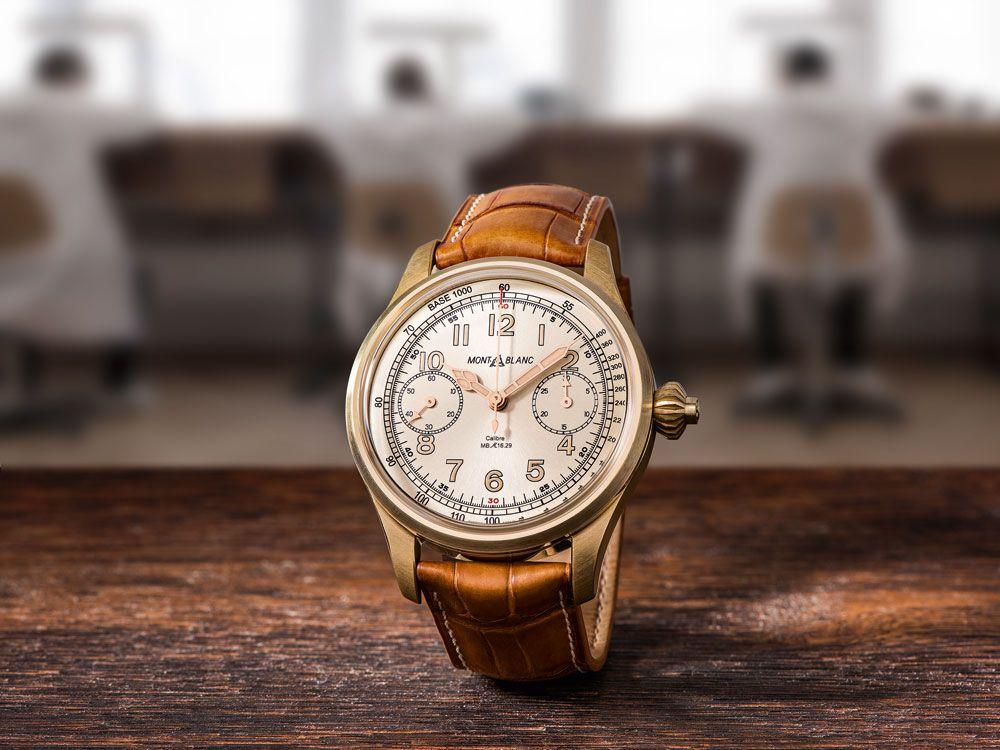

Monblanc’s watchmaking expertise goes back to 1858, the year Minerva was founded in Villeret, Switzerland. Since 2007, the brand has been exploring this heritage, finding inspiration in historical functions, mechanics and design codes. The appointment of Davide Cerrato as managing director of Montblanc International Watch Division was therefore a masterstroke. Here was a brand with a rich heritage that wanted to reboot itself for the modern age. And now it had the man who had just reinvigorated Tudor. And with this first significant collection since joining, Cerrato has laid down a very clear roadmap about where he intends to take the brand. The Montblanc 1858 Collection captures all the spirit of the past, but in a thoroughly modern way — not an easy balancing act.
The magic ingredient to Cerrato’s secret sauce for this new collection is bronze. For starters it captures the military spirit of the 1930s, thereby reinterpreting the famous Minerva military chronographs of the decade.
It also complements both the colours of the dials and the antique-style straps with its warm sheen. Close attention has been paid to creating the perfect bronze alloy that will develop its own unique patina over the years, without any of the previous drawbacks of previous versions of the alloy.
This further enriches their vintage appeal and helps set the collection apart from its rivals.
_8284742.jpg)
Esquire Middle East was invited to a pre-SIHH preview of the three new bronze pieces within the Montblanc 1858 Collection: a Montblanc 1858 Chronometer Tachymeter Limited Edition 100, a Montblanc 1858 Automatic Dual Time and a Montblanc 1858 Automatic. Afterwards, Cerrato talked us through how he was inspired by the era of transatlantic sea travel, and why he thinks these new pieces unite fine watchmaking, the best of Swiss craftsmanship and Montblanc’s own tradition.
***
Why did you go for a more vintage appeal with this collection?
We have something very unique as a brand because we have a constellation of three planets. There is Montblanc watches, which will soon be 20 years old and is mainly developed around classic elegant watches. Then we have Villaret and Minerva. In reality they are two sides of the same coin, but with aspirations that also make them separate. So what has been done by Jérôme Lambert [CEO of Montblanc since late 2013] is to place Villaret, with all its expressions of complicated high watchmaking, into Montblanc to enrich and nurture all the collections, and present new lines such as the Heritage collection. So now we are going further into the relationship between early Minerva and Montblanc. And this is going to include two very important elements. First of all, heritage and the fantastic adventures of our very unique history, which includes the development of the stopwatch and counters — something that is completely unknown to most people. This was how professional sports watches were born. So this gives you clues as to what will come from the Maison Montblanc in the future. And this is how we explore the use of bronze and the vintage aged straps. These expressions of details help us to get the full story of where we came from and where we are going in the future.
How aware are you of the need to tell this backstory when designing new watches?
To me it is absolutely primary. I’ve been called an archaeologist and I like this word a lot, because when I work with a brand the first thing I do is dig into the archives to go into the many small details of the old watches. Because that’s how you get the DNA of the brand. And this is how you get to good design.
But you don’t want to make pastiche pieces, so how do you get the balance right?
The inspiration with this collection is the military pieces of the 1930s and 1940s. You have the size, 45mm, big and robust, with simple, big dials that offer good visibility, hence our choice of luminous materials. And the domed dial you see here was developed at that time. Then you have the graphical elements. These watches are difficult to do because the simple things are the most difficult to express. You have very few elements to play with, so it’s all about the shape and the graphics that you choose. And then we went for a warm, aged leather with the strap and the colour of the dials. This is all about the match between the different elements.

Tell us more about the use of bronze…
We’ve done a lot of research to create a light material that will evolve over time. It evolves with you in terms of age and emotion and life situation, depending on the environment you place it in. It’s an alloy material that gives a more balanced patina, and also you don’t get the [usual bronze] oxidisation problems that give the green element, which is not good for the health. So you get all the advantages and none of the disadvantages of bronze. It’s a great alternative to steel, gold and titanium.
How do tastes change according to economic climate? For example, you saw men dressing better in 2009 after the crash. Does this have any bearing on what you design?
Yes, but in an indirect way. You follow what is in the air and what is working. So it is a consequence but you are working on what you sense. Maybe there is a reassurance that you get from more timeless pieces. ‘Reassurance’ is the exact right word to describe the appeal of classic looks.
Yes, you have these cycles going quicker and quicker and people seek solace in more timeless principles.

Does the value that Montblanc offers help in leaner times?
Absolutely. It is not a practical reaction to the times, but Jérôme Lambert set this as one of the key points of our whole strategy when he joined. We call it ‘disruptive value’. We want to create a unique proposition at a unique price point. So he has been quite visionary. A lot of big brands are now launching entry lines, and spinning back on their price points. Which, by the way, is not a very good indication for the consumer.
So how do you achieve credibility when you sell watches at a lower price-point? Is it because the vision was solid from the outset?
Yes. This is quite unique to Montblanc and it allows you to target different groups and gives you a little more flexibility and freedom. It is difficult to handle in terms of overall consistency, but overall it’s a great asset.