
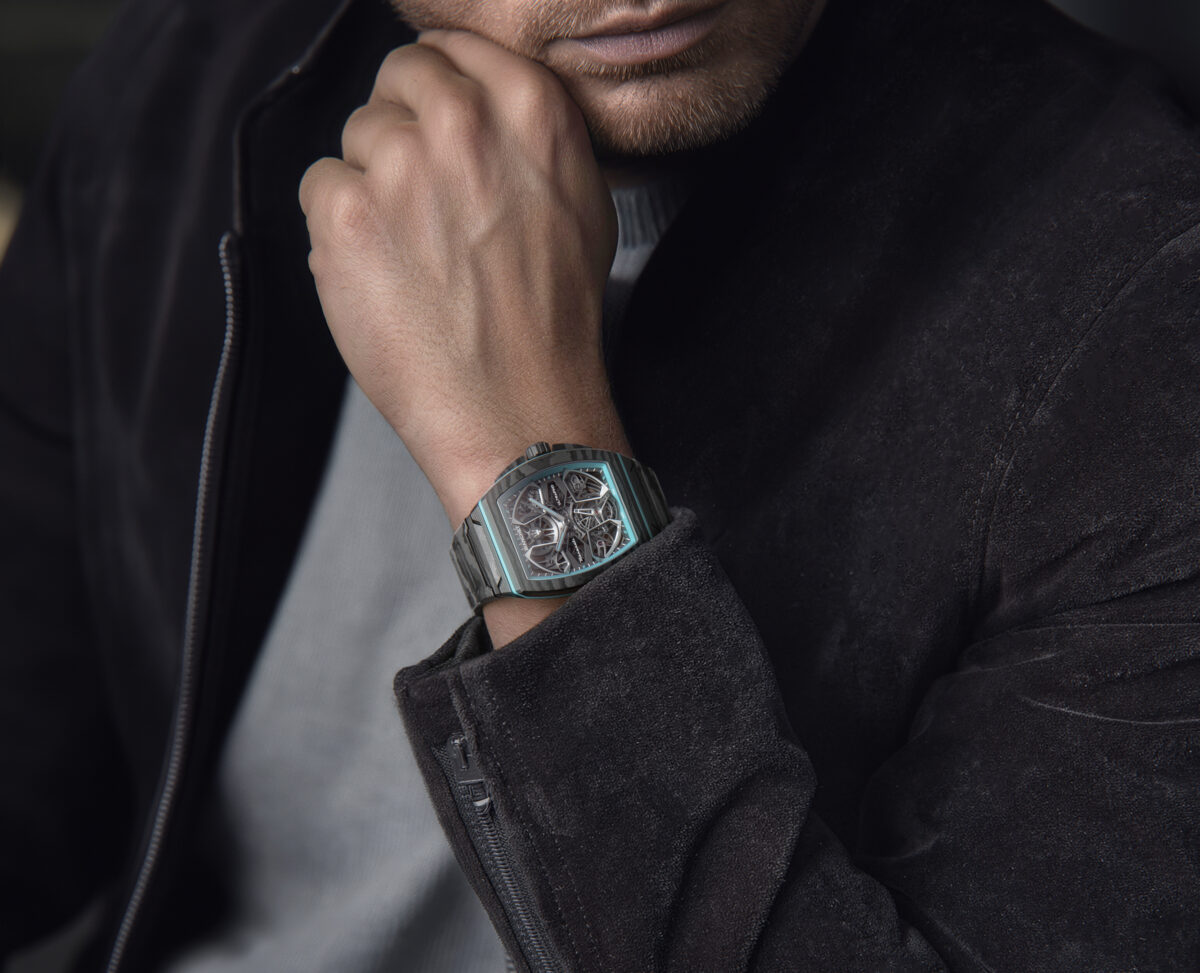

At the latest Watches and Wonders 2026, Maserati marked a milestone not with a retrospective or a concept car, but with something far smaller and arguably more intimate: a flying tourbillon watch developed alongside Swiss haute horlogerie maison Bianchet.
The occasion is the centenary of Maserati’s Trident emblem, first seen in competition on the Tipo 26 at the 1926 Targa Florio and inspired by Bologna’s Fountain of Neptune. A hundred years later, the symbol remains one of the most recognisable signatures in Italian motoring. The new UltraFino Maserati, limited to 100 individually numbered pieces, approaches that same idea from the world of watchmaking.
At first glance, Maserati and Bianchet occupy different worlds, but both are driven by the same instinct: treating engineering as an art form. Maserati has long balanced speed with elegance in its grand tourers, while the Swiss watchmaker builds its timepieces around precision, proportion and the principles of the Golden Ratio. In both cases, beauty is built into the structure, not added afterwards.
That shared mindset becomes clear in the UltraFino Maserati. The watch does not rely on the usual automotive clichés often found in car-inspired timepieces. There are no miniature steering wheels hidden in the movement, no tachometer graphics pressed awkwardly into the dial. Instead, the references are subtler and more architectural.
Its open-worked skeleton dial takes inspiration from the wheel design of the Maserati MCPURA, the brand’s latest supercar unveiled at the 2025 Goodwood Festival of Speed. The wheel’s distinctive triple split-spoke geometry forms a discreet trident motif across the face of the watch, while the exposed flying tourbillon appears suspended beneath sapphire crystal like a visible mechanical heartbeat.
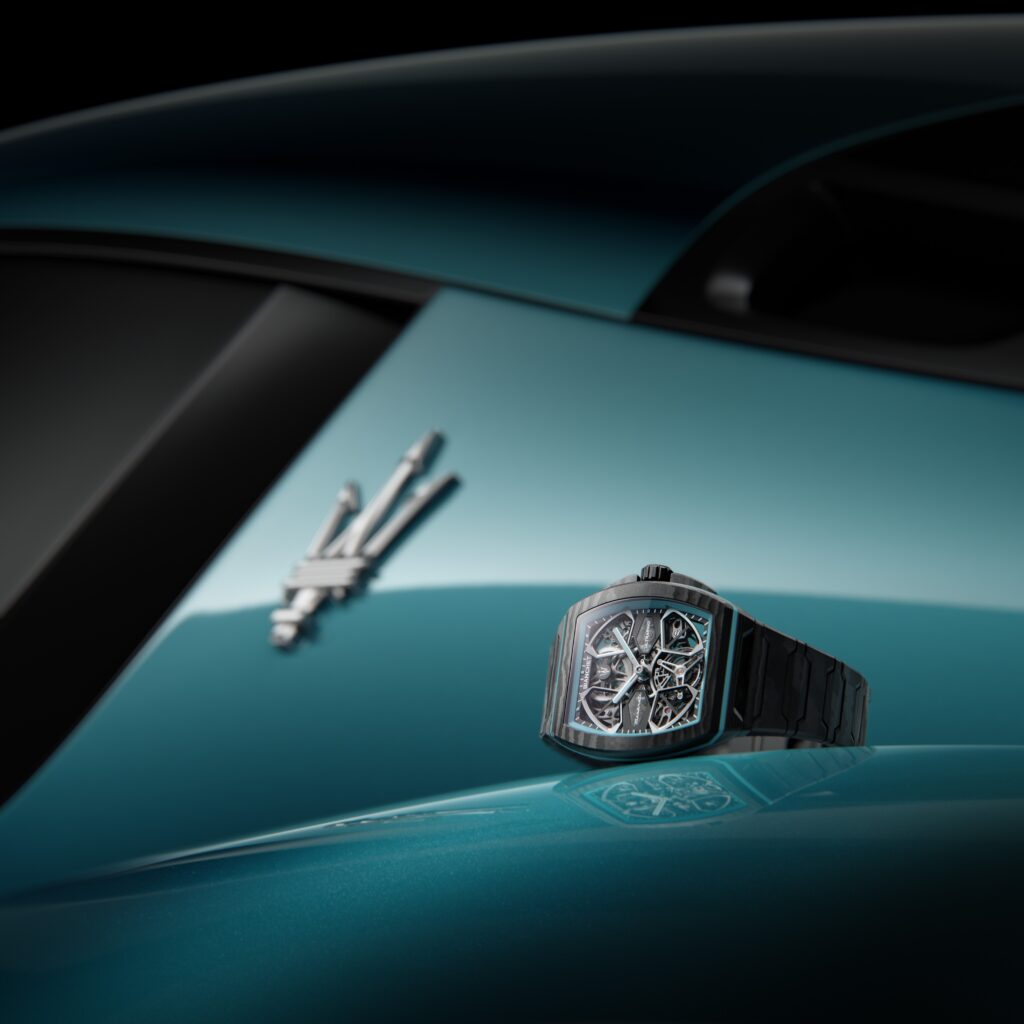
The colour treatment comes directly from the MCPURA as well. Maserati’s AI Aqua Rainbow finish — developed through the brand’s Fuoriserie Collezione Futura programme and first revealed on the car at Goodwood — appears across the dial and along the rubber detailing of the case. In changing light, the effect mirrors the shifting iridescence of the supercar’s bodywork at speed: technical without feeling cold, futuristic without losing warmth.
The parallels between the two machines extend well beyond aesthetics.
The MCPURA, built in Modena around a carbon-fibre monocoque, is powered by Maserati’s 630-horsepower twin-turbocharged 3.0-litre Nettuno V6 engine. The powertrain uses a pre-chamber combustion system with dual spark plugs derived from Formula 1 technology, allowing the car to reach 100 km/h in under 2.9 seconds. Yet what defines the MCPURA is not brute force alone. Like many of Maserati’s most compelling cars, it is engineered around balance: low weight, structural rigidity and responsiveness working together rather than competing for attention.
The UltraFino approaches watchmaking through much the same philosophy.
Inside sits Bianchet’s UT01 calibre, a hand-finished movement measuring just 3.85 mm thick. Achieving that profile required a series of unconventional engineering decisions, including a suspended mainspring barrel that removes the traditional ratchet wheel in order to recover vertical space. The movement consists of 225 components and 29 jewels, all finished by hand through sandblasting, satin-brushing, polishing and hand-bevelling across the bridges, main plate and tourbillon cage.
The flying tourbillon itself remains the visual centrepiece: open, suspended and intentionally exposed. But the more impressive achievement may be its durability.
Material choices follow the same logic. The case combines high-density carbon fibre with grade 5 titanium and vulcanised rubber, creating a watch that weighs just 36 grams without the strap. Sapphire crystal appears on both the bezel and case-back, while integrated carbon crown guards reinforce the streamlined profile. Buyers can choose between a carbon-fibre bracelet or a natural rubber strap with a titanium folding clasp.
Only 100 examples of the UltraFino Maserati will be produced, each assembled and hand-finished at Bianchet’s atelier in La Chaux-de-Fonds. The number, naturally, marks a century of the Trident.