

Few names carry the same weight of heritage and artistry as Cartier. From adorning royalty to redefining luxury with its signature panther motifs and revolutionary timepieces, Cartier is more than a jewellery maison — it’s a cultural icon. With a history spanning over 175 years, the brand has become synonymous with timeless elegance and meticulous craftsmanship. But behind the glittering facade lies a deeper mission: preserving the rare and endangered crafts that make such masterpieces possible.
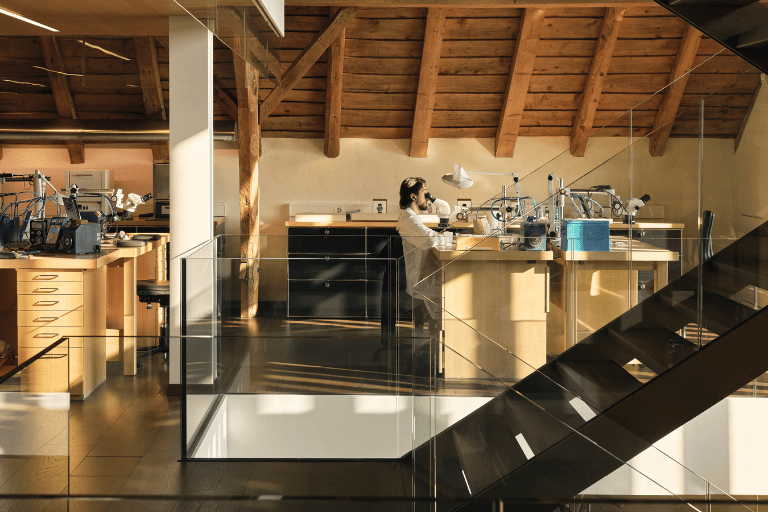
Enter the Maison des Métiers d’Art, a sanctuary for artistry, innovation, and heritage in La Chaux-de-Fonds, Switzerland. Established in 2014, this institution is Cartier’s pledge to protect, innovate, and share the savoir-faire that has defined its legacy. Here, ancient techniques meet cutting-edge technology in a symbiotic relationship that pushes the boundaries of what fine jewellery and watchmaking can achieve.
Housed in a 17th-century Bernese-style farmhouse, the Maison is a fusion of past and future. Restored with respect for its original architecture yet reimagined with modern sensibilities, the building itself mirrors Cartier’s ethos: a reverence for tradition, coupled with an unrelenting drive to innovate.

In its 1,500-square-metre space, ancestral techniques — some dating back millennia — are given new life. These methods, often passed down from master to apprentice, are at risk of extinction in today’s rapidly industrialised world. The Maison des Métiers d’Art acts as a hub of preservation, not only safeguarding these techniques but also enhancing them with modern innovations.
Take, for instance, the art of fire, which encompasses a variety of enamelling techniques. Enamelling is a delicate and laborious process, requiring a piece to be fired multiple times in a kiln at precise temperatures to achieve the desired colour and texture. Each creation is a testament to the mastery of heat and material, with techniques like cloisonné, champlevé, and plique-à-jour giving Cartier’s watches and jewellery their distinctive allure.
One example of this is the Crash Tigrée watch, a masterpiece of champlevé enamelling that combines engraved metal, vibrant enamel, and diamond settings. Its creation requires exceptional patience, precision, and over ten firings to achieve the intricate interplay of colours and textures.

Another discipline perfected at the Maison is the art of metal, including granulation and filigree. Granulation involves creating minuscule gold beads and arranging them into patterns before fusing them with heat — a technique that originated in Etruscan goldsmithing. Filigree, meanwhile, requires the fusion of gold or silver wires into delicate openwork designs, adapted by Cartier to the dimensions of watch cases and enhanced with diamonds and platinum.
Innovation is not just a by-product of tradition at the Maison des Métiers d’Art—it is an integral part of its ethos. The Maison’s research team collaborates with artisans to integrate modern technologies like 3D printing and micro-fluidics into their creations. This synergy allows for groundbreaking designs that combine technical ingenuity with timeless elegance, as seen in their jewellery watches, which marry mechanical complexity with aesthetic beauty.


Cartier’s dedication to preserving and sharing these crafts extends beyond the Maison’s walls. By partnering with local schools in Switzerland and France, the brand ensures that the next generation of artisans inherits this invaluable knowledge. The Cartier Watchmaking Institute, established in 1993, has trained countless apprentices, fostering a culture of learning and collaboration that enriches the entire industry.
The Maison des Métiers d’Art embodies Cartier’s unwavering commitment to excellence. It’s a place where history and innovation converge, where rare techniques are not only preserved but reimagined for a contemporary audience.