

It’s bizarre to think that the 2000s is already two decades ago. Born in 1989, I am an in-betweener millennial by all accounts, having experienced the ’90s, but it was in the 2000s where I lived and breathed the pop-culture. Maybe it’s denial on my part (I’m slowly creeping towards the mid-30s here), but it honestly seems like it was just a few years ago that we all had frosted tips and wore low-rise jeans. The noughties was the height of everything. And I do mean everything.
The turn of the century coincided with the start of a new millennium. There was a general panic about the then-impending Y2K computer bug that analysts cautioned could potentially disrupt operational systems on a global level (spoiler alert: there were little effects, if at all). The online search demand for Jennifer Lopez in a floral Versace gown propted the creation of Google Images as we now know it. Brad Pitt and Jennifer Aniston got married and became the power couple of the decade. Hip-hop music was brought to the fore with rappers like Nelly, Eminem and Snoop Dogg smashing the charts. There was a lot happening in just the year 2000 alone.
“Those from the TikTok generation think dressing up as if they’ve walked right off the set of Malcolm in the Middle is cool”
If the ’90s was the beginning of the obsession with pop culture, the 2000s was when pop culture truly thrived. The world seemed to revolve around celebrities, with the Internet providing even closer and almost-instant access to celebrity-driven news; at least, in relation to the decade before. What these celebrities – musicians, athletes, reality tv stars, actors and models – wore became part of the coverage that magazines and gossip blogs (of which Perez Hilton was at the top of its game) highlighted.

But that’s not saying fashion was great in the noughties. In actual fact, it wasn’t. What was very definitive of the noughties was in hindsight the very apparent bad taste that was prevalent. And it’s not something that one could easilt say of fashion in other decades such as the ’70s and ’80s. Sure, there may perhaps have been instances of questionable choices in design or styling, but there was an overall sense of elegance and a certain level of chic to the decades preceding the 2000s.
Chunky blonde highlights and spiked-up hairdos aside, nothing fit quite like it was supposed to. The whole idea was for clothes to stand out, and in some cases almost to the point of enveloping one’s frame. It was ostentatious to the point of ridiculousness but everyone seemed to be in on the joke. Denim jeans were embellished to the high heavens with studs, riddled with frayed ends and thoroughly destroyed, and were baggy to the extent that a leg could easily fit a person’s entire lower half. At times, they were paired with statement belts, each with a buckle that could rival something that Stone Cold Steve Austin or ‘The Rock’ would wear.

I, too, was a victim of that very particular aesthetic. What’s now known as the ‘French tuck’ was just a styling trick (that we’ve all used) to showcase a branded buckle – it was mostly Billabong or a thrifted studded belt bought with my teenage allowance – that was helping to hold my jeans up. The emphasis was really how bigger meant better. It felt like a collective consciousness that we had all somehow come to because everyone from Usher to Justin Timberlake to David Beckham was seen in similar combinations.
There was nothing too serious about fashion then. Nor was there a convoluted pseudo-intellectual reason why plain, white tank tops were a staple part of a man’s wardrobe. But of course, the 2000s was a time when luxury fashion wasn’t as accessible as it is now. Brands which were icons of that period included Adidas, Tommy Hilfiger, Ed Hardy, Lacoste, and a host of other mid-tier brands that one could have bought off-the-rack.
It’s interesting that luxury fashion is adopting the 2000s both in styling as well as in the marketing of late. But the thing about fashion is that it has always been more than just clothes. Fashion encapsulates a period better than any other form of record based purely on its constant and consistent change; nothing ever stays still in fashion.

As repetitive as this may sound, the past two years of living in relative uncertainty and unprecedentedly controlled settings have certainly played a role in why fashion is reviving the noughties. Nostalgia is a powerful tool and while the period wasn’t exactly all sunshine and rainbows – the 2008 financial crisis comes to mind – the bulk of the 2000s was definitely more frivolous thatn the times what we’re currently in. We’re slowly moving on to the endemic phase of Covid-19 and it seems triumphantly fitting then the devil-may-care attitude of the noughties is one that’s reflective of the hopefulness of this new chapter.
More than emotions, I can’t help but feel that it’s quite a brilliant calculated move. Those of us who have lived through the 2000s and grew up watching Friends and Sex and the City or listened to music by legends the likes of Mary J Blige and Lil’ Kim (who were both among the attendees of creative director Daniel Lee’s final show for Bottega Veneta) now have the purchasing power for luxury fashion. The idea that what we once thought was cool is coming back and being validated by brands such as Loewe, Prada and Balenciaga? It’s almost too ridiculous to believe but definitely providing us a chance to right some sartorial wrongs.
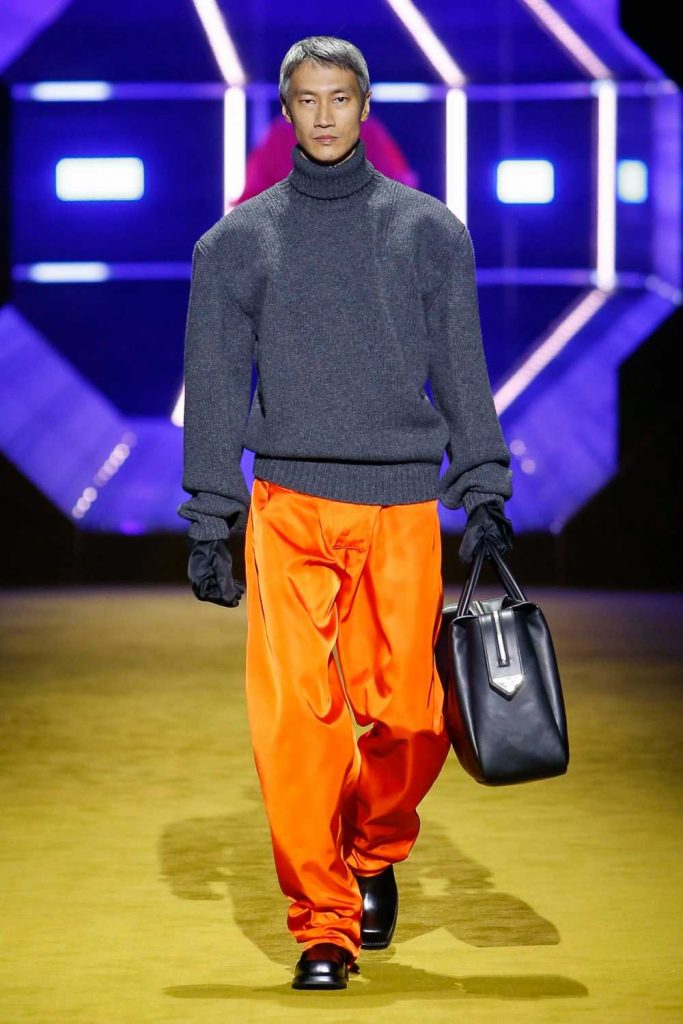
Noughties fashion is better now by leaps and bounds. Prada’s Autumn/Winter 2021 menswear show was a tour de force of oversized belted coats, done in a multitude of colours. They’re reminiscent of the ones that members of the now-defunct boyband NSYNC were seen wearing on various occasions back in the day, but better constructed, cut and designed. And of course, styled in a more timeless manner.
At Fendi, the Spring/Summer 2022 menswear collection is perhaps an allusion to the fervent bad taste of the noughties. Cropped tops and blazers make up a significant part of the collection – at times both were slashed neatly right at the same length and paired together. Then there’s also an all-denim ensemble which immediately brings to mind that decade-defining image of Justin Timberlake and Britney Spears decked out in matching denim-on-denim outfits at the 2001 American Music Awards.
If you’re still not fully convinced that the 2000s is back, look to Balenciaga’s latest campaign. Justin Bieber is one of the stars featured, and in the campaign, he looks like he could possibly pass off as a new-age Eminem, complete with destroyed denims and a too-long-to-care belt that’s anything by subtle. Would Bieber have looked completely at home back in the noughties? Yes. But is he perhaps a better version of that era? Quite possibly so.
Fashion has been a bit too serious in the past, especially while in the race to work towards being better in the sustainability and environmentally conscious aspects. But sometimes it’s nice to just be mindless. The bonus is that those from the TikTok generation think dressing up as if they’ve walked right off the set of Malcolm in the Middle is cool. And if all on Tiktok is considered cool now, I guess by default that makes us millennials cool again?