
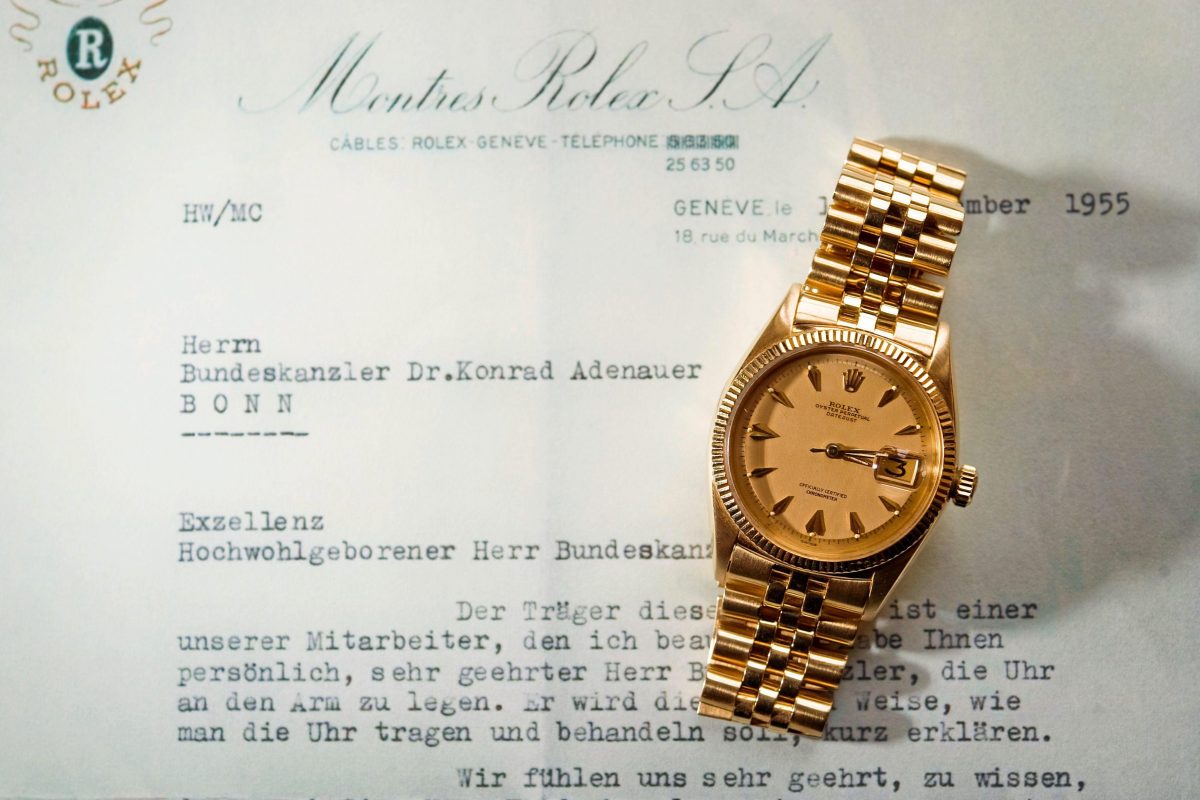

Wristwatch collecting only truly emerged as a separate auction category in the late 1970s and early ’80s. In those early days, incredible watches could be bought for modest sums of money, the legendary Daytonas were a few hundred pounds on the second hand market, with little differentiation between Paul Newmans or standard Daytonas – these vintage watches today fetch in the tens or even hundreds of thousand of dollars.
At the top end of the scale, a 1950s dual crown world time wristwatch by Patek Philippe (ref.2523) with a blue enamel dial could have set you back a few thousand dollars in the early 1980s, a watch that today should fetch over $1 million. These isolated examples show the massive growth in this market. But it is also an illustration of how important brand and quality are in the value of a vintage watch.
The Kings of the vintage wristwatch market are Patek Philippe and Rolex. Prices achieved by these brands frequently set new benchmarks at auction. Today, the million dollar watch is not such a rare beast as it once was. Indeed, in June this year, Sotheby’s sold Patek Philippe’s first split seconds chronograph wristwatch (originally sold in 1923) for a shade under $3,000,000. Other brands which frequently impress at auction include Audemars Piguet and Vacheron Constantin. Arguably it is often amongst brands such as Audemars and Vacheron that the best value can be found on the vintage scene, for these two brands are renowned for the exceptional quality of their vintage pieces, yet prices have tended to remain competitive for the buyer over the last decade.
Three important factors to consider when purchasing a vintage wristwatch are: quality, condition and rarity. Quality, of course, usually goes hand in hand with brand and the single biggest factor in determining the value of a watch will be who made it. Condition makes an enormous difference to the value of a watch – a model in poor condition can be worth perhaps 10 times less than a perfect example.
 Collectors will aggressively compete to secure the finest example of a particular model at auction. Restoration can also have a big impact on the value of a vintage wristwatch. The most significant restoration is that done to the dial and here there are different methods of restoration, from cleaning to full re-finishing and re-printing, the latter of which, especially if poorly done, can have a big impact on a watch’s value. Rarity also leads to extremes of price difference – auctions see very rare or unique examples of particular references. To illustrate the extremes of difference, whilst you may be able to secure a 1950s perpetual calendar chronograph, Ref.1518, by Patek Philippe in yellow gold under $300,000, an extremely rare variant of the model in steel could be $3,000,000.
This all makes the vintage wristwatch appear to be the preserve of a wealthy elite, but this is very far from the truth. Those with budgets from $800 to $5,000 can secure some incredible watches by top brands. Vintage Omega, Longines and Jaeger-LeCoultre, for example, offer the collector incredible value, these brands all have a rich heritage and have manufactured some extraordinary wristwatches with ‘in-house’ calibres. The same rules that govern the value of the most expensive watches can be used to help when buying more modestly priced pieces. Quality, condition and rarity are still the buzz words and collectors will still pay considerably more for the perfect example of a particular model, whatever the brand.
Venturing into the collecting world of any category, whether it be ceramics, silver or watches, should always be a cautious affair for a novice. However, there are plenty of ways to get involved. If you are near one of the major auction houses which specialise in vintage wristwatches, such as Sotheby’s, Christie’s, Bonhams or Antiquorum, it’s well worth going along to their auction viewings. The major watch auctions happen usually between March-May and October-December in Hong Kong, Geneva, New York and London. Christie’s also offer wristwatch auctions in Dubai. The viewings generally happen for a few days prior to the auctions and you can handle the watches, try them on and speak to one of the experts that will be on hand to help. Remember that watches are ‘sold as seen’ at auction so it’s always advisable to ask for a condition report which is usually prepared separately from the auction catalogue. This will generally give you a better idea of the watch’s state and should note any obvious restorations and whether the watch is currently working. If you bid for a watch at auction, you’ll also have to pay a buyer’s commission on top of the price you bid (often in the region of 25 percent). Remember that when buying from auction, watches are not sold in a serviced state and they will often require an overhaul, clean or re-sealing.
Another good buying option is to go straight to a reputable and experienced watch dealer, this route has many advantages. Respected dealers will have vetted their watches prior to sale and you will usually find that the watch has been serviced and overhauled and is offered with a guarantee. The best dealers like to build relationships with their clients and are usually only too willing to pass on information, advice and expertise. Remember that dealers will often have examined thousands or even tens of thousands of watches during their careers and that experience is invaluable.
Today the internet gives access to a plethora of specialist watch auctions and dealers, many of whom will offer sales online. The most important consideration when buying online is the reputation of the vendor and their returns policy. Many buyers also prefer to buy from an online seller who has a ‘physical’ shop presence, since you have the reassurance that the vendor is an established business. Bear in mind that auction houses, as previously mentioned, usually only sell ‘as viewed’ and will not accept returns unless the item is proven to be a fake, however, reputable dealers will usually offer a returns policy within a specified period so, if you purchase online, you’ll have a time frame in which to return the watch. Many dealers will also offer you a guarantee as previously mentioned, which will allow you to return a faulty watch, within a specified period, for repair. They will also usually offer ongoing support, even outside any guarantee period, in the form of future servicing and overhauling of watches that have been bought from them.
One final interesting buying option is via one of the established Watch Fairs, amongst the best is the Miami Beach Antique Show (January 30-February 3, 2015) which usually sees a gathering of some of the world’s most prominent dealers.
Investing in watches takes time, patience and expertise but it can be immensely rewarding and enjoyable. There are only a finite number of vintage watches out there, so, as the market grows and more people take an interest and start to collect, expectations are that values should rise. However, as with any investment, watches that rise in value can also fall. A style that is popular today may not be so in 10 years time. However, watches are one of those rare vintage objects, an item that can be worn and enjoyed every day. For this reason, the prime motivation of most collectors is the enjoyment of the timepiece, investment should always come secondary; however, buy wisely and the chances of appreciation in value are good.
The Essentials – The contacts book of a serious watch collector
Specialist vintage watch dealers
blackbough.co.uk
daviddugganwatches.co.uk
onbehalf.jp
alessandrociani.com
matthewbaininc.com
Auctions
sothebys.com christies.com
bonhams.com antiquorum.com
Recommended watch fair
Miami Beach Antique Show: originalmiamibeachantiqueshow.com
Recommended blog
hodinkee.com
Suggested book
Kahlert, Mühe, Brunner: Wristwatches History of a Century’s Development, Schiffer Publishing
Alex Barter has been in the vintage watch market for almost two decades. Formerly the head of Sotheby’s Watch department in both London and Geneva, he now co-owns Black Bough, a shop based in the UK, specialising in the sale of vintage wristwatches. He also acts as a consultant to Sotheby’s and a number of other art organisations.