
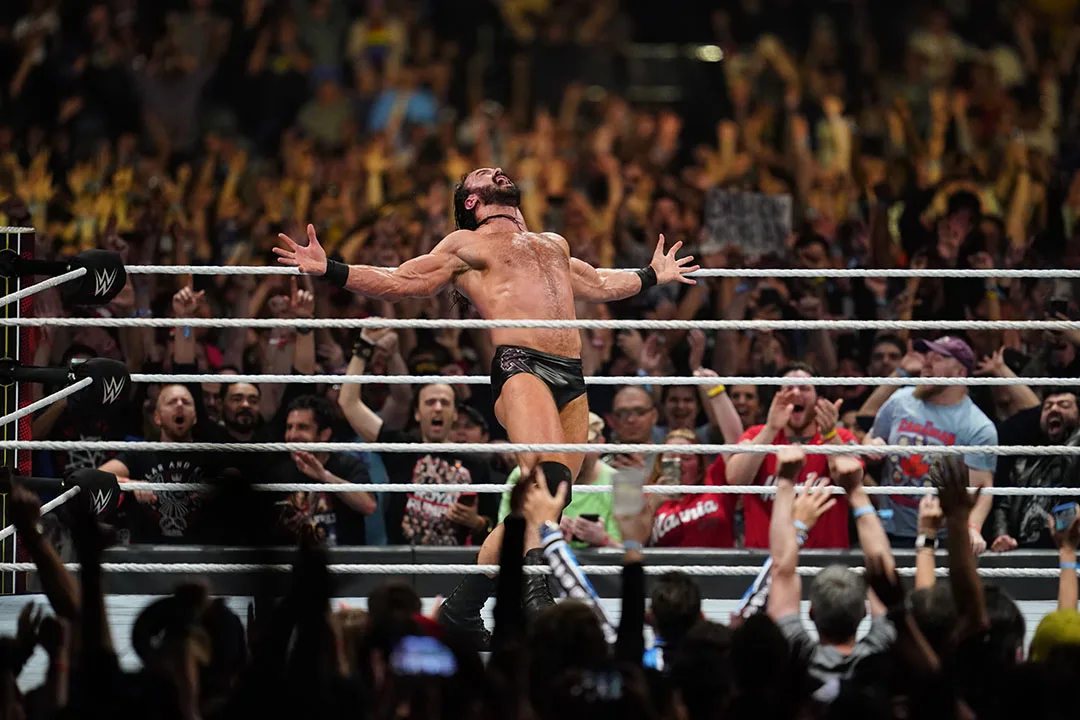

It is easy to be cynical about professional wrestling. You can sit there, arms folded, muttering about how the punches don’t connect and the outcomes are predetermined. But asking if the Royal Rumble is “fake” is like asking if Timothée Chalamet really is a great tabletennis player. You aren’t here for a documentary; you are here for the entertainment. And, boy, are you entertained.
And this year, the opera has a new stage. For the first time in its 39-year history, the WWE’s most chaotic creation, the ‘Royal Rumble’ Premium Live Event (PLE), has left North America, landing in the gleaming amphitheater of Riyadh’s King Abdullah Financial District (KAFD) on January 31, 2026.
The significance of the venue change may seem by-the-by to casual fans watching Live on Netflix – but as one of WWE’s flagship PLEs, the exporting of this globally televised event to the Saudi capital is a statement of intent. Surrounded by glass skyscrapers and desert air, the stakes feel less like a carnival and more like a corporate takeover.
But before the business and the brawllin’, let’s establish the context. Since it started in 1988, the annual Royal Rumble has been one of pro-wrestling’s most recognisable events. While the undercard is filled with end points to World Championship bouts and other end points to other fueds in its continuous storytelling arcs – the mainevent is undoubtably the men’s and women’s Royal Rumble matches.
The premise of the match is deceptively simple: two competitors start. Every 90 seconds, a new entrant joins the fray until 30 souls are fighting to be the last person standing. Elimination occurs only when a competitor is thrown over the top rope and both feet hit the floor.
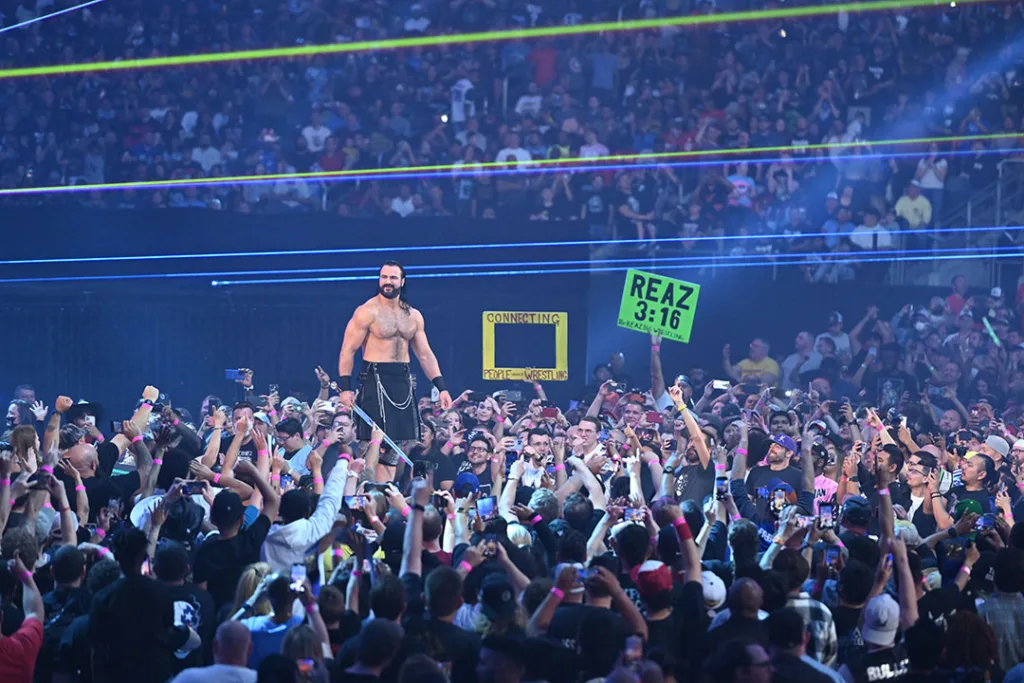
Current WWE Undisputed Heavyweight Champion Drew McIntyre, a man who has conquered this very mountain, argues that this simplicity is exactly where the magic lies. “The Royal Rumble is special because the format is unique,” McIntyre tells us. “Growing up I remember being such a big fan and the Rumble was my favourite event of the year, because you just never know what’s going to happen, and you’re constantly getting that new excitment hit to see which wrestler is going to come out next.”
Knowing how to build the drama and tell stories that feed the excitment level of the audience is central to what makes the WWE a $10 billion global sports entertainment juggernaught.
The Royal Rumble matches are an perfect example of how to create spectacle, and a narrative engine through athletic theatrics. It is the only sporting event where your best friend is your enemy; where alliances forged in minute four are shattered by minute ten; and every 90 seconds you are guaranteed that something noteworthy will happen.
The Geopolitics of Spandex
To understand why this event matters, you have to look past the ring and into the boardroom. For decades, the WWE’s “Big Four” events—WrestleMania, SummerSlam, Survivor Series, and the Royal Rumble—were the exclusive property of North America. They were domestic rituals in the company’s primary audience base.
That era is over. Under the ownership of TKO Group Holdings, the strategy has shifted from “touring the US” to “auctioning global moments”. The logic is simple: cities like London, Paris, and now Riyadh don’t just host these events; they bid for them, much like cities bid for the Olympics or the Super Bowl.
Hosting the Royal Rumble PLE in Riyadh is the first major piece of this strategy. It signals that TKO views sports entertainment not as an American export, but as a borderless, high-margin asset class. By planting its flag in the KAFD, it is telling the market that the “Road to WrestleMania” (the WWE’s biggest annual showpiece) no longer starts in Florida or Texas—it starts wherever the highest bidder builds the biggest stage.
Over the past five years, the WWE has doubled down its growing international reach, building its frequent international tours into part of the company’s weekly live television shows – RAW and Smackdown. The waters of hosting ‘special’ PLEs overseas were tested with events in Australia, UK, France, Puerto Rico, and both Riyadh and Jeddah – but not since SummerSlam 1992 in London has one of the ‘Big Four’ been left North America.
“As I am the first (and only) British WWE World Champion, I have been pushing for more events being hosted ‘overseas’ for a long time,” says McIntyre. According to McIntyre, the business reasoning was often that due to the time difference, the majority of the WWE’s audience in the US wouldn’t be able to tune in and watch.
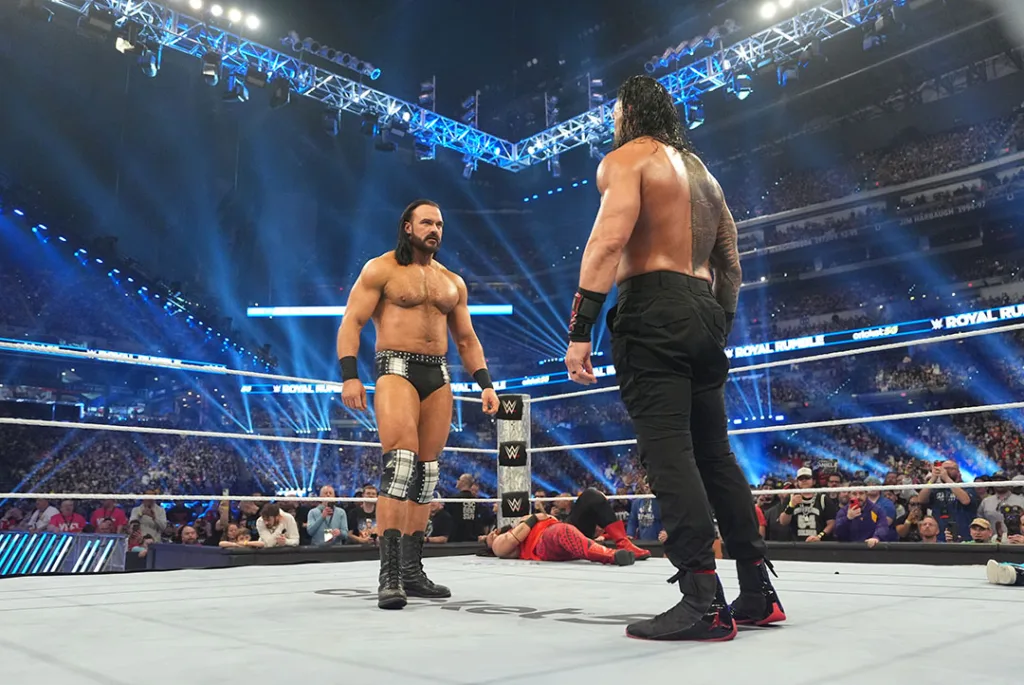
“Then around 2018 we had a show in Melbourne, selling out a massive stadium. I remember saying ‘Come on! You always gave me the excuse about the time difference. There’s no bigger time difference in Australia! People everywhere want to experience this. We got to make this thing happen!'”
McIntyre would eventually be proved right, in 2022, when 55,000 people sold out a stadium in Cardiff, Wales, to see him headline (and lose) against Roman Reigns – the WWE’s biggest marquee talent, and at the time, the Undisputed World Champion.
Four years on, Drew McIntyre is the one now holding that Championship. Roman Reigns? Well, he has officially declared his entrance into this year’s men’s Royal Rumble.
The Cast of Characters
If the Royal Rumble is a play, the casting director follows a strict, time-honored formula. To the untrained eye, the ring is a blur of limbs, but for the performers inside the ropes, it is a high-wire act of improvisation.
“It is always such a buzz when participating in it,” McIntyre explains. “So much of it is made up on the fly, so you get butterflies when you come in and the fans are going nuts, and you survey the situation of who’s already in there. You have to be aware of when your spot is to shine and when it is time for others to get the spotlight.”
While the faces change, the roles remain eternal. The drama usually pivots around some classic architypes. The Iron Man – this is the unlucky soul who draws an early entry number (normally one or two). Their job is not necessarily to win, but to suffer. As fresh opponents sprint down the ramp every 90 seconds, the Iron Man simply endures.
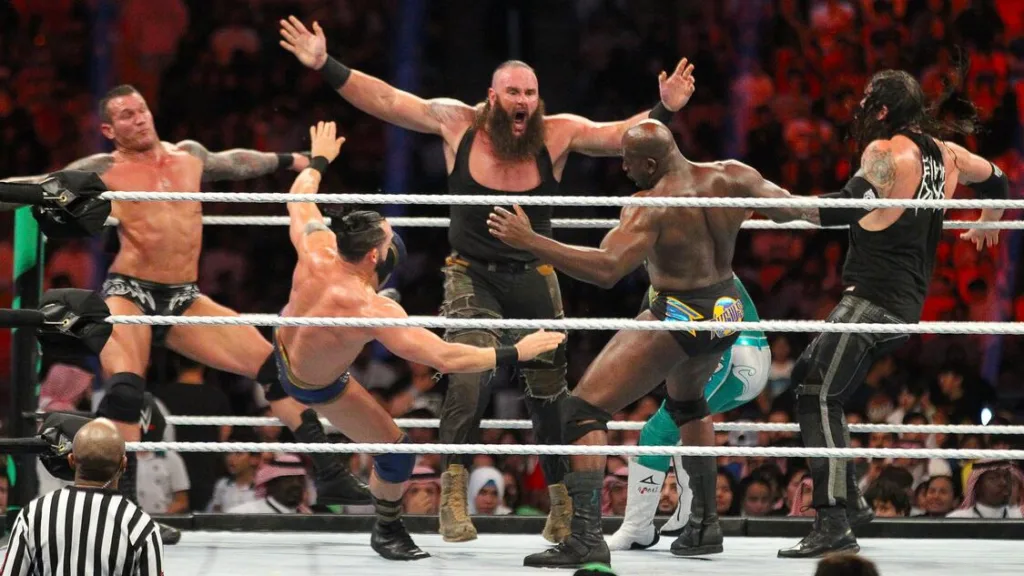
Inevitably, the texture of the match changes with the arrival of The Kaiju (The Monster). Whether it’s a returning legend or one of a number of enormous wrestlers on the roster (eg. Brock Lesnar, or the 7’3″ Nigerian giant Omos) this archetype serves a specific purpose: to clean the slate. The ring, previously cluttered with ten wrestlers grappling in gridlock, is suddenly cleared as bodies fly over the top rope like ragdolls.
It creates a fascinating, fleeting moment of realpolitik where enemies must briefly unionize to lift the giant out of the ring. McIntyre himself was the beneficiary of this exact mechanic during his own victorious run.
“The year I won, the storyline of that Rumble was Brock Lesnar went in as WWE Champion and said he was going to run through everyone and win it,” McIntyre recalls. “He was on a tear and threw out 13 people, so we needed someone to step up and beat him – that man was me.”
McIntyre’s experience highlights the narrative power of the Rumble. He admits that when he walked out, he wasn’t in a storyline that screamed ‘winner.’ “But when I came out, and something felt different… the way Brock reacted to me made me a star.”
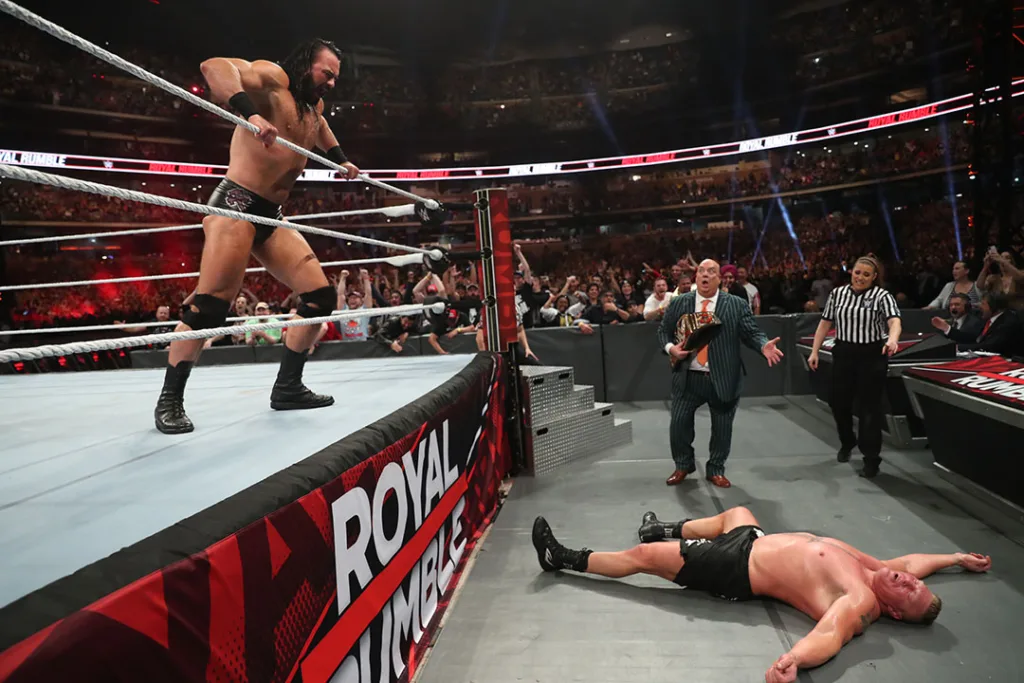
But the production team’s sharpest weapon remains The Ghost (The Surprise Return). Because the entrants are kept secret, the Rumble is the only time WWE can effectively weaponize nostalgia. This is the “Pop”—the deafening roar of recognition that will shake the glass of the KAFD arena. “It is also super interesting to hear the reaction from the crowd when I interact with certain people,” says McIntyre. It is a dopamine hit of pure surprise.
The Point of No Return
If the first 59 minutes are chaos—a blur of bodies and countdown clocks—the final minute is pure clarity. Eventually, the herd thins. We are left with two men. The noise in the Riyadh arena will shift from the roar of surprise to a hum of anticipation.
The prize they are fighting for is arguably the most valuable contract in sports entertainment: a guaranteed main event match at WrestleMania. In football terms, it’s like winning a semi-final that books your ticket to the Super Bowl.
For the athletes, the victory is life-altering. “To win the Royal Rumble when I did was just unbelievable,” McIntyre reflects. “It took my career to an new level, and legitimised me as one of the company’s top guys – all in one night.”
When the last opponent finally tumbles over the top rope in Riyadh, the music hits, but the ritual isn’t over. The winner will climb the turnbuckle, look up into the rafters, and point. Hanging high above the crowd is a massive neon sign reading WrestleMania.
As the victor points a finger at it, pyrotechnics will explode from the roof of the KAFD arena. It is theatrical, absolutely. But as the fireworks fade over the Riyadh skyline, the message is clear: The prologue is over, but with the announcment that in 2027, the WWE will return to Riyadh with for its flagship event, WrestleMania 42, the real story has just begun.