
‘La Doyenne’, or Liège–Bastogne–Liège as its officially called, was first held in 1892, and is considered the most demanding as well as the oldest of the five European one-day road cycling races. This is chiefly because of the 258km route, which grinds through Belgium’s Ardennes region.
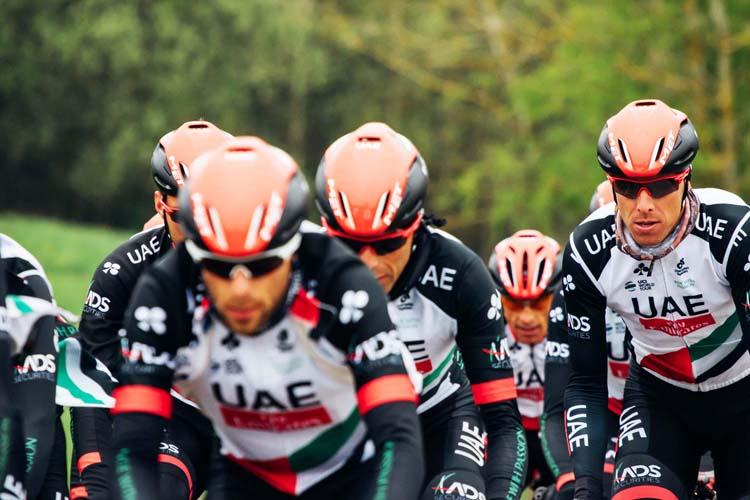
The top riders of the Union Cycliste Internationale (UCI) World Tour competition are all present, but I’m here to follow UAE Team Emirates. Cycling has gathered in popularity since the additions of the Dubai Tour in 2014 and the Tour of Abu Dhabi in 2015 to the UCI Asia Tour. And last year a naming rights deal was struck to turn the 25-year-old Lampre-Merida cycling team into Team UAE Emirates, which took effect this February.
The most animated member of UAE Team Emirates is promoter Mauro Gianetti, a Swiss legend who won this race and the Amstel Gold Race back in 1995 and represented his country in the 2000 Olympics. Gianetti helped broker Emirates coming on-board as a title sponsor along with another cycling legend, Giuseppe Saronni, the team’s general manager. Carlo Saronni, son of Giuseppe, is team manager while Andrea Agostini is responsible for all things media. I’m ready to see what they can do.
Training Day
Up bright and early shortly after 6am, I can taste the cold, crisp Belgian air. The UAE Team Emirates HQ for the next three days is the Hotel Limburgia, in Kaane, a five-minute walk from the Dutch-Belgian border and a 20 minute drive from Liège. I walk down the stairs to hear distant yet loud laughter echoes from the breakfast room. Eight of the Italian-dominated team’s 26 riders are here at LBL. Cycling is a team sport, there is a strategy behind the race, and each rider has a very particular duty to carry out. Some are strong climbers, some are good road racers, while others excel at sprints. In the end they form part of the buffer around the ‘protected riders’; in this case, Rui Costa and Louis Meintjes, who they hope will win the race.
After breakfast, we make our way to the two humongous team buses. One is of the rock star variety, with a TV, lounge area, shower and coffee machine that would give the Starbucks a run for its money. As Agostini explains, “You can’t have a bus full of Italians and no espresso”. I’m given a tour of the second coach by Gianetti, which has a kitchen with a huge fridge full of Parma ham. “The riders need to restore their energy,” says Gianetti. “They often eat a bowl of pasta with ham and parmesan that they’ve brought in from Italy.
The back of this coach contains about 50 bikes of the highest quality, costing around Dhs45,000 each and weighing only a fraction more than the 6.5kg minimum regulation. Gianetti tells me that some teams end up placing metal weights just below the saddle to pass muster.
The convoy is completed by two SUVs, the command centres of the race, which are equipped with team radios, GPS and an array of gadgets. The team’s sports director, his deputies, the masseuse and medical team ride in these cars, forming part of the flotilla of vehicles that chase the riders throughout the race.
We settle in our VW transporter and follow the team bus. Saronni tells me how, for the riders, this first day is about warming up their legs and familiarising themselves with the course. The hard work in training has already been done and so this is more like F1 drivers getting used to the track on qualifying day.
Belgium has always been of immense interest to me, mainly because it’s the birth place of the most famous and brilliant detective in all the world, Agatha Christie’s Hercule Poirot. It wasn’t enough, however, to make me want to stop and explore it on one of the many trips I had driven through as part of the London-to-Amsterdam route during my university days. As I see more of the countryside now, I begin to realise what a mistake that had been. The landscape is as green as the colour could get and continues as far as the eye can see.
We park the convoy in a layby, where several other team busses have also stopped. The riders decamp from the vehicles, claim their bicycles and then start the 40km track that will take them through some if the toughest climbs, the sharpest bends and the fastest descents they will have to race along tomorrow. We follow the team through spectacular Belgian countryside, where diehard fans have lined up the roads to catch a glimpse of the riders . Here I start to comprehend what a huge sport this is, given the reception this dry run receives. I’m impressed to see these endurance athletes laughing and chatting away to each other on a day that is considered ‘light training’ for them, but for us civilians would be an epic day of cycling.
After the session we head off to have lunch near Liège with the team. As we pull up to the restaurant a cluster of fans is swelling in the car park, ready to ask for photos with the riders and autographs. It’s an indicator of just what this sport means to Belgium, and Carlo Saronni further illustrates this point, telling me that a Belgian farmer was so keen for the riders to go past his farm he re-cobbled the nearby narrow streets to facilitate just that.
When lunch is over I ride back on the team bus to interview the team members. All are excited about Emirates coming on as a title sponsor and explain how big a deal this is for the team. Previously they were athletes on contracts who just got on with the race. Now, with the endowment of cash and carrying the UAE flag on their uniform, a different kind of pride, responsibility and pressure has come into the equation. I’m assured it’s the kind of pressure athletes like. As riders they want to do better, and UAE Team Emirates has changed a UCI riding team into a global brand and de facto national team. They all have their goals: for instance Rui Costa wants to win the Tour de France, and he also tells me the Emirati rider in the team, Yousif Mirza, is a real talent with outstanding potential.
Race Day
As I enter the breakfast room, the energy of the previous day has given way to an eerie silence. Word has filtered through that Italian cyclist Michele Scarponi died while training near his home in central Italy. He was hit by a van. Scarponi had won the Giro d’Italia in 2011, and was a close friend to many in the team. The news has hit Diego Ulissi the hardest because Scarponi had been his mentor for many years. Nevertheless, when I asked Gianetti about the impact this is likely to have on the team, he is very clear: “They are professional athletes and they’ll do their job.”
After a 40-minute drive following the team bus we arrive at Liège, a typical central European city that sits close to Belgium’s Dutch and German borders. Here, in Place Saint-Lambert, the square is filled with spectators of all ages. By now UAE Team Emirates riders are in full concentration, despite the hundreds of fans crowding round the team bus. While they head to the sign-in ceremony the UCI officials weigh and conduct all sorts of tests on the bikes.
We leave the square 15 minutes before the official start time to follow the 10km warmup. The swarming peloton appears, the bicycles separated by a matter of inches, and a huge flotilla of team 4×4 vehicles trails the riders as they head into the countryside. Gianetti has the official radio and he keeps us up to date with what’s happening over the next four and a half hours.
Eventually we catch them at the feeding zone. The riders have completed 183 km, riding at averaging speeds of 35-40kph. It’s at this point that Oliviero Troia stops and dismounts. This is a team sport and he’s done his job guiding the protected rider so now he can relax.
Later on, 40 minutes from the end, we arrive at the team bus. Agostini, Saronni and Gianetti are watching the last stage intently, sipping on espressos. As the riders come through the last bend we’ll run to the finish line to see Alejandro Velverde comes in first, with our boy Rui Costa only 10 seconds behind him but with 12 riders separating them. Having hoped to be in the top ten, the disappointment in Gianetti’s face is obvious.
After the race, everything is very methodical. The riders head to the team bus, though they can’tdisappear without signing autographs, even after spending over six hours riding the 258km course. Back at the bus the nutritionist cooks up a carb-heavy pasta with parmesan as the pit crew get on with washing the bikes.
In response to the crowd still gathered outside, the UAE Team Emirates riders come out to meet the public. I hear a fan ask Louis Meinjtes how he’s doing, to which Meinjtes quite rightly replies, “I’m dead!”. Rui Costa is given some Portuguese delicacies by some compatriots and Manuele Mori chats to admirers. I ask Costa about Alejandro Valverde’s victory, and he replies that the Spaniard has been doing similar day races this season so he’s not surprised about the win, his fourth LBL overall.
The boys head to Milan straight after the race, where the rodeo continues. It’s time for me to head back to Brussels to catch my flight.