
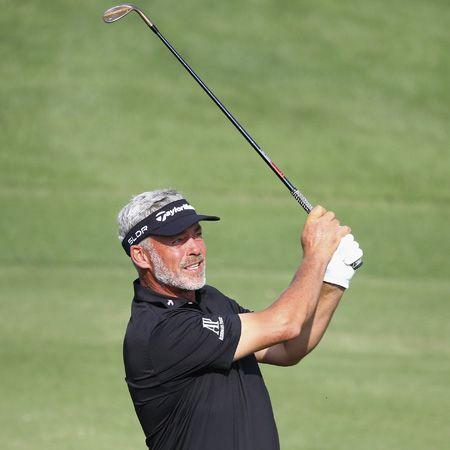

Darren Clarke has never looked better. Clad in all black, silver hair quiffed back over the forehead and with a Clooney-esque smile, he laughs and jokes his way through some driving drills on the practice ground of the Els Club in Dubai’s Sport City. The 2011 Open champion has good reason to exude confidence. His famed fitness regimen, which he began in late 2013, has helped him lose 28.5 kilogrammes and reduce his waistline from 42 inches to a positively teenage 32, and he is hoping it can ensure a successful turn to the European Tour after a brief sojourn in America.
Then, of course, there is all the talk of his impending appointment to the captaincy of Europe’s 2016 Ryder Cup team, a decision that will be taken “early in 2015″ – after he returns to the region for the Dubai Desert Classic. He is the clear favourite, with the likes of Rory McIlroy and Ian Poulter backing his candidacy.
Although he’s now 46, there’s little to suggest that the Northern Irishman’s best years in the sport aren’t still ahead of him.
We have to begin with the Ryder Cup captaincy. You would love to do it, right?
Well, it’s not a position that you lobby for. That’s just not the way it works. It’s up to the panel to decide who they think is the best man for the job and if that’s me, then that would be fantastic and that would be a great honour, no doubt about it. If you’ve had a career which has been predominantly in the European Tour, and I’m proud to be a member of the European Tour, then it will be an honour to be asked to captain the European team at the Ryder Cup. It would be wonderful. If it’s not me, then I will be delighted for whoever gets it and wish them all the best. But it’s the committee who will make the call.
You’ve played in five Ryder Cups, winning in four of them. What makes a good Ryder Cup captain? How much does a good skipper mean to a team? Is it two points, four… any?
I honestly couldn’t answer that question. I really don’t know. What I would say is, whoever the next captain is, if he doesn’t immediately go to Paul McGinley and ask what he did at Gleneagles, he’d be very foolish. His man-management was absolutely fantastic, and he was clearly very close to the players. But he also had very clear ideas about what he wanted to do and how he wanted to do it, and he did it brilliantly.
Do you think a rapport with the players is perhaps the most important attribute? Someone like Nick Faldo, a brilliant individual player but not necessarily someone with a reputation for camaraderie, seemed to struggle in 2008.
I wasn’t a part of either Paul or Nick’s team, so it’s difficult to know for sure, but I saw the rapport that Paul had with his players and it seemed stronger. You take a look at Faldo and what he did in his career: as a golfer, his record can be matched by very few people in the game. The way he was able to achieve his success was by being an inward sort of a guy. Was he aloof? Maybe to a degree. Was that at a detriment to his ability communicate with other players? Possibly. Ultimately, though, it all depends on the players in the group, and maybe a Nick-type character can come in and win, but it seems that Paul’s way had results this time around.
Sticking with captaincy issues, what was your take on the Mickelson-Watson spat? It all seemed a bit unseemly and, in terms of the timing, unnecessary.
It’s difficult to comment on that as I wasn’t there. What I would say is that I think the European way has always been to say what they want to say behind closed doors. On the other side, I can’t really fault Phil for speaking his mind because it shows how much it means to him. The Americans have been accused in the past of not caring about the Ryder Cup, but that’s never been true and this shows it. He spoke out because he was fed up with losing again. He was clearly p****ed off and Phil does usually have an opinion.
You’ve been a pro for over 20 years now. How has the Ryder Cup evolved in terms of its importance to players on the tour in that time?
The Ryder Cup is unique. It only comes around once every two years and it’s the one time our sport becomes a team game. It’s very passionate and special week and I’ve been privileged enough to play in five of them. The bonds you make with those players will last forever. It’s very special. What we do the other year and 51-weeks, though, is complete as individuals and players, rightly or wrongly, players are judged by the majors. That’s the sport. You ask a golf fan how many majors Jack Nicklaus won and they’ll say 18. Ask how many Ryder Cup points he has? No one is going to be able to tell you.
We all want to play the Ryder Cup, of course we do. Would my career have been anything like as special without the Ryder Cup? No. But the Claret Jug, the fact that I’m a major winner, that’s how my career will be remembered.
The Open Championship was obviously a career high point. But you won it at 42, which is usually the top age range of major champions. Having finally got one, did it affect your motivation or approach to the game?
It’s an interesting question. If I’d have won it in my twenties, I might have thought, right, I want another four of five of those. But at 42, the main thought was, ‘what’s my goal now?’ It’s honestly all I ever wanted to do. When I was a kid, hitting balls in Dungannon, hitting chips under a tree, everything in my head was: ‘And this is for the Open Championship!’ For me, it’s the biggest and best tournament in the world bar none. I always hoped I’d be able to win one, I always thought I had the talent to win one, but until you get over the line and do it, you’ll always ask the question of yourself.
I was lucky enough to do it, and be able to walk up the last with a three-shot lead! But it actually made me try even harder. I tried to prove to myself that I deserved to win The Open – and the harder I tried, the more I struggled. But my name is on the Claret Jug and no one can take that away from me. There are, dare I say it, better players than me that have never won it, or won any major.
“Would my career have been anything like as special without the Ryder Cup? No. But the Claret Jug, the fact that I’m a major winner, that’s how my career will be remembered”
And at least you avoid the question now: Will you ever win a major? It followed Montgomerie around and is now attached to Lee Westwood like a shadow…
I know. Poor Lee. I really hope he wins one – and his career deserves one, maybe more than one. He certainly has the talent. Whether things go his way or not is another thing and with a bit more luck, he could be on two or three already. But that’s professional sport. Quite often you don’t get what you deserve.
What are the immediate plans and goals on the playing front now?
Well, I’m going back to the European Tour for 2015. I have resigned from the PGA Tour because, if I didn’t, I’d be required to play a minimum 15 tournaments over there and I really didn’t want to do that again. I’m exempt from qualifying until 2016 because of the Open win, so I can rejoin then if I choose to. But I miss my kids. Tyrone is 16 and Conor 14. Pretty soon they’ll be off to college and then off for good, so it’s important for me to spend time with them.
So, what phase of your career are you in now? Does the world “retirement” crop up, or perhaps “semi-retirement”?
The bottom line is, I love golf. I love the game. For a professional player, golf does have an element of love-hate, depending on how we’ll you’re playing, but I still want to play. At 46, I’m also exempt from the Seniors Tour in the States. In a couple of years’ time, Tyrone will be off to college, and the ideal scenario would be both boys studying in the US and me on the Seniors Tour.
Have either of the boys got their sights on making a living in the game too?
They might, they might not. They’ve both got talent, there’s no doubt. But I would hope they would be good enough to get a college scholarship. Now, whether I want them to be golfers is another thing. Contrary to what a lot of people might think, professional golf is a very hard job! We’re lucky to be doing it, and we get to travel around the world and we get looked after, but it is every week now. It’s packing, unpacking, flying here and there, and also the standards are so high now – and getting higher and higher. So, it’s a tough sport to break into now.
Finally, we have to talk about the famed fitness regimen. What was the motivation?
It was after the Dunhill Championship in Scotland in 2013. I’d played well all week, finished just outside the top ten, but I got back home to Ireland and saw myself on the television. I just thought ‘you fat so-and-so’ and realised I needed to do something. I knew a guy called Jamie Myerscough who runs a successful chain of gyms in Dublin that use the Educogym programme. I called him the next day and that was it.
So, what is the programme and how does it work?
It’s really simple. No sugar, high protein, low fat, low carbs, amino acids and fish oils and going to the gym four or five times a week. And it’s all resistance work. One day I do legs, another back and shoulders, another arms. I have a little session of crunches and stretches at the end. There’s no cardio – and I’m done in 24 minutes.
It’s much easier for me to go to the gym knowing that I’m only going to be in there that time. If you know you’ve got to be in there in an hour, on the treadmill, on the bike, then it just becomes a grind. This is all quick reps: say three reps of seven on heavy, heavy weights – and fast. Rip through them as fast as you can.