
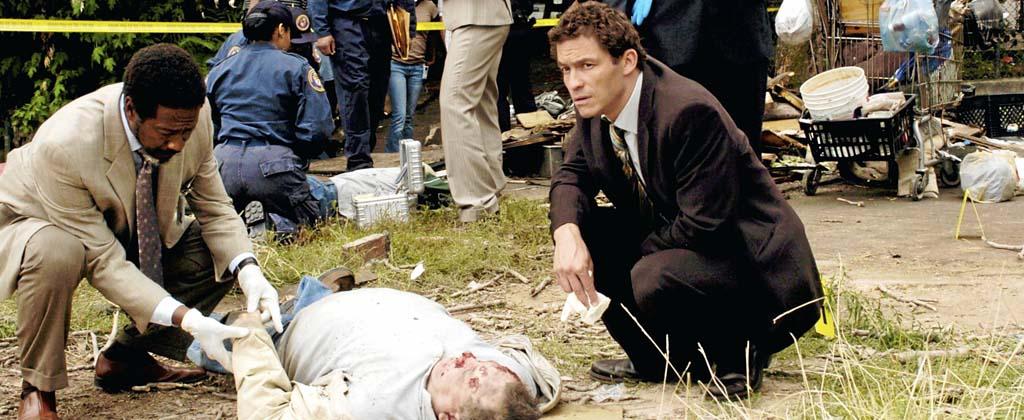

The Wire
It’s easy to say that The Wire finale brought the drama of the drug trade, police, and politics in Baltimore “full circle” over five seasons, but it’s more accurate to acknowledge the simple and sad reality that sometimes things don’t change. The good guys, whoever they are, won some and lost some. A few dealers and junkies turned their lives around, though most didn’t. Lt. Daniels stepped down, figuring it’s easier than going toe-to-toe with the incumbent governor. McNulty lost his job because he manufactured a fake serial killer to try to force the hand of the department. And in almost every instance a new face rose up to fill a spot someone vacated. Michael is the new Omar, Dukie is the new Bubbles, Snydor is the new McNulty, and so on.
Season five was specifically about those willing to step outside the standard boundaries – moral, ethical, social, and otherwise – to try and end the drug game early, with each soldier in the fight ultimately losing out to a messed-up system. It’s not the most satisfying ending in television history, but, ultimately, it’s probably the most honest. – MK

Seinfeld
Few finales have let down their audience quite like Seinfeld did in 1998. At the end, there were no real surprises or shocking elements, no dreams or snowglobes. It was just a reunion show that ended with four of TV’s most beloved characters – Jerry, George, Kramer, and Elaine – going to jail for being idiots in a small Massachusetts town.
But I dare you to re-watch the run of the show and not believe it’s the perfect ending to TV’s undefeated champion of sitcom. Because, for all the lies and manipulations and schemes, for the hurt feelings, the people fired, the lives and businesses ruined, the stolen breads, deported foreigners, and Bubble Boys popped, the cavalier attitude toward sex and relationships, and for the lack of remorse for everything up to and including the accidental death of George’s fiancée, Susan, the ending to Seinfeld was the ultimate comeuppance for the terrible acts of four truly awful human beings.
“I do not know how, or under what circumstances the four of you found each other,” the judge remarks, “but your callous indifference and utter disregard for everything that is good and decent has rocked the very foundation upon which our society is built. I can think of nothing more fitting than for the four of you to spend a year removed from society, so that you can contemplate the manner in which you have conducted yourselves. I know I will.”
Fans of the show didn’t like the finale because they had just spent the past nine seasons laughing at the misfortunes of others while spouting all the catchphrases and comparing themselves to the different characters.
Now, unfortunately, they began to realise that the characters they loved so much were actually just fools, and that probably meant they were too. – MK

Lost
After about three seasons of hatches and smoke monsters and an arbitrary set of numbers that could lead to the end of the world, ABC gave Lost showrunners Damon Lindelof and Carlton Cuse 48 episodes to wrap it up. They then proceeded to become our abusive girlfriends, taunting viewers weekly with beautiful ideas tied to empty platitudes and cliffhangers. Then they would apologise, say things would be different, that we’d be satisfied – even happy – and we would take them back episode after episode, season after season, because they said they wouldn’t hurt us again.
At times we even blamed ourselves, because we expected so much from a show that suggested it would be meaningful and offer answers. Our theories matured and we gave our favorite show the benefit of the doubt because it already had us in its grasp. “Jack wants to go back? Wow. Not Penny’s boat? I’m genuinely emoting. Time travel? Sure, there you go. Jacob and the Man in Black have been at this for millennia? Wait, what?” We knew it all had to lead to something and we believed we’d be better for the journey, right? Think of the time and energy wasted.
But maybe Lost’s failures were our fault. We were an eager young generation so bent on having our own touchstone TV moments that we anticipated a groundbreaking ending before we even understood what we were in for at the start. We were bound to be disappointed. But there’s some truth in Lindelhof’s self-admitted “hokey and new-age-y” finale.
“They were all messed-up, sad individuals who were lost in their own lives and hated themselves,” he told The Verge two years after the final episode aired. “And somehow they found some fundamental community among each other. If they hadn’t met each other and spent all that time on the island, then they would never have been able to forgive themselves for their past sins and break through to some sort of level of self-awakening and forgiveness.”
“At least you remember being disappointed in the way Lost ended,” he added. Agreed. But I wish I had known his view from the beginning, because by the time I heard it I no longer cared about the journey it took to get there. – MK

The Sopranos
remember where I was when it happened, in the same way people remember where they were for blackouts and reports of assassinations. I was at my friend Sue’s house. Tony Soprano, having seemingly vanquished all his enemies, was taking his entire family out to Holsten’s, an ice-cream parlor in Bloomfield, New Jersey. He put a coin in the jukebox. “Don’t Stop Believin’” started to play. The man in the Member’s Only jacket got up to go to the bathroom. The narrative tension rose to excruciating levels. Was this it for Tony Soprano? Was he going to live or was he going to die? And then, as Steve Perry sang the words, “Don’t stop!” everything stopped. The screen went black.
We, Sue and I, joined the throngs of the outraged. We immediately thought we were victims of some kind – at first, of a power outage, oddly particularised to HBO subscribers, and then of the show’s creator and maestro, David Chase. He had copped out. He had ripped us off. So unblinking during the seven-year run of The Sopranos, he had saved his blink for the worst possible moment – the last. Over the next few days, Sue and I called each other, using each new interview that Chase gave to the press as pretext for continuing our speculation over Tony’s ultimate end. Sue was among those who thought him still alive, forced by his misdeeds to the sentence prefigured at Holsten’s: A life devoted to a contemplation of death, in which every man in a Member’s Only jacket figures as a possible executioner. I was among those who thought him conclusively dead, based on Chase’s comments that “Anybody who wants to watch it, it’s all there,” and his disgust at the viewers who “wanted blood,” who “wanted to see [Tony’s] brains splattered against the wall.”
Sue thought that we were in the hands of a master manipulator – “he wanted us to keep talking about it!” – while I thought that Chase was betrayed by the terms of his own creation. He wanted to make The Sopranos more than a show about mobsters, and he found out at the end that if he actually showed what happens to men like Tony Soprano, it would never be anything more than a show about mobsters. There would be blood, there would be brains splattered against the wall, and after seven years that’s what people would remember.
So I became one of those people who argued the point of Tony’s death while professing not to care about Tony’s death, because David Chase let us down. It wasn’t the blackout punctuating the finale of The Sopranos that haunted me; it was Chase’s artistic failure, his inability to see his creation through. And so, when I watched the finale of Six Feet Under, a show I hardly watched and barely cared about, I judged it inestimably superior to what Chase had done – or hadn’t done – with Tony. A show about death, Six Feet Under ended by showing the deaths of all its major characters. It hit a note, and the note resolved everything that had come before. It didn’t leave us hanging on the words of Steve Perry. It didn’t resort to a trick not so far removed from a declaration that what we had watched for the last seven years had all been a dream.
But that was a long time ago. I have forgotten the finales of Six Feet Under and just about every other show I’ve ever seen – hell, the inevitable disappointment of the finales of just about every other show I’ve ever seen, no matter how artfully they were done. But I’ve never stopped being haunted by the last moments of The Sopranos, because time itself has filled in that final consuming blank. I’ve been to Holsten’s, in Bloomfield, New Jersey, and went there years before Tony Soprano existed. I can even remember, vaguely, that the tables were bolted to the floor. But I didn’t know that by the last episode of The Sopranos, James Gandolfini, the actor who created Tony Soprano and made him indelible, had grown so large that he couldn’t fit into the booth unless the table bolted to the floor was unbolted – and I only knew that, of course, because James Gandolfini was dead, and people were wondering what killed him.
Indeed, I can remember where I was when I heard that James Gandolfini died, because I can remember the message I got from my friend Sue: “Well, I guess we finally know what happened to Tony. He died.” I was right, all along – but so was David Chase. It really is all there, for anybody who wants to watch. There’s a man in a Member’s Only jacket waiting for all of us. For James Ganodolfini, it was his appetite – not the stranger who loomed as a possible assassin, but the ice cream he ordered with his family. For Tony Soprano, well, such is art that we’ll never know. What David Chase did at the end of The Sopranos was a trick, all right, and nobody will be able to use it again. But Chase really was the master manipulator, as my friend Sue insisted. He not only managed to end his show on an exclamation point; he contemplated mortality onscreen in a way that actually felt like death. He did us the favour of refusing to finish off his main character. Life would do the rest. – TJ

M*A*S*H, Cheers and Friends
There always seems to be this unnecessary need to surprise or shock an audience at the end of a show, even if it ruins our understanding of the story or the characters by going against everything that usually would have happened in that moment. It can be seen as an insulting ratings grab, or a need to live on in an Entertainment Weekly or BuzzFeed list from here unto eternity. But the best shows don’t need the help: Three of the four most-watched TV finales in history – M*A*S*H, Cheers, and Friends – didn’t rely on gimmicks in the waning moments. They simply let time do the work, and the characters move on to the next day without us, and us without them.
Because the war ends, and the bar closes, and friends sometimes grow up and move away. Maybe it’s not the most memorable way to end the show, but it’s often the right way to end the story. – MK
Words by Tom Junod and Matthew Kitchen