
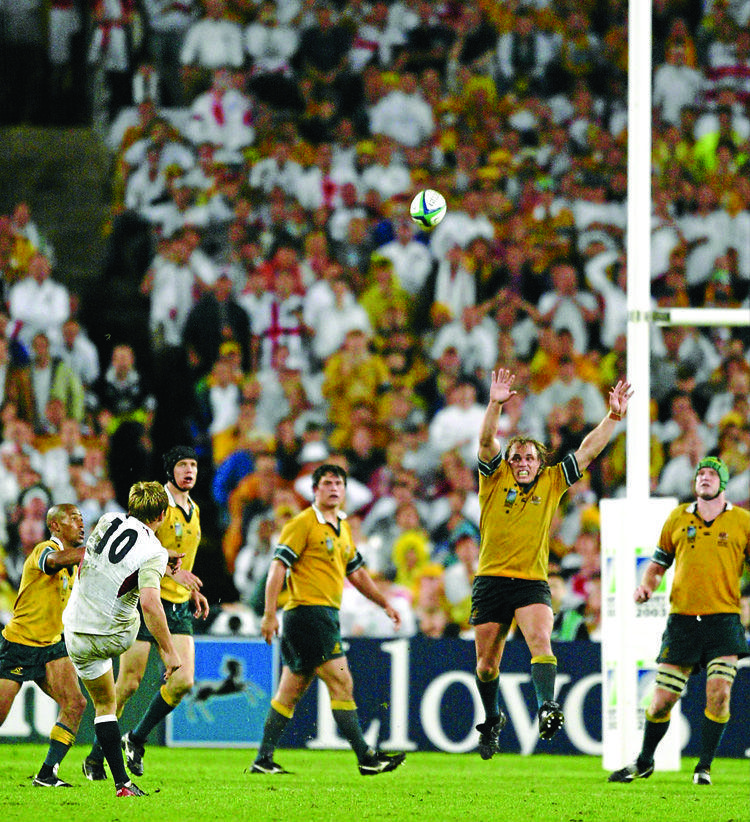

Few sporting careers have captured the public eye in a single moment quite like Jonny Wilkinson’s. Not that he would have considered this as he collected a pass from Matt Dawson in the dying seconds of the World Cup Final in 2003, such was the grim focus that defined his ability. But once his resulting drop-goal (pictured) sailed over the Suncorp Stadium posts, Wilkinson’s place in rugby legend was confirmed. England were champions of the world. Wilkinson, with his steely eye, clasped hands and wiggling behind, was their man who never missed a kick.
But Wilkinson, who retires from the game aged 34 this month, doesn’t owe a glittering career simply to talent. He has it in bundles, of course. But what has separated him as a great next to rugby’s good, has been a professionalism and determination matched by few others. From his first days as a Newcastle Falcons back-up, to today’s place as the fulcrum of a fearsome Toulon side, Wilkinson has quite simply never stopped working.
It’s that hard work that has endeared him to fans, coaches and players the world over. “I hope when Wilkinson is mentioned in future, in the past tense, that he will be recognised for his worth, which is colossal,” said England head coach Stuart Lancaster this week, as Wilkinson’s retirement was announced.
It’s hard to imagine an England set-up without Wilkinson’s name being mentioned, despite a career that was often injury-hit. The figures speak for themselves: 1,246 Test points in 97 caps – 91 for England and six for the British and Irish Lions. Wilkinson is one of only four players to top four figures at the sport’s summit. New Zealand’s Dan Carter, who at 32 boasts a massive 1,440, is first. But those numbers have risen slowly and steadily, and owe plenty to a young Wilkinson’s academic choices.
For Wilkinson, as is the case with so many greats, sport was in the blood: his father Phil was a keen rugby player and cricketer while his mother, Philipa, played squash at county level. Wilkinson’s older brother Mark also enjoyed a brief rugby career as a centre for Newcastle.
The young Wilkinson studied first at the Pierrepont School, then Lord Wandsworth College – two upmarket institutions that nurtured his ability and love for the game. But as he hit 18 in 1997, Wilkinson’s aim switched to the realms of academia.
Thankfully for the sport, Premiership side Newcastle Falcons – the team closest to his University of Durham choice – were coached by Steve Bates, a former Lord Wandsworth teacher. Bates convinced Wilkinson to defer his studies for a year and give rugby a go. Neither looked back. That year the Falcons won their maiden league title – a feat they have failed to repeat since – thanks in part to Wilkinson’s kicking skill and tough tackling that belied his age.
His country came calling soon after, and in 1998 he made his Test debut for England on April 4, 1998 at Twickenham against Ireland. Despite a shocking tour down under that year, his place at fly-half was safe. Six Nations victories followed, but it would be the 2003 World Cup that cemented his place in English rugby history. Wilkinson was the tournament’s top scorer with 113 points, and upon his return from Australia was awarded an MBE, BBC Sports Personality of the Year, and was named the IRB International Player of the Year. An OBE was dished out the following season.

Jonny Wilkinson at Newcastle Falcons
Despite overtures from clubs around Europe, and Newcastle’s yo-yo form in domestic competition, Wilkinson stayed true to his club for 12 years, scoring 1,938 points in 158 appearances. The 2005 and 2006 seasons were hampered by injuries – first knee ligaments, then a torn abductor muscle – but in 2008 Wilkinson became the first player to score a thousand England points in a 23-19 victory over Italy.
In 2009 the riches of French rugby finally proved too difficult to ignore, and Wilkinson was signed by south coast side Toulon, an unfancied team that had ping-ponged between the country’s top two divisions for much of the noughties. The Wilkinson effect was immediate: Toulon finished 2010 second in the Top 14, as well as achieving a runners-up spot in the European Challenge Cup, the continent’s second-level tournament.
The pinnacle of Wilkinson’s Gallic adventure came at Dublin’s Arriva Stadium last summer, where Toulon felled compatriots Clermont to lift the Heineken Cup for the first time in their history. Wilkinson contributed 11 of Toulon’s 16 points that day, including the 64th-minute conversion that edged them a point ahead of their rivals. “It’s right up there,” said Wilkinson after the match when asked wehere the moment ranked. “In fact it’s beyond because life’s for the now, not in the past.”
There’s no doubting Wilkinson’s importance in France. Last weekend brought a chance to become only the third team to defend a Heineken Cup (after Leicester and Leinster), when Toulon took on London’s Saracens at the Millennium Stadium in Cardiff. Aussie international Matt Giteau has even gone as far as to suggest the team would have gone all out in Wales last Saturday, in honour of their most famous player, “He’s just the ultimate professional and it’s not just in rugby. It’s in life too. He almost leads the perfect life. He trains very hard and is a genuine nice guy who is happy to help anyone.”
While it’s seemingly been the perfect career for Wilkinson, even he admits that retirement is giving him the jitters. “There’s always a huge amount of fear when anyone goes into an area they’re not accustomed to,” said Wilkinson. “I’ve played rugby professionally since I left school and I’ve never had a proper job. It leaves me a bit unprepared for what comes next, but I see that as a positive.”
Perhaps American football is that step. Wilkinson’s boyhood hero was Chicago running back Walter Payton, and he hasn’t ruled out a switch across the Atlantic post-retirement, “I have thought about the NFL a little bit,” was the word from Wilkinson. “I would love to go over to America and try. I need to see the transition as one door closing and a very attractive one opening.”
However, typically of his professionalism and will to win, Wilkinson was waiting until after last weekend’s final in Cardiff to decide on his future. “The focus has to be on the next two weeks,” he said. You see England’s golden boy may well have won almost everything rugby has to offer, but for sportsmen like Jonny Wilkinson, there’s always something more.