

Jaeger-LeCoultre
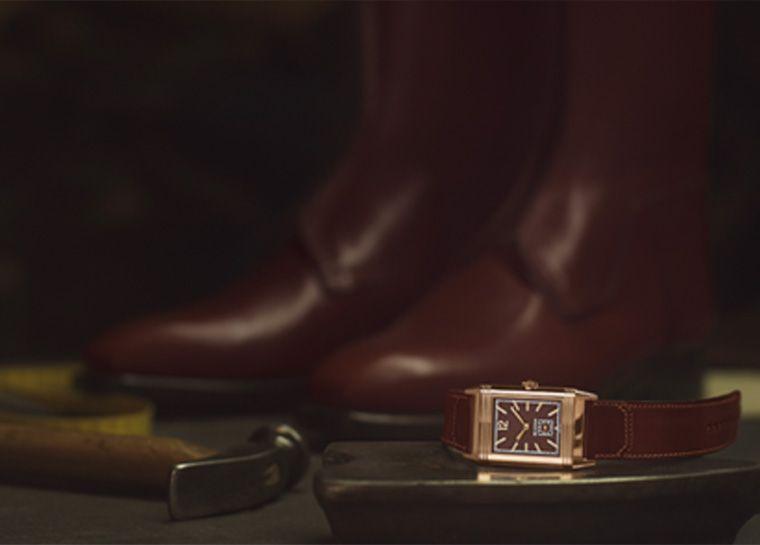
AW: JLC was one of my favourite brands from 2013, so I was keen to see what they had in store for us this year. The Grande Reverso Ultra Thin 1931 [main picture] caught my eye, mainly due to the chocolate face and Fagliano strap. I have never been bowled over so much by a strap as I was with this one. Casa Fagliano, who is more famous for making polo boots for the world’s elite riders, has turned his hand to producing a strap for a watch long associated with polo. The original sports watch sits beautifully on the strap, and if Faliano ever gets bored of making boots he has just found a new career for himself.
 ST: As always, it was a very strong showing by Jaeger LeCoultre. The chocolate face Reverso was nice, but the Duomètre à Quantième Lunaire [right] was my favourite. Its new case comes in a smaller diameter, which works well and it has an immaculate dial crafted in Grand Feu enamel, which is just beautiful. I once had, and then sold, a Duomètre and it is a watch that I really miss.
Roger Dubuis
 AW: What do you get if you cross a steam engine with a cuckoo clock? Yep, you’ve guessed it – the wonderful world of Roger Dubuis. Last year was the Excalibur Round Table and now we’re being treated to another historical revival. The Hommage Chronograph [right] was first produced in 1995 and this pays homage to the founder, Roger Dubuis. The attention to detail is never lost, with the guilloche pattern and railway track flange creating a real colour contrast.

But if you have a big bonus coming your way, then go the full hog and invest in the Hommage Double Flying Tourbillon [left]. This complicated beast complements the stunning hand-made guilloché and is driven by the innovative new RD100 movement. Roger Dubuis is a tourbillon expert these days so this is a worthy collector’s piece.
ST: I agree that the Hommage in pink gold is a nice watch and is a sensible size at 42mm. But for me to enter the world of Roger Dubuis it would have to be one of its previous offerings from the La Monégasque range. As an aside, I can’t help but to pop into the Emirates Towers boutique in Dubai as I think it’s one of the coolest watch shops around. When the new collection is available I will definitely be paying a visit.
Audemars Piguet

AW: I’m a fan of the Royal Oak and, apart from the fact that it withdrew its iconic 39mm which angered me to the point of exhaustion, you will not ever hear me say a bad word about them. The Offshore, however, is not for me. It’s too big, too macho and too expensive. Or at least it used to be, because the new Royal Oak Offshore Chronograph 42mm [left] has just converted me to the dark side. At 42mm it is not too big or bold and sits beautifully on the wrist. I particularly like the navy variant of the new 26470 collection. The pushers have gone back in time to the original design but have kept with the more recent use of ceramic. The new collection comes in stainless steel or 18-carat pink gold.
If the Royal Oak and Offshore collections are too sporty for your tastes, then I strongly urge you to check out the Millenary Minute Repeater [right]. This is the watch that the AP watchmakers wear, and with good reason. The complicated oval-shaped AP is now in pink gold. This hand-wound beauty has a three dimensional architecture that gives real depth to the watch and allows you to admire the double balance spring and striking mechanism and blued gongs from the face.
ST: AP is the original pioneer of the chunky sports watch and the Royal Oak Offshore was 42mm at the time of its release, which was considered large. A few years ago, AP decided it was time to up it to 44mm. The original was kept in production and I thought it was only a matter time before it would be discontinued. To my surprise, we saw the 42mm take centre stage at this year’s exhibition. It essentially looks the same as it has always done aside from for a few minor changes. It now has ceramic chrono pushers, a sapphire display back, and a few new colour combinations. It seems that AP has listened to the people who buy these watches. More importantly, this re-release shows a shift in dynamic from AP and I hope this continues. The version with the slate coloured dial is my particular favourite.
AP also released its Diver model in white ceramic. The original diver was released in steel and gained a lot of praise, but I think this white ceramic version looks cheap; it’s like something we would expect to see from Hublot. It may be a good watch for those who like ostentatious bling, but probably not the general watch community. My white Casio G-Shock, which costs less than Dhs1,000 looks better than this. This diver model will cost you up to about Dhs90,000. Come on AP, you can do better than this! You should be the brand that leads the way rather than follows trends.
Cartier
AW: Cartier put on a watch presentation master class and the ability of its technicians to transform timeless models with cutting edge technology has made me a real fan. The Tank Louis Cartier Sapphire Skeleton [right] combines two of my favourite Cartier creations: the see-through Mystery Clock technique first insipred by French magician Jean-Eugène Robert-Houdin, combined with the most iconic dress watch in the world and the additional skeleton craftsmanship. (And exhale…) But while I am of the view that every collector should own a Cartier Tank or Santos, the watch I was really keen to see was there new Calibre de Cartier Diver [below]. With a diameter of 42mm and 11mm thick, it is one of the thinnest dive watches on the market, making it great for every day wear. It also has a uni-directional bezel, a screw-in crown and allows for depths of 300 metres. Your weekend watch will now look good on the beach and, due to its size, will probably work its way into your working wardrobe as well. Who said that dive watches can’t be stylish?

ST: While I agree with Andrew that Cartier’s watch division continues to excel, I think the Diver is a notch too far. When I think of Cartier, I think of the classy Tank. The Diver in my opinion is the opposite. The roman numerals are far too big and the bezel text looks far too similar to that of a Richard Mille. Combined Roman numerals and modern fonts don’t do it for me. I don’t think Cartier need to be all things to all people.
IWC
AW: IWC is the master of relaunching. We saw it last year as the Ingenieur was re-engineered to take on the Offshores and Hublots. This year its focus was on the Aquatimer and it did not disappoint. Seven new watches were introduced to the diving line and there was a new SafeDive system with a really convenient quick change strap system. (I can’t believe all watches don’t have this facility.)
Three of these watches caught my eye for different reasons. Firstly the Aquatimer Perpetual Calander Date-Month [right]. At 49mm this is a monster of a watch with a red gold bezel, depth of 10 bar, rubber coated titanium and the amazing 89801 movement. Realistically, it’s a watch that will be lucky to go for a dip in its owner’s swimming pool, but in a world of big watches with big complications it ticks a lot of boxes. My personal favourite was the Expedition Charles Darwin with a flyback chronograph. It is 44mm and comes in a bronze case, which surprisingly is a first for IWC. The watch looks amazing and with a bronze alloy will change and add character over time.
The watch that most divers will go for, however, is the Deep Three [below left], which carries a depth gage to 50 metres. The blue hand shows current depth while the red hand shows maximum depth. It also carries an extra-large strap allowing the watch to be worn over a wet suit. So basically the Aquatimer is back. I can’t wait to see what IWC does with the Da Vinci, which I am sure will be its next project.
ST: IWC revamped its Aquatimer diving watch line with a new collection that spans many models. The best release is the automatic base model which is a sensibly sized diver at 42mm. It has a new steel bezel with an internally rotating dive calculation ring and a quick change strap system. It’s a very practical and clean-looking watch that will look just as good on land as it will down below. I particularly like the white faced version on the black strap.

The not so good bit is that Aquatimer Perpetual Calendar Digital Date-Month. It’s the flagship model, but its 49mm – yes, that’s right: 49mm! This maybe a good size for diving, but how often will a rose gold perpetual calendar be taken diving? My guess is not that often, and for sure, it will end up as a desk diver. I don’t know many men who can pull off a 49mm, and fortunately IWC is only making 50 of these – there must be enough giants in this world with money to burn.
Montblanc
AW: Montblanc is a brand in a hurry. I say this because it has just jumped up another few levels since last year, skipping over some rather notable watch brands with great reputations. My favourite watch of the show, and one that I would genuinely buy if I had the cash, is the Meisterstuck Perpetual Calendar [below]. The design reminds me of some of the great classics of our time, which is not a bad way to go if you want to show the world that you are watchmaker who can offer serious complications. The sunray finish on the dial is beautiful and the watch is available in red gold at 39mm. My only criticism is that there is not a 41mm option for the bigger guys. But I am sure that will come in the near future.

ST: Montblanc definitely created a stir this year. With Jérôme Lambert, the ex CEO of Jaeger-Le-Coultre at the helm, the brand is going from strength to strength. Its Meisterstück Heritage Perpetual Calendar costs around Dhs50,000 and while it might not be up there with the big boys’ perpetuals it has got people talking thanks to the extremely competitive price. For many a watch lover, it’s an opportunity to own a complication that is normally well out of reach. It’s also a really nice size at 39mm.
The Montblanc Meisterstück Heritage Pulsograph, finished in red gold, is a real looker and also houses the Montblanc Villeret (formerly Minerva) movement, which is fantastic and is priced around Dhs128,000. But the only small problem for me is that it looks very similar to the Patek 5170J. Which, of course, might be a plus point for others.
Piaget

AW: Piaget has once again rewritten the rule book for ultra-thin watches. This year the Altiplano Ultra-Thin [left] has broken all records, with its very clever case and movement fusion. It has been three years in the making, and with 145 components the Altiplano is a beautiful piece. With the main plate replacing the case back and the dial and hands integrated into the movement, Piaget has managed to make the thin even thinner. The dial sits at 10 o’clock and reveals a movement with skeletonised bridges and traditional finishes. This was my favourite dress watch of SIHH.

ST: The Ultra-Thin may have broken records, but it just does not do it for me. I don’t think Piaget should focus quite as much on ultra thin watches when they produce fine pieces such as the still slim Emperador [right] cushion-shaped watch. To me this is a totally overlooked watch with a unique case shape that still remains quite conservative. I know this is an SIHH article but I can’t help but talk about my favourites. The version in gold with a blue and white dial is a real looker.
A. Lange & Söhne

AW: There is something quite beautiful about the 1815. It is a classic watch that all collectors should aspire to own. If your budget permits, and if in your world “accurate is not accurate enough”, then you can simply upgrade to the 1815 Tourbillon [right]. It comes with the Zero-Reset mechanism, which adds convenience to the complication by allowing the watch to be stopped and restarted to the second.
ST: Year on year, ALS steps up its game, and this time they produced a technical marvel. The Richard Lange Perpetual Calendar Terraluna [below left] features an instantaneous perpetual calendar and a celestial display showing the relative positions of the sun, Moon and Earth as well as a Moon phase found on the back of the watch [below right].
It has a 14-day power reserve, fitted with a constant force escapement. Basically, there is an awful lot going on. But with Lange, as always, it is all made to seem so easy. I would get the white gold version, as then only those in the know would realise just quite what you have on your wrist.
Greubel Forsey

AW: I have never seen a watch with a magnifying glass in the crown. And certainly not one that looks into the watch and shows you that the dot that you can see on the watch face is actually a micro-sculpture of an old sailing ship. But that’s exactly what the Art Piece 1 [left] does. Do not imagine that the brand is going down the line of tacky innovations, however, because these guys are serious about their watches and are masters of complications. Check out the QP à Équation [below] which has a perpetual calendar, a tourbillon and, just for good measure, a Solstice equation on the back. Yes, they have just reinvented the mechanical computer.
ST: The QP à Équation is one seriously complex watch, with a price tag to match (670,000 Swiss Francs, which equates to Dhs2.8 million). I really like the look of it, and so I should for this kind of money. Some Greubel Forsey models have tended to have too many tourbillons and overly busy dials. This is clean looking and very wearable in comparison.
They also unveiled a new platinum version of the GMT with revolving globe. There is just far too much going on, and although it is technically very impressive, I don’t think it would be very wearable. Having said that, we have a lot to thank Greubel Forsey for as it pushes the boundaries of what can be achieved. This keeps the pressure on other brands, which is a good thing.
Panerai
 AW: Panerai is a design icon and this year there were two highlights. The new range of Radiomir 1940 chronographs [left] includes a thinner and lighter 45mm platinum white-face case. The sandwich dial gives it great readability in the dark. But the watch I would buy is the Luminor 8 days in titanium [right]. It’s very light for such a big watch, with a sandwich dial and vintage strap. The brushed finish makes it the ultimate weekend watch.

ST: Panerai had good offerings all round this year. The 44mm Luminor 8 days in titanium is a really nice piece, with an in-house movement with eight days of power reserve. They call it an entry-level model; I call it a design classic. The clean, no-fuss dial is classic Panerai. Titanium is not everybody’s cup of tea, but it’s very light in weight and has an almost stealthy feel, which adds to its no-nonsense look. You can put this watch on a whole range of coloured straps to give it a new personality. I don’t have a Panerai in my collection but this would possibly be the one I would go for.

My favourite Radiomir 1940 chronograph was the red gold with dark face [left]. The dial has a real vintage feel and its brownish colour complements the red gold. It has a combination of graphic hour markers, with Roman and Arabic numerals, referred to as “the California dial” by collectors. It has a cushion-shaped case that should make it very comfortable. The design of the case and chrono pushers all comes together very well to make a great watch.
Parmigiani Fleurier

AW: This year’s Tonda Metrographe chronograph [right] with black dial is my favourite chrono of the show. It also has one of the most impressive luminor displays on the market. The calibre 3000 movement and housing has been redesigned to give it a slimmer, more refined case. The counters sit on top of snailed discs, which are outlined with Superluminova material. This picks them out in the day and renders them luminous at night. The two counters form a slanted figure of eight, which is consistent with the Parmigiani Fleurier brand. It comes with a steel bracelet but my personal favourite is the option with a fabulous black Hermès strap (see right).
 ST: The Tonda Metrographe chronograph stands out as being that bit different, while still retaining a stylish look. But for me, the Toric Résonance [left] is the star. It looks like a relatively uncomplicated watch but with a large date. A more thorough examination reveals an instant date jump and minute repeater. This combination is quite rare, because both of these complications require a lot of energy to function properly. The dial layout is so easy to read, but on closer inspection you can clearly see the attention to detail with the hand-engraving. This adds real depth and warmth to the watch, and I am sure it would be an absolute pleasure to wear. This is my favourite watch of SIHH.
Vacheron Constantin

AW: SIHH really kicked off when Vacheron launched its 14 new products. I was pleasantly surprised to see additions to the Malte collection, as I am a fan of the tonneau shape. But the watch that struck me most was the Patrimony Contemporaine Ultra-Thin Calibre 1731 [left].
It carries one of the most difficult complications to master in its striking mechanisms, and manages to do so in a movement that measures just 3.9mm. This beautiful watch is set in a pink gold case with a diameter of 41mm, and at 8.09 mm thick is the thinnest manual-winding minute repeater on the market.
 ST: It was the year of the skeletonised watch for Vacheron, with the Vacheron Constantin Malte Tourbillon Openworked [right]. The skill required to produce watches of this complexity is astounding. But unfortunately for me, they are just a bit too detailed, and in some instances seem overcrowded. If I was to ever go open-worked, it would be a Cartier, whose versions are just a bit easier on the eye. Don’t get me wrong, Vacheron is one of the finest brands around, and those who favour open-worked watches will be in awe of the new offerings. And, as Andrew says, the new minute repeater is very nice indeed.
Richard Mille
 AW: To truly get your head around the world of Richard Mille you need to add some ET-style thinking and know that nothing is impossible. Consider the beautiful Natalie Portman RM 19-01, with its spider design with a black rhodium web and a white gold spider whose belly is also the upper bridge of the tourbillon, or Sébastien Loeb’s RM 36-01, which measures lateral forces. And there’s my personal favourite, the RM 63-01 Dizzy Hands [left], which introduces a new movement just for fun. Each watch is different and very personal to the individual who inspired it. Richard only works with people he likes, and you get the feeling that the personal connection he has with the individual adds a creativity that knows no bounds.
 ST: Richard Mille follows his own path and has created a niche brand that is hard to compare. I have always been a fan, but I am not overly keen on the RM 63-01. It strikes me as being too much like the Franck Müller crazy hours concept, and at Dhs550,000 is certainly not cheap. My choice would be RM 61-01 Flyback Chronograph Regatta [right] — a substantial watch with true purpose.
Ralph Lauren
 AW: I usually switch off during the women’s watch presentations, as the male watch snob in me does not like to think of watches as being jewellery pieces. The Stirrup Petite-Link [right], a steel watch with a mother-of-pearl dial, is exactly that — so what made me sit up and take note? It stood out as a very definite purchase for any of the following: Valentine’s day, birthdays, anniversaries and other excuses to spoil the wife. Not to mention that one good turn deserves another, and buying a beautiful jewellery piece that tells the time might just get me my next watch sooner rather than later…
 ST: There was a smaller version of the Ralph Lauren RL 67 Safari [left], now sized at a sensible 39mm. There has been much debate over the price — approximately $3,000 — which many say is far too much for a watch from a fashion brand. I personally think it’s a nice model and think that it comes down to Ralph Lauren being a watch collector himself. I am sure he must have been involved in the design process, which comes at a price. Nevertheless, I am with the camp that calls it a fashion watch, and I would find it hard to part with this kind of money when I could buy a vintage Rolex for the same or less.
Baume & Mercier
 AW: Last year’s Clifton was a highlight of SIHH, so I was keen to see what they had to offer. I was not expecting this gold dress watch to join the Tourbillon club. The Clifton 1892 Flying Tourbillon [right] comes in 45.5mm, 18 carat red gold and will be set at a very affordable price. The term they use at B&M is “high quality and affordable luxury” and they certainly deliver here with the Côtes de Genève finishing. The Clifton did not stop there and has expanded the collection with a 43mm chronograph. My personal favourite is the Clifton Retrograde Date Automatic [below left], which is also 43mm and has eye-catching blue steel hands.
 ST: Not many people know this, but Baume & Mercier is the seventh oldest watchmaker still in existence. They have built on the success of the Clifton range by adding new variants. The retrograde model is a good start, but I am not sold on the dial layout. The new chronograph, however, is a clear winner. I think it will be priced at around Dhs17,000 and will really mix up this price segment. It’s clean, crisp and easy to read — all the things a great chronograph should be. The 1892 Flying Tourbillon also shows what the brand is capable of. It gives even greater credibility to the Clifton range, and will likely cost somewhere in the region of Dhs250,000. Only 30 pieces will be made.