

Last year, a brush with death prompted Esquire writer Chris Jones to compile his very own bucket list. Here he recounts his experience with the most harrowing task of the lot: performing a stand-up comedy set
I’d wanted to try stand-up for a long time, for reasons I can’t really articulate because it’s an impossible ambition to explain. How do you tell people you think you’re funny or that you would like to live out their most private nightmares? Nearly every time I mentioned the idea to somebody, their immediate reaction was horror, like I was telling them that I harboured this secret desire to eat my own flesh. My wife would literally put her hands over her ears and leave the room, and I never had a counter for her shame-by-proxy. Except that years ago, I had watched my friend Tony try it, and
I admired and envied him so much. I just thought it was such a stony thing to do. It felt necessary.
I met with Tony the afternoon before my performance — such a grand word for the six minutes I’d spend s****ing my pants. I’d hauled up to Ottawa and all I needed was a pep talk and a drink. Tony, who has now done more than a hundred routines, had already given me some advice. “Don’t wear a funny shirt,” he’d written to me. So that morning, I’d pulled on a plain grey T-shirt, the least funny shirt I owned.
In a cozy little venue, Tony gave me some more advice. Don’t go for the easy crass laugh, he said; don’t confuse shocking with funny. And don’t memorise your material: Know what you want to say, but not how to say it. That’s how amateurs usually trip themselves up — they recite rather than perform, and if they miss a line or even a word, the rest of their bit can vanish from them like dreams. Now it was my turn to react with horror, because I’d committed my routine to memory. Tony must have seen my pupils dilate. “I’m sure you’ll be fine,” he said a little quickly. “It’s six minutes of your life. What’s the worst that can happen?”
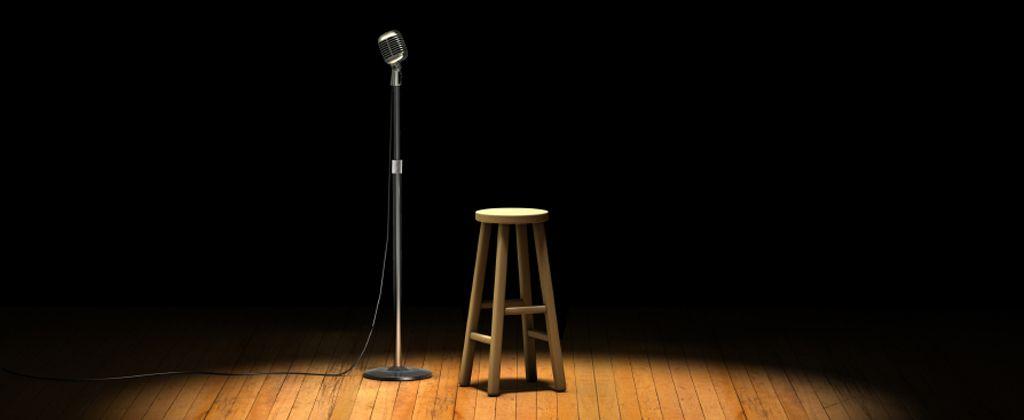
Some other friends joined us, and we walked through the blistering cold to Yuk Yuk’s bar, with its low ceiling and brightly lit stage, a single microphone in a stand casting a shadow on the wall. It looked really stark. It reminded me of a boxing ring for some reason. I met Howard and the MC, a tall guy named Wafik, and they gave me a quick breakdown. I’d go seventh. Wafik would probably tell the crowd I was a newbie; that sometimes softened things up. “But you never know,” he said. After five and a half minutes onstage, I’d see a red light go on. That was my warning. At six minutes, one way or another, I was done.
“I feel like I’m taking a quiz and know all the answers. And whenever I pause to come up for air, there’s a little more laughter. It never reaches uproarious, but the walls are inching closer”
The first up, an amateur, had it a little rough, maybe a couple semi-laughs. “How much time do I have up here, anyway?” he said, and Howard immediately yelled “Time!” from somewhere in the dark. The second act, a chubby guy in a hoodie, fared much better. It was easy to tell that he’d been up there before. He had the looseness that only practice can bring.
Wafik then went up to introduce me. He said I was a newbie, and the room was suddenly the size of a football field. There were loud groans. “Hey, he might be funny,” Wafik said, the way someone says, “Hey, I think it’s clearing up” in the middle of a summer downpour that’s not clearing up.
“A minute or two in, I have the most supremely conscious thought: Everything’s fine. Everything’s going to be fine”
I made the short walk to the stage and took the single step from the floor and began to pull the microphone out of its stand. There was a kind of buzzing in my ears. Somewhere a clock started: five and a half minutes from the red light, six minutes from kill or bomb or the great muddy gulf in between.
I looked up from the microphone, and all I could see was light.
The light is white and it’s blinding. I can’t see the bar at the back of the room or the room or any of the faces in it. I can’t even see the stage or, it seems, my feet, which are lost somewhere in the glow beneath me. I am very concerned about falling.
“This is going exactly the way I dreamed it would,” I say, out loud, deadpan, and from somewhere out there, I hear laughter. That’s laughter, without a doubt — not giggling or chortling or snickering, but laughter — and I earned it. It’s mine to keep. I feel my shoulders relax just a little. I lift the empty microphone stand to the back of the stage, look at my shadow on the wall, take a shallow breath, turn around, and launch into my routine: “When I was a teenager, like a lot of teenagers, my greatest fear in life…” And I feel, almost instantly, like a marionette somehow, like my hands and mouth and brain are all working, but they’re working independent of one another and maybe even independent of me. I’m just talking, not thinking, and each line of my bit — my bit — is right there waiting, one after the other.
A minute or two in, I have the most supremely conscious thought: Everything’s fine. Everything’s going to be fine. Some lines that seemed funny on the page aren’t working out loud, and I think I should improvise here, or maybe it’s there, but those windows streak by like highway exits, too late to turn around.
Now, after three or four minutes, maybe — I really have no idea — I’m experiencing systemic override. Waves of endorphins are rushing in. Biology is taking over again. I’m not in control anymore. But it’s okay, I tell myself. I’m still doing it. I’m doing what I’ve always wanted to do. There’s another little burst of laughter. After all the doubts and fears I’ve had, after all the sleepless wondering and being unable to think beyond these six necessary minutes, I’m not scared anymore.