


There’s an 830-million-year-old rock salt crystal out there—and it may contain life. If you’re thinking of the mosquito frozen inside the amber in Jurassic Park you’re not alone.
This might actually be more exciting than science fiction however, as it was announced in the Geology journal last month that there seem to be ancient prokaryotic and algal cells inside the discovered crystal.
For all of us wondering, we won’t have to wait long to get our answer, crystal is set to be opened soon.
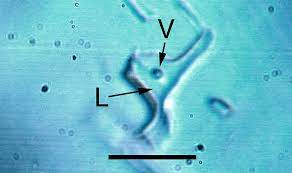
The report from Geology said that the team used a selection of imaging techniques in order to determine that there are well-preserved—even living—organic solids locked in the fluid inclusions inside the rock salt.
If you’re full of questions, that’s normal. Crystalized rock salt is not supposed to be capable of sustaining ancient life itself—much like the mosquito in amber. But these microorganisms appear to not be in the crystal itself, but in the trapped small amounts of water and organisms that got stuck in the salty seawater as it evaporated, forming the crystal.
Video of the ancient crystal
As you can see in the below video, there are bubbles within the crystal that contain fluid, and that could potentially be the home of the living organisms.
The study’s author Kathy Benison, a geologist from the West Virginia University, told NPR that they are planning to open it to see if they have yet died in the last 830 million years.
“There are little cubes of the original liquid from which that salt grew. And the surprise for us is that we also saw shapes that are consistent with what we would expect from microorganisms. And they could be still surviving within that 830-million-year-old preserved microhabitat,” Benison said to NPR.
Don’t worry about this being the start of a horror movie, though—they would be doing this with every safety measure in the book in place.
“It does sound like a really bad B-movie, but there is a lot of detailed work that’s been going on for years to try to figure out how to do that in the safest possible way,” Benison said.
Other scientists agree it’s likely not a threat.
“An environmental organism that has never seen a human is not going to have the mechanism to get inside of us and cause disease. So I personally, from a science perspective, have no fear of that,” commented Bonnie Baxter, a biologist at Westminster College in Salt Lake City, who was not involved in the study.