
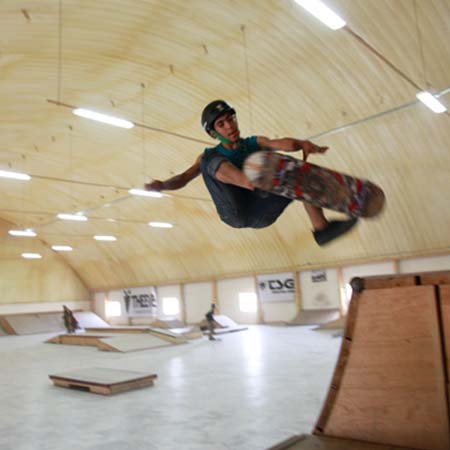

Afghanistan has been torn apart by war for decades and its people have endured unimaginable hardships. There are no easy fixes. But one NGO – Skateistan – has hit on an unlikely way to educate and entertain a new generation of Afghans.
Perhaps the most impressive accomplishment of Skateistan may be that fifty percent of the community is female

Dawn broke on June 10th to the sound of gunfıre ın Kabul. Taliban fighters were engaged in a bloody shoot-out with the Afghan National Army after a seven-man suicide bomber team hit the international airport early that morning. Meanwhile, on the other side of town, away from the explosions, ten Afghan boys were busy strapping on knee pads and helmets at a makeshift skatepark. Caught in the excitement of the session ahead, they laced up used sneakers that a volunteer issued from a wooden shelving unit, picked their boards from the neatly arranged rows, inspected trucks and excitedly chatted away to each other in Dari. For a brief moment there was no war in Afghanistan; there was only skateboarding.
Oliver Percovich arrived from Australia for the first time in 2007. He was thirty-two and came to Kabul with his girlfriend at the time, an aid-worker in the worn-torn city. Although he’d never been to the country and didn’t have a job lined up, what Oliver (affectionately known in Kabul as Ollie) did have with him was three skateboards.
A lifelong lover of the sport and lifestyle, Ollie quickly began making friends in the street. His boards would attract the attention of curious kids who mostly had never seen a deck or an experienced skater on one before. What started out as a handful of people meeting casually to learn how to skateboard and have some fun quickly turned into and a large group. They’d meet regularly at an empty public fountain in Kabul — one of the few locations in the war-torn city that provided an appropriate surface for skateboarding.
This was how Skateistan began. The NGO today employs forty staff members plus countless volunteers, operates across eight countries and has provided skateboarding lessons and designated facilities to over two-thousand kids in Afghanistan.
“I think it was Fazila, a girl who was selling chewing gum and begging in the streets, who motivated me to try something bigger,” says Ollie in response to what it was that motivated him to turn casual skate sessions into an international organisation. “She became this skate instructor who connected with the richer middle class girls who were also coming to the fountain through skateboarding, and that amazed me. It really was a turning point and made me realise the potential of the skateboarding project.”
The giant hangar-like space that constitutes Skateistan’s Kabul skate park sits right next door to the notorious Ghazni Stadium. This was the venue where, back in the Nineties, the Taliban held public executions during breaks in football games. Today the crack of metal trucks slamming onto pinewood ramp edges and the squeaks of sneaker soles skidding against the smooth surface of the linoleum floor are the more optimistic sounds that fill the air. Some of the skaters wear jeans and graphic T-shirts, while others are in traditional Afghani shalwar kameez. Sweat pours down from beneath their black helmets onto flushed cheeks and a hard fall here and there elicits occasional yelps of pain.
But mostly there is just die-hard determination and lots of deep breaths when the younger boys try the big ramp for the first time. Meanwhile, the older teenagers launch with all their force down the wooden slopes onto the steep ramps that catapult their tucked bodies through the air like cannonballs. There are ministers’ sons and street workers from group homes; kids originally from Kandahar, Panjshir and Herat. These diverse ethnic groups might be at odds in the street but they are equals here at the skate park. “Skateistan changes your life,” says seventeen-year-old Ahmed Romul, who volunteers as an instructor in between studying to get into university. “In Afghanistan there is always war, war, war, so when you are skating and people see you they laugh or smile, it brings happiness and peace for a moment.”
The positive attention also breeds confidence among many of the kids, who speak with pride about riding through the streets together, watched by amazed onlookers. “When the people see us, they say we must have magnets in our feet,” says Hamadullah Hamdard, a twenty-year-old skateboarder and communications director at Skateistan.
Skateistan has achieved many impressive feats in its short life. The organisation secured funding from several international embassies in Kabul, and used it to build and maintain the current operation. They garnered the support of General Mohammed Zahir Aghbar, president of the Afghan National Olympic Committee, who granted them the land on which to build their facilities. He also admitted the organisation into the Afghan Olympic fold, establishing it as a serious sport in the eyes of many countrymen. The next step was to engage a slew of international sponsors, who donated everything from helmets to custom-made skateboarding ramps. And recently they opened a second three-building compound in the northern city of Mazar-i-Sharif that will also offer classes in the arts, along with a garden and residential facilities for its staff. But the most impressive accomplishment of Skateistan may be that fifty percent of the stakeboarding community is female, making it the largest female-to-male ratio of any skateboarding community in the world.
The considerable achievements bely the initial scepticism that Oliver Percovich faced when he looked into establishing Skateistan as an NGO. A skateboarding school in Afghanistan! Did the country not have more important issues to deal with? But as the organisation’s sustainable growth and positive impact on the community over the past four years demonstrates, this may have been one of the best aid ideas focussed on youth, development and education to come out of Kabul.
Seventeen-year-old Faiaz has worked on the street selling bracelets for the past ten years. Most days he’s stationed near the heavily guarded concrete blast-walls of Kabul’s International Security Assistance Force [ISAF] headquarters, which might explain why his English is accented both with his native Dari and with a slight Southern American drawl. In fact his first board was gifted to him by a U.S. Marine who hung out with him and his friends teaching them skating tricks. “My favourite skateboarder is Tony Hawk!” he says excitedly. “He can do anything!”
Faiaz is back in school now, thanks to Skateistan’s education programme, but not everyone he used to skate with has made it as far as he has. “The last suicide bomb in front of ISAF killed three of my friends,” he says with a matter-of-fact solemnness all too common in a country ravaged by war for the last four decades. “We all worked together selling bracelets on the street. One of them came to Skateistan too.”
To a Westerner, skateboarding after class might seem like a totally normal social interaction between kids. But in a place like Afghanistan it is anything but. The building of self-confidence within the collaborative and safe context of peers is unique for many of Skateistan participants. “The environment itself is treatment,” says Gurusewak, a thirty-five-year old American from Seattle who heads up the newly opened facility in Mazar-i-Sharif and worked with trauma counselling teams in Kabul prior to making the move to Skateistan. “This is the most holistic youth development programme that I have ever seen.”
Skateistan has a few carefully implemented tactics that have ensured its rare success in a saturated aid market over the years. It insists on an hour being spent in the on-site classroom for every hour of skateboarding. This makes a difference in a country where the average monthly salary is $30. Large, impoverished families rarely opt for an education for their kids, pushing them instead towards street work to provide a small contribution to the household income. Extended back-to-school intensive courses arranged through an agreement between the Ministry of Education and Skateistan are available for these kids. This allows them to enter into the Afghan education system after completing a year-long course through the NGO.
The NGO also requires that every student has a letter of permission signed by a guardian. In this way the organisation ensures there is no friction caused between itself and the community, securing a sustainable and continued existence. Finally, after almost four years in existence, Skateistan is currently operated and maintained by a large Afghan staff that has risen up through the ranks from students to volunteers and eventually to full-time employees.
As the withdrawal of foreign troops and aid money continues this year and next, Skateistan, like many aid and development organisations in Afghanistan, will face new challenges. The successful reconfiguration of funding sources will be paramount to its survival. “Many donors are leaving the country right now,” says Ollie. “We do not have any funding confirmed yet for 2014 and it would be a huge shame if the country’s largest female sporting organisation was not able to operate because of this.”
Ollie insists that Skateistan is committed to staying in Afghanistan, and is looking to raise $800,000 for all of its projects in 2014. To help reach this target, the NGO has begun shifting its fundraising efforts to the Internet, producing online videos, books and T-shirts for sale to entice donor participation, but they are still way off their goal for next year.
“I met a lot of good guys here, they are my best friends,” says fourteen-year-old Emran, who works as a car washer in the streets of Kabul and has also recently joined the back-to-school programme. “When I am working in the street all week I am waiting to come to Skateistan. It is the best day of my week.” He found out about the NGO through its street outreach programme, where Afghan volunteers and instructors head out into the city, do live demonstrations and encourage the kids to come try it out.
“Skateistan is good for Afghanistan because it’s a new sport; a sport where young people can do something more than they could before,” says Nurzai, an eighteen-year-old instructor from Kabul who now teaches at the Mazar-i-Sharif facility. He also came to the organisation via its street outreach programme. A street-working kid at the time, he went on to get an education with Skateistan’s support and now works full-time for the NGO.
Sitting on a bench next to him is Talia, a young Canadian woman with a cropped haircut and a pair of worn-out Vans sneakers. She lives full-time in Mazar-i-Sharif and works as the programmes and development officer the skate park. “There are so many young people in Afghanistan today,” she says, referring to the fact that almost seventy percent of the country’s population is under the age of twenty five. “For this generation to have something of its own, something to be proud of, is really, really cool.”