
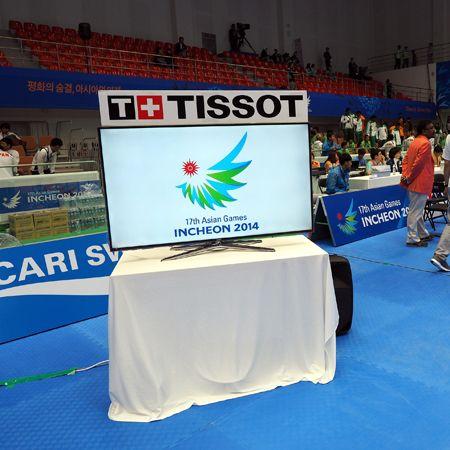

When timed records in sport are broken, they do so because reliable timing has proven it. Tissot are at the cutting edge of technology that has come a long way since the days of a man with his finger on an analogue stopwatch. Esquire spoke to Eckhard Frank, Chief operating officer of Swiss Timing, at the 17th Asian Games in South Korea about how events are timed and how technology is changing the way we view sports.
Out of all the events, which is the hardest to do time keeping for?
You need the most discipline in sports where the focus is on the timing, such as in athletics or swimming. These kinds of sports require a lot of attention to detail and preparation because of how fast paced they are. For example, in most cases a 100 metre race takes place in under 10 seconds, that’s why you also need more timing equipment for these sports.
Aquatics is one of the only sports where the athlete himself stops the time with a touchpad. We have cameras on each line to monitor exactly when the athlete touches it so that we can see that exact moment from a visual point of view as well and not just an electronic point of view.
In athletics there’s a famous photo-finish camera where the picture you see actually isn’t a single photo; its 2,000 pictures a second. By putting that together, since its coordinates are all set on the finish line, you’re able to see the full arrival of a run. With a cursor, you can go into that so-called ‘picture’ – which is in fact many pictures put together – and measure the exact time the athlete passed the finish line. You can measure that for all the athletes, not only the one who achieved the best time.
How do you link it to the gun?
It’s linked to the timing system so the ignition is done by the electronic gun. The camera is not stopping anything because you have a picture to follow up with. When you see what is called the ‘best time’, the scoreboard at the venue will stop the running time a meter after the finish line. This is not stopped by the photo-finish, but the cell which stopped once the racer passes by. But it doesn’t mean that this is the right time because in athletics you know that it’s just a point of reference. For example, in cycling it’s the middle of the wheel, in cross-country and winter skiing it’s the shoe. That’s why you sometimes see those funny pictures where the guy is leaning back and putting his shoe ahead or in athletics where the runner is jumping past the line.
How accurate was timing prior to these things? Are records from before reliable?
They were reliable but the big difference was in the late 70s and early 80s, which is when things were first done with an electronic system. In the old days the stop-time was measured by hand and there is a delay between what you see and what you do whereas nowadays it’s instant. When we measure 1/100th of a second, our machines have to be accurate to 1/1000th of a second. Today we go even further because the systems are faster. The big jump was when timing changed from being manual to electronic.
Another big step in technology was when IT systems were put into the loop for data management and displays for the community, because in the old days it sometimes took a couple of hours to get the results. This was because they would try to re-analyse the results and a lot of print weren’t done with printers till they appeared in the 60s, so it was all done manually.
At the very beginning of the Olympic games or multi-sport games, it wasn’t necessary to have the time because all that mattered was who came first, second and third. But they wanted to talk about records and timing had come up early because athletes wanted to use it when they were training, however in a race it was just about the top three. When you talk with athletes you see that they’re very focused on the gold and the rest doesn’t count.
When everything went digital, in regards to records, you were eliminating the human reaction time…
Definitely, the accuracy is a lot higher now compared to back then. There’s no discussion on the time now either, since in the old days the timing was sometimes done by a couple of guys. If you look at the old pictures you’ll see a couple of timekeepers sitting and discussing the time they each got. Once you start accommodating such things, that’s when it starts getting a bit difficult. The big step was also the photo-finish itself because that’s the next step in checking accuracy and especially now since we’re getting records which are very close to each other.
We don’t define the rules for how accurate timing has to be, in terms of whether we take 1/10th, 1/100th or 1/1000th of a second. The faster the sport, the higher the accuracy has to be and that’s why in this case we easily go as high as 1/10,000th of a second.
In hockey the stopwatch is the whistle, so in effect you’re changing the sport itself because you’re creating more game time. Is there anything else you’re doing that’s having that kind of effect?
We always do these in cooperation with the federations and the ideas always come from our engineers. We have more than 100 engineers in development alone. It’s not only about technology as in electronic systems or software, but also simpler things.
For example, the back stroke in swimming. The swimmers just put their feet on the touchpad and then start and the problem with that is sometimes when it’s slippery people don’t get the right start. So we provided a system which allows you to put your feet on a platform that gives you more stability. It’s very easy but you have to make it bearing in mind that every swimming pool is a little bit different in terms of the depth of the water. It also has to be something very light that can be put away because when you have a medley race there’s only one back and forth lap for backstroke, so you’ll have to take it aside anyway. These are the kinds of things we’re also doing, so it’s not just one type of technology.
During winter, we also made a special localization system for bobsleighs to enable you to see where the sleigh is going and also the speed and acceleration when it’s going downhill. Tissot was also working with the ice hockey federation on a system where you can localize a player on the field. This is something that can be seen on television, so it’s interesting, but it’s also for the athletes to know the configuration of the moves they made to try and gain a point. It’s quite exciting to see from a training point of view as well, since it’ll let them know how much distance they’re covering in a match. They used that on a referee and found out that he actually covers more distance than the athletes.
Are there sports you’re not involved in that would benefit from what you do?
There are a lot of sports in which we’re not active because they’re too small in terms their audience. We’re involved in the dragon boat races, it’s not something that’s too spread out, but there we can use the software and systems we already have for rowing. We have the same approach to the canoeing slalom as skiing. It’s the same system although the start is different because in skiing you have a gate and in canoeing there’s a cell and at the end there’s cell number 2 which is where you stop the time. Cricket is very specific and we only work in that sport during the Asian Games and use some suppliers. But we at Tissot are still the ones responsible, so the organisational committee wants us as the partner there and don’t want to give that to anybody else. So we are concentrating on using certain suppliers in our overall system. So when they’re doing the cricket for example, what they do has to go into the bigger data management afterwards which is part of our business.
Could the photo-finish technology potentially be used in football to judge whether a player is offside?
It could definitely be used for that, it always depends on how many people you need to operate it and what the benefits are. What has been used so far in football is quite expensive because the system is quite costly. In photo-finish the operation is done by us but it’s the referee who makes the decision. So in 100 percent of the cases he will agree with what we show in the picture but its only official if he agrees.
We’ve gotten involved in rugby over the last couple of years to see what we can do more than just sponsorship from a timing perspective. There’s a rule in rugby where the kicker has to kick within 60 seconds of a try or penalty but no one has enforced it because they don’t have the tools or instruments and the referee is casual about how long the minute lasts. But the French rugby federation wants to enforce this rule because they want to speed up the game. The English guy Johnny Wilkinson likes to take an hour and a half over a kick. That is exaggerated but the process he goes through takes a minute and ten to a minute and twenty seconds. So it slows the game down and that’s why they want to enforce this rule.
So they came to us with that problem and asked how it could be enforced. There’s a Swiss timing system we developed that’ll make it publically viewable to everyone in the stadium and on TV. It integrates to the system so as soon as the referee gives the signal he presses a button and the board with the match time starts a 60 second countdown on the side. Apparently there have been very few cases this season where it has gone over that 60 second mark and if it does then the referee will give the scrum to the other team from that position. The speed of the game has really picked up because of it and people are conscious of that. At first referees were hesitant because they knew the player had to prepare and waited until the kicker was ready. But it has really sped up the game because the kicker knows he has to be in the right position when the signal is given or else he’ll run out of time. We changed the sport a little just through a technical development.
Timekeeping in some sports was never that important, the referee is in charge of it in football. There’s a time displayed on TV which is a theoretical demonstration of how much time has passed but only the referee knows how much time is added on. In rugby the referee also decides the time but he calls time-on and time-off so that everyone knows he’s stopping it. The problem is that on TV the time display stops but in the stadium the big clock just continues. So you get to 80 and think that it must be the end of the game when there are actually two or three minutes left. The integrated system we have goes from the stadium to the TV so that everyone sees the same time. It’s a small technical development which isn’t that complicated but it has a big effect on the game and is appreciated by spectators and players.
Developing a photo finish camera is not that complex as technology moves forward. We have ones in the Moto GP that capture images at 10,000 frames per second, that’s not complex technology but it makes a hell of a difference to the actual result because we’ve had people who’ve won by 1/100th of a second. We had one literally in dead heat and you couldn’t pick out the winner on the picture, you could even go back over the second’s 10,000 frames in that scroll but there was no difference.
It’s not our role to decide who wins; we just make the technology available. There’s a rules commission that says if it’s a dead heat then the one who had the fastest lap is the winner. The technology is incredible because the racers are going at a speed of 140 kilometers per hour when they cross the line. There were a lot more dead heats in the olden days because the winner couldn’t be picked out.
We now have goal-line technology in football to see if the ball actually crossed the goal line, but it has killed the pub argument. Such as if England rather than Germany would have been in the World Cup final if it wasn’t for a dodgy decision about a ball crossing a line.
You’re eliminating questionability and that is good for the sport but you may be ruining the pub debate.
We have ones in the Moto GP that capture images at 10,000 frames per second, that’s not complex technology but it makes a hell of a difference to the actual result
So it’s good for things like 100 meter races and similar sports but less for sports like football which are less linear. It makes things sterile if every decision such as an offside would be correct because it would become like a computer game since it would never be wrong.
It would difficult to set up a photo-finish camera in football because you would have to have 20 of them across the field, stability is an issue, it might not be directly in line and so it would be very difficult to get a perfect angle. These days you don’t even need to use the TV camera since there’s a human decision being made. But you never take the human part of refereeing out of it, you never remove the decision making process from the federation. You just provide them with more information which they need. What the rules are is up to them, such if whether they should go to 1/100th of a second in athletics.
Some races such as the Moto GP are 1/1000th of a second and we could go into the 10,000th’s or even further because we have the technology to do that. Once I saw a finish to a Moto GP where the winner originally won by 1/1000th of a second but unofficially it was by 0.000846 seconds. We have that measure to know the exact time but there has to be a line you draw, some athletics choose to round up and others round down. We have to fit it around the federation and their rules. They make a decision and we just put it into action by executing what they tell us to do. We never tell them how to make decisions. We just tell them what technology we have available and if they would be interested in it. If it’s not something they would consider having because it would change fundamental rules then we won’t develop it for them.
Who has said no?
Normally it’s a case of whether the project can be financed, no one yet has said no due to developmental reasons or a fundamental change in their rules. It usually fits in with their processes and is practical for them.
How many full time staff do you have working on these projects?
About 420 people across 3 offices in Germany, Switzerland and the Czech Republic. At the games here the Swiss Timing team has 222 technicians and 18 support staff so 240 altogether. The Olympics will have even more because the event is a huge undertaking for the Swatch group. The full time staff, even the ones here, are always already working on the next event or project. We have a full-time guy based in Azerbaijan for the European Games next year working on integrating the IT systems so it’s full time work. For them it’s what they do and live for and that’s what’s great about being in a company focusing just on that.
Tissot Sports is a part of multiple sports and we’re also involved in multi-sport games such as the Asian Games. It has been a two and half year project from the initial discussions till now. We have developed the timing in the sports right from the beginning since we were at the first meetings that took place. So it has been a teamwork project which is important for the brand in terms of marketing.
There are also big risks involved but so far we’ve managed to get it right. For example, in fencing things are going very fast as you can have multiple hits every 1/10th of a second and up to 7 each second. In one case a referee who was attending the Olympics for the first time, normally the athletes in fencing must have a certain distance between them before they can start, started the bout when they were too close to each other. They began when they saw the time starting but you only get to see the second while we at the back have a 1/1000th of a second clock running which is unseen. Hence the athlete said that the time wasn’t running. The last second of the match could last around 3 minutes because of the stops. When the referee pushed the button to restart and says ‘Allez!’ which is a long word so it makes a difference whether you push it at the beginning or at the end. There was no error made but there was a scandal because French Fencing Federation felt really bad.
Is being 100 percent correct every time in a sporting decision taking that soul and debate out of the sport about who was right and who was wrong. Is there a risk involved in making it too clinical?
In a timing sport you need that accuracy. In football you’re talking about seconds which can be measured using many devices, you don’t need something special. The referee has the freedom to add another minute or even a couple of minutes so time doesn’t have the same role because you have to take whatever the referee says.
Do you think football and other sports should also implement your timing system just like hockey has in order to have an accurate amount of game time?
That is my perception although I’m not a football specialist, but in a football match size of the field of play is very different in contrast to the 100 meter track which is very precisely measured before any athletic event. In hockey we didn’t do anything apart from reducing the reaction time, the referee still blows the whistle before the puck goes off the ice except before the time was then started manually. So all we really did was remove the human error in the timing of the game.
What technology are you currently working on for the future?
We’re developing technologies which have a lot to do with the positioning of athletes and how to better explain to the public what exactly is going on. For example, we do a 3D animation in diving so can see exactly what he’s doing during the exercise such as all the turns and twists which is really clever because you can figure out what he intends to do. It’s also not at the same speed so you can see all the rotations he does. We also work on the scoreboards and how to bring information to the public which is very important. It looks very basic but you need to work on graphics, colours and there are some rules you need to put into place so that the information isn’t disrupted and instead focused on properly.
We also want to include this technology on systems such as phones and tablets because of the impact they have on data. Technology is developing but we still use some paper which needs to be aligned and improved but in the future we expect everything to be electronic. So there are a lot of thing that are changing from an operational point of view. The technologies for timing systems we have are already very precise and equal in terms of their reliability and back up. The measurement of time is synchronized to many digits after the comma so you don’t see any difference or inconsistency because of the technology which uses satellites and other similar things to be very precise. We always synchronize our technology with GPS systems at the beginning of an event so that it stays consistent throughout. When you took at the two timing systems, the main and the back, they’re both always running the same.