

On 7th April 1805, the French emperor Napoleon Bonaparte ordered two envoys to depart immediately for Tehran. They were Pierre Amédée Jaubert, a trusted adviser, and an eager, ambitious arriviste, Antoine-Alexandre Romieu. Only one would make it back alive.
Romieu was an adventurer. Born in 1764 in a mountainous region of southeastern France, he was working as a municipal councillor when revolution in 1789 changed everything. A decade of increasingly eye-catching military escapades made him a national name, and he secured a diplomatic posting in 1801 to the Mediterranean island of Corfu – then a fortified outpost of the French Empire under Napoleon.
Perhaps bored by three years overseeing trade in a Balkan backwater, Romieu returned to Paris in 1804 seeking greater thrills. Through a high-up contact in the military, he petitioned Napoleon’s chief of staff, Louis-Alexandre Berthier, for a role in active service.
By then, Europe was at war. With the outbreak of open conflict between France and Britain, Napoleon began massing an army, ready to invade England. His navy faced the British fleet in the Mediterranean and he was also squaring up to the Russians and the Austrians.

Antoine-Alexandre Romieu
After the extraordinarily successful 1799 expedition to gain control in Egypt, Napoleon had also begun contemplating further territorial advances to the east. As Romieu toured the corridors of power, imperial plans were forming to launch a diplomatic thrust beyond Turkey. Rapprochement with the Shah of Persia, the thinking went, would form a bulwark against Russian power – and would also serve as a useful bridgehead from which France could attack perhaps the greatest prize of all: British interests in India.
Romieu was in the right place at the right time. He packed his bags for Persia.
The move did not go unnoticed by the British. In late September 1805, as war between France and Britain continued to escalate, a letter landed on the desk of William Bruce, Britain’s diplomatic representative in Bushire, a normally placid port on the Persian shore of the Gulf opposite Bahrain.
“There is a French officer of the name of Romieu, whose destination is suspected to be the East,” it warned. “Romieu has the reputation of being a man of talents, of having a considerable sum of money at his disposal, and of being a great proficient in the science of intrigue.”
The letter had been written by Alexander Stratton, Britain’s ambassador in Constantinople, and forwarded to Bruce by Harford Jones, a British official in Baghdad.
It was dated June 14th, more than three months earlier. In the same delivery, Jones had included another dispatch, from July 25th, by which time Romieu had been spotted in Aleppo. A detailed description ran:
“His person is of the middling size, that is about 5 feet 8 or 9 [1.74m], without any prominent feature of countenance, his complexion and hair dark, his age about 36 [Romieu was actually 40], his habit rather spare, and when he speaks a slight lisp in his speech is discernible.”
Napoleon’s secret mission to Persia was a secret no longer.

Pierre Amédée Jaubert
Bruce acted fast. The next day, September 28th, he wrote to his subordinate in Muscat, alerting him to Romieu’s presence, and sent word to ports all along the Gulf to keep watch. But unbeknownst to Bruce, by then it was already too late.
Romieu had arrived in Constantinople on May 20th, meeting up with Jaubert – and setting off alarm bells among British observers. British trade official John Barker tracked Romieu from Constantinople (Istanbul) to Antioch (modern Antakya in southern Turkey) and then to Aleppo, where the Frenchman had changed large sums of money into gold – further evidence of his intentions to continue east.
It was at this point that, perhaps, panic set in. Outside Aleppo Romieu was waylaid by a Tatar assassin named Sarcos Haly – hired, from one account, by Barker himself.
“Rapprochement with the Shah of Persia would serve as a useful bridgehead from which France could attack perhaps the greatest prize of all: British interests in India”
But Romieu survived the encounter and a war of words broke out in Constantinople as French diplomats pointed the finger at Britain. Meanwhile Romieu journeyed on to Baghdad and then Tehran, arriving on September 25th while Stratton’s letters to Bruce were still unread in transit.
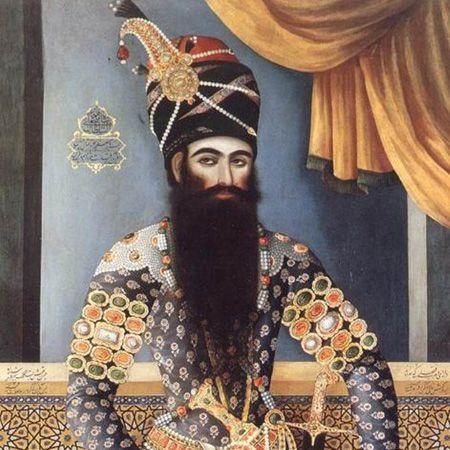
As Bruce’s orders spread along the Gulf to look out for a “person of the middling size”, Romieu was already seated in the court of Fat’h Ali Qajar, Shah of Persia, presenting compliments from Napoleon, Emperor of the French. The Shah was impressed and looked favourably on the proposal of an alliance against Russia.
But then Romieu was suddenly taken sick. After three days of fever and vomiting, on October 12th he died. Almost immediately, rumours began to circulate that he had been poisoned. The French accused the British ambassador. Britain denied involvement. Fat’h Ali had no choice but to bury Romieu with the case still unresolved.
Jaubert, meanwhile, had vanished. It later transpired that he had got as far as Bayazid (modern Dogubeyazit), on the Turkish-Persian frontier, before being arrested. Jaubert only emerged from his underground cell months later, eventually making it to Tehran and, after two years’ hard slog on the road, back to Paris.
The mission was a failure. Less than ten days after Romieu’s death, the British fleet under Nelson defeated the French and Spanish at the Battle of Trafalgar, curbing Napoleon’s territorial ambitions.
France and Persia did sign an alliance, on May 4th , 1807, but it came to nothing – within weeks, Napoleon had also joined with Russia in order to attack Britain closer to home. The Shah was forgotten.
Nineteenth-century French travellers reported visiting Romieu’s domed mausoleum in Tehran. But then the reports peter out. Today, nobody is even sure where Napoleon’s “man of talents” lies.