
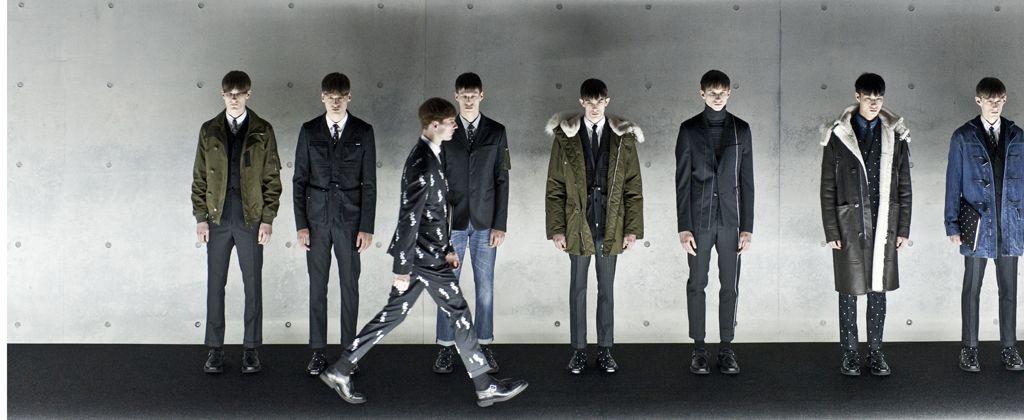

It’s the morning after the night before and while the Dior Homme team are still sleepy, artistic director Kris Van Assche is clear eyed and sharp witted when we meet him in a Shanghai hotel room. Last night, the team
presented its A/W14 collection to the financial capital of China, followed by a private, champagne-fuelled afterparty, soundtracked by French techno DJ Gesaffelstein. Unlike most journalist-heavy events, the whole crew, including Van Assche, were in full-on party mode well past 2am. In fact, we’re discussing the fact that the team went to a dive club after the after-party when Van Assche bounces in. The show itself was reason enough to celebrate. Critically acclaimed as one of his strongest for the brand to date, the collection was inspired by Christian Dior himself and presented Savile Row suiting in myriad silhouettes, with a polka dot and lily of the valley print running throughout on ties, belts, shoes and even suits. It was also one of Van Assche’s most formal collections yet, considering the designer has a firm affection for casual wear. But truth be told, the 37-year-old designer, who took the helm at Dior Homme in 2007, has been on a winning streak for the past few years. Many may see his story as being closely entwined with his former boss, Hedi Slimane, who headed the brand from 2000 to 2007, but the designer is now clearly writing his own tale. After growing up in the Belgian municipality of Londerzeel and graduating from the prestigious Royal Academy of Fine Arts in Antwerp in 1998, Van Assche began interning with Slimane, who was designing at Yves Saint Laurent at that time. When Slimane moved across to Dior two years later, the young Belgian designer followed, before leaving in 2004 to start his own label. When Slimane left Dior in 2007, Van Assche was called back to continue Slimane’s legacy and while he’s retained the cool, rock’n’roll aesthetic that Slimane left behind, Van Assche has managed to carve out his own territory for the brand. And for someone so softly spoken and seemingly shy, the menswear designer now has our full attention.
Kate Hazell: We’re sorry to get you out of bed so early after last night…
Kriss Van Assche: It’s okay, I’m used to it. I’m tired but I’m fine.
KH: What really inspired you to be a fashion designer when you were young?
KVA: I became interested in fashion at a very young age. Basically when I started realising that clothes didn’t just grow in a closet, you know? That somebody was designing them. There is a time, as a child, when you take everything for granted but then there is a time when you start to question everything and so I wanted to be that person at a very young age. So I guess at the beginning I noticed the designers who were making the most noise, like Jean-Paul Gaultier or Thierry Mugler. Like the Parisian bad kids, you know? But then, through some self-education, I learned pretty fast about what was going on in Antwerp and I felt much more related to that quite early.
KH: So it was the kids making the loud noises…
KVA: Well that’s always how you learn about things, and then if you get to know about it you investigate it and maybe you feel more related to it. That was my case.
KH: Did you ever even dream that you’d be sitting in Shanghai presenting a collection to the other side of the world?
KVA: Well, as a kid I wasn’t really expecting to be sitting in Shanghai. But I did dream of moving to a big town; getting away from my home town was, for sure, a big project. But yeah, I didn’t ever really think that I’d move to Paris because Paris wasn’t really on my agenda; I didn’t like it in some weird way. I was more about New York.
KH: How would you describe your signature style?
KVA: It’s always difficult to put definitions, especially on my own work, and especially since they’re all constantly evolving, but I guess that this last Dior Homme show is pretty close to what I like. Even for my own brand there’s always a mixture, this constant balance between high-end tailoring and the more casual sportswear pieces, which is kind of a cliché, but to find that right balance is, I think, not so easy. And this show was definitely an exercise in that.
KH: I thought Some of the utility style pockets on the blazers were brilliant and a really nice tie-in to that contemporary but formal mix…
KVA: Thank you.
KH: What is it about more casual street wear that really inspires you?
KVA: I just think it’s a form of reality. I mean, the man I have in mind is a very active person. He’s not just the guy on a catwalk, so it’s supposed to practical; it’s supposed to be comfortable. It’s not just a showpiece. It’s supposed to be useful in everyday life. And I like to think that in one of my outfits you can go anywhere at any time. So it’s elegant enough to get away with anything, but it’s also cool enough to wear anywhere. I think that’s really what today’s fashion and reality is all about. I mean, it’s not like you can go home and change according to the next meeting.
KH: Absolutely— how many people still change their outfit to go out for dinner?
KVA: Yeah, right! That’s a really old-fashioned idea. It’s kind of romantic and it’s kind of cute when you work as a designer and you divide your show into three, like morning, day and evening. But in reality it doesn’t work like that anymore.
KH: Is that why you famously loosened the cut of the Dior Homme suit?
KVA: Well there are two answers as to why I did that. When I arrived at the helm of Dior, the big question was what am I going to do. I have my own label so I’m not going to do 100 percent Kris Van Assche at Dior Homme. I guess that wouldn’t have been the right answer anyway, even without my label. It’s going be doing what every designer before me was doing, so there had to be this balance to figure out. Usually people take over a brand that is dying, or hasn’t been cool for a while, but that wasn’t the case, although the look had become a bit mainstream and needed to be updated. That’s on a conceptual side. Then on a real reflection side, I felt that these stiff, uncomfortable, tight suits weren’t such a luxurious feeling and luxury is all about comfort and reality and just being able to move in your clothes. So the loosening up had a lot to do with that. The new vision of what I felt would be a high-end tailoring statement but yet still contemporary.
KH: It’s been 10 years since you first left Dior Homme — what do you wish you’d known then that you know now?
KVA: Wow! Umm… I don’t think I was naive when I launched my own label because when I got out of the academy I was only 22, so it would have been silly to launch my own brand at that point. I was an assistant for six years and then I launched my label. So I can’t say I was naive but I was still pretty young. It was maybe necessary to make that step, so I don’t regret anything. But I would love to be able to grow faster in a way. But I don’t regret anything; the way things have evolved is quite nice.
KH: Christian Dior himself inspired this collection. Was there anything that really surprised you about him while doing this research?
KVA: Well I already knew a lot about him when I was doing research as an assistant, so there were no surprises. I mean, the thing about Mr Dior is that he never did menswear. There was only this one tie collection, which as cool because he would always be dressing in made-to measure suits from Savile Row, which you could see in his womenswear. He had a real thing with men’s fabrics, like the houndstooth. So there has always been a link to menswear, although his clothes are extremely feminine. And if you look at his dresses, which are very feminine on the outside, they’re totally constructed on the inside. So, this again links to menswear, so I’ve always handled that as a starting point. The thing that I liked most about him — the catchphrase that comes up most in some of his biographies — is that he felt surprised that people thought he was revolutionary because he was
only trying to make women look more beautiful, which I think is pretty cute.

KH: So why did you show this collection in Shanghai particularly?
KVA: Well it’s the second time we’ve had a show in China. The first time was Beijing last year, which happened a year after I had been to Shanghai for a store opening, so I guess it was the next logical step, strategically speaking.
KH: Do you think it’s becoming increasingly important to have a big presence in the emerging markets?
KVA: I guess so. I mean, I’m not part of the strategic committee at LVMH [of which it is a part], but I know it makes total sense and Dior Homme is doing really well in the emerging markets like Asia and the Middle East. And the fact that we are coming here once a year is proof, so I can only be happy about that.
KH: Menswear is growing bigger and bigger…
KVA: There has been a real liberation. There have been some pretty huge icons that have helped — famous football players sharpening up and all that. I mean it’s really a huge cliché but they did help to erase this silly idea that being interested in fashion isn’t very masculine. There’s been this big liberation, this big revolution and now menswear is as interesting as womenswear and that’s really cool.
KH: Do you think men are getting braver in their style choices?
KVA: Yeah, now that it’s really okay, that makes all the difference.
KH: You’ve added two more mid-season collections this year. How do you get time to do everything?
KVA: Well, it is tricky. These mid-season collections have become very important and we decided to call them Spring and Autumn because they are such separate stories. They are not pre-deliveries of the catwalk shows; they’re a totally different idea and totally new concepts. We started presenting them in catalogues and presentations — like the one I’m doing next week in New York — and its growing fast, which is cool. But it does take a lot of energy and a lot of ideas because it does need to be creative and we have a radically creative point of view, which is in between collections. So it’s certainly not easy, but we’ve grown into that. It wasn’t a decision that [was made] from one day to the other; it kind of just evolved. I was supposed to come here on Sunday, and my team did, but I ended up coming on Wednesday because I had too much to do.
KH: Are you constantly looking for inspiration in everything around you?
KVA: You can’t really program inspiration. I mean, sometimes I do have a trip out of Paris just to get inspiration. That can happen for a few days a season and it can work but it’s more about going to stores and seeing what other people have done because you never really go there and you need to know what other people do, if only just to know what not to do. But apart from that it’s just constant work. I mean, I’m developing three Collections at the same time, if you count my own label, because I’m now working on next Spring and obviously two Summer shows. So the inspiration is like a constant circle now, and once I finish Spring I’ll be thinking about Autumn so it never really stops. I need to constantly think.
KH: So how do you relax outside of work?
KVA: I can enjoy just sitting on my terrace, because now I have a very nice apartment in Paris, finally — I looked for it for years. And so I have a little outside space and when the weather’s nice I can sit outside and go through the piles of books I haven’t had the chance to go through, so that’s cool. And when the weather’s not nice I’ll probably buy more books and go to galleries or whatever. There’s nothing extraordinary about it; it’s a form of constant self-education.
KH: How would you like your time at Dior Homme to be remembered?
KVA: I guess I would like the collections to be remembered, or the brand as a label. Dior Homme becoming one of the biggest, if not the biggest men’s label, is really my aim — that it would be unthinkable for Dior Homme not to exist. If it could be a little bit like what Mr Dior said himself: if it can make men feel more beautiful, or more comfortable or self-assured then that’s not bad. It is about clothes to be worn. I’m not a performance artist. I like to think I have a creative point of view and I put my heart in there and there are lots of stories to be told, but in the end it is out there and the fact that it is that makes me very happy. I want to make some noise.
Dior Homme is at The Dubai Mall, +971 4 330 8739