

Theo bucker is sitting in a plush suite overlooking a miserable,
cold and windswept Martyr’s Square in Beirut, listening to a song written in honour of his team’s recent heroics.
The coach of the Lebanese national football team nods politely, if a little awkwardly, as an aspiring female Lebanese singer explains why she felt compelled to arrive at his hotel with a MacBook under her arm and her producer in tow to play him a song she had written about a sport she had barely given a second thought to until recently.
“It came to me one night in a dream, all of the names of the players,” she explains to him, as the song — a bland but inoffensive Arabic pop number — wafts through the room. “I felt inspired after the last victory,” she adds, before giggling a little too hard. Bucker smiles mechanically.
That victory.
It had been a long time since the Lebanese national football team had tasted any victory at all, let alone inspired the affections and songwriting talents of the country’s beautiful people. Civil war, assassinations and lingering sectarian squabbling had seen all supporters banned from attending local league games since 2006 — lest they start a new conflict.
For years, the national team’s Shia, Sunni, Orthodox Christian, Armenian, Maronite and Druze players had been unable to escape the burden of Lebanon’s history, nor rise above the hatreds. Things had become so bad that by the time they began group qualifying matches for the 2014 World Cup, the country had plummeted down FIFA’s rankings and had become the lowest ranked team in Asian qualification and one of the worst teams in world football. But then along came Theo Bucker and with him the possibility that Lebanon might qualify for their first ever World Cup finals. This unlikely scenario has given the Lebanese an opportunity to remember that they can be greater than the sum of their parts.
The German-born Theo Bucker had been in charge of the Lebanese side a decade previously, before embarking upon a string of club postings throughout the region. He’d also won the Lebanese Premier League title with Al Ahed in 2008 — a first for the team. He answered the call when his adoptive country (he calls himself half-Lebanese after marrying his dentist the last time he took charge of the national team) came calling.
Things didn’t look good to begin with, after successive six-goal maulings at the hands of the UAE and Kuwait. But then something strange happened. The team started winning. And then came that victory: a 2-1 home win against 2002 World Cup semi-finalists South Korea on November 15 last year.
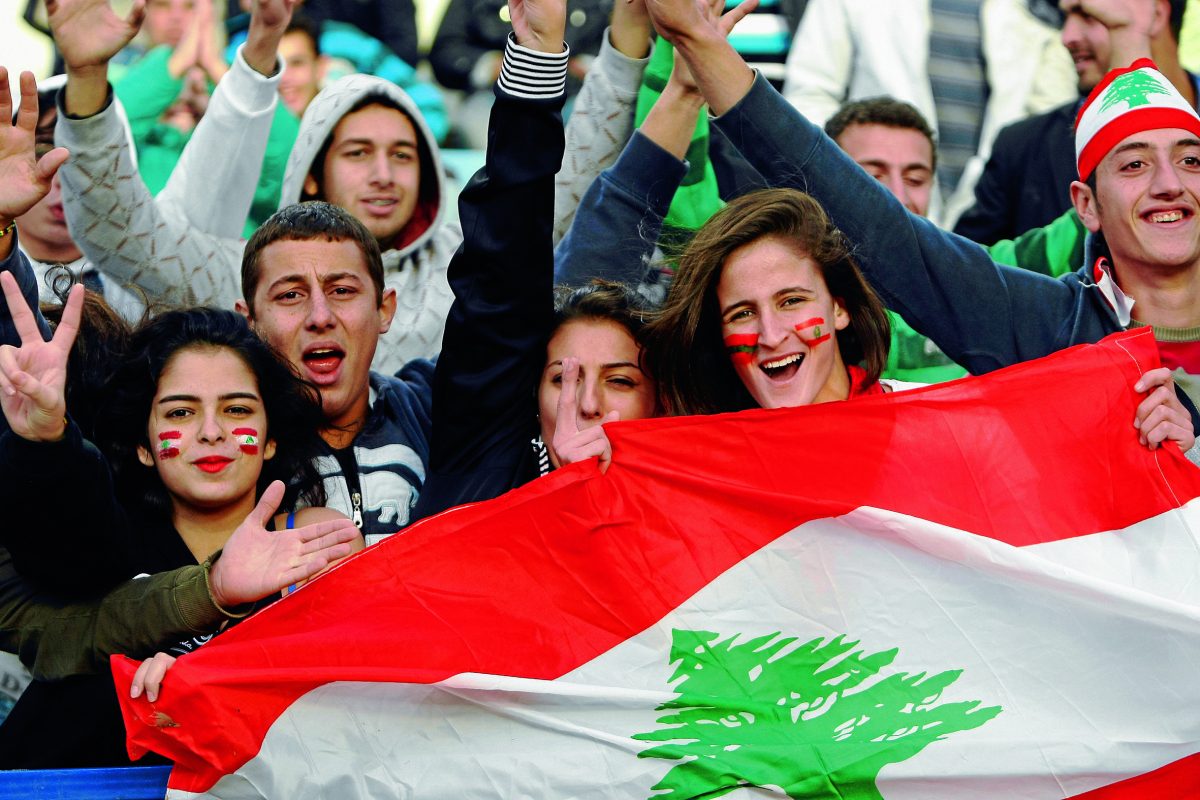
The victory, in Group B of the Asian Zone World Cup qualifiers, took place in front of nearly 50,000 fans at the Camille Chamoun Sports City Stadium after the government decided that the fans could return to the grounds. It gave the team hope of reaching the World Cup finals for the first time, and with it came an outburst of rare national pride.
 “Lebanon football before I arrived wasn’t under the carpet. It was deeply under the ground. It was not existing at all,” says Bucker, once the singer and her producer leave the room to get
a drink.
Bucker was right. The local soccer league mirrored the sectarian violence that led Lebanon towards a vicious civil war between 1975 and 1990. Each club had a distinct religious identity entrenched by the patronage of politicians who would help fund them. Teams like Ansar and Nejmeh would be supported by the Sunni Hariri family, first by the assassinated ex-Prime Minister Rafik Hariri and then by his son Saad. Safa is supported by the Druze; Racing Beirut is aligned with the Orthodox Christians and Al Ahed has strong links with Hezbollah. Al Ahed’s shirt sponsor is Al Manar, Hezbollah’s TV network, which is considered a terrorist entity in the United States. In those circumstances,
a five-year spectator ban was probably inevitable.
“The Lebanese are tired of all the problems of the past,” Bucker insists. “They are happy that this is uniting them. Now they have a very good reason to come back to the stadium. I believe it is very good for the nation. There’s a deep love for football in
the country. But before they had no home to dedicate their love. Now they have
a home and they can support their own team.”
Such has been the national team’s resurgence that the government and the Lebanese football association has also finally allowed fans back into the stadiums for local league games. But it is a tentative recovery. Two days after meeting Bucker and his female admirer, I travel to the Olympic Stadium in the northern city of Tripoli where the fragility of Lebanon’s sporting recovery is laid bare. Just 108 fans turn up to see Tripoli Sporting Club take on Bucker’s former team, Al Ahed.
The stadium used to be the pearl of Lebanese football — a modern construct located so close the shore of the Mediterranean you could hear the waves lapping at the scrubby beach nearby. It had been built when Lebanon hosted the 2000 Asian Cup and represented an era of new hope for the country, which was experiencing a post-civil war economic and cultural boom — a mirage that ended when a massive car bomb killed the former prime minister Rafik Hariri in 2005. Now it had fallen into disrepair. Football hadn’t been played here for five years because the army seized it to use as a base while dealing with the restive Palestinian refugee camps in the north of the country.
When I visit, soldiers with machine guns patrol the running track, and the pitch is a green and brown mess destroyed by the helicopters that regularly land here. Two men with coffee cups scoop as much muddy water from the penalty box as quickly as possible before the teams emerge from the tunnel.
Khodr Arja, a sixteen-year-old Tripoli fan, cannot remember the last time fans were allowed into the stadium. “It’s new and we are happy to see it,” he says from the virtually empty stand as the match degenerates in the mud. “But the federation is not helping the audience to come here. They don’t support us. You have to pay LBP5,000 ($3.25) and these are poor people. It should be for free. Look at the pitch. It is a farm, yes? The worst pitch in the world. Everything is bad.”
But even a few dozen fans marks progress. The last Lebanese league game I attended was three years ago, at the climax of the 2008-2009 season, when Nejmeh snatched the league title from Al Ahed on the last game of the season. The final round of matches took place with the backdrop of tense parliamentary elections. Despite fans from both sides being barred from attending their respective matches, a crowd of Nejmeh fans aligned politically with Hariri attacked the Hezbollah-backed Al Ahed’s team bus. The bus careered down the street to escape, crushing passing cars as it went. It was a miracle no one was killed. Back then it was hard to see how the supporters could ever return the stadiums.
 “We don’t see many fans but it’s better than nothing. It is like a revolution in Lebanese football,”
explains Ali Hijazi, a soccer journalist with Al Jadeed TV watching the game from the freezing stands. “The football was miserable. Politics is a great reason why Lebanese football was bad. The politics is still here in Lebanese society but Theo Bucker is working with the national team, with no politics or religious views. The Lebanese national team is doing the job that no politician can do.”
Both teams grind out an excruciatingly bad goalless stalemate. Al Ahed’s star player, twenty-one-year-old Ahmad Zreik curses under his breath as he leaves the field. He’s used to better than this, having spent five years playing college soccer in Michigan before Al Ahed called him. “Look at the field. It is not for soccer,” he says pointing to what has now become a brown rectangle of wet dirt. “I left here to go with my family to America. But then the team [Al Ahed] call me many times. They offered me the same money I was earning there.”
Zreik was one of the beneficiaries of Theo Bucker’s new regime, and was put straight into the national team just a few weeks after returning from Michigan. Despite the setbacks, he is happy to be helping his country. “Every day I worked fourteen hours in my uncle’s restaurant [in Michigan],” he says. “Now I can dream of playing in the World Cup.”
The next day Zriek joins Bucker and the rest of the Lebanese squad to prepare for the most important game of their lives. They are to travel to the UAE to play their final match in the third round of Asian World Cup qualification. Victory, or even a point, will be enough to ensure their passage to the fourth and final group stage — where four teams are guaranteed passage to Brazil. It would be, by some distance, the furthest Lebanon will have ever reached. Even defeat against a team that has already been eliminated won’t be a disaster if other results go their way.
The team should have been travelling to Doha now to play a friendly there in preparation for the qualifier, but the Qataris pulled out at the last minute — a regular occurrence when you are at the bottom of the international game. So the players arrive instead for training at Beirut’s Safa Club stadium in blazing sunshine, the cold and mud of the previous day’s game in Tripoli a distant memory. Bucker screams instructions to his players as he runs them through their paces. He takes a tough-love approach, offering both his open hand and his fist.
When training is finished, he gathers the players to the dugout, banishes the two journalists from the pitch and gives a final pep talk on Lebanese soil. But his loud Germanic bark can still be clearly heard from the sidelines. “You are the ideal for Lebanon and Lebanese football,” he shouts. “Think: if you can’t respect each other, how will other people here respect you?”
On February 29, the day of the World Cup qualifier in Abu Dhabi, Lebanon’s team hotel is deluged by fans and dignitaries draped in red, white and green, waiting to have their pictures taken with the team. Also present are several politicians from the rival anti-Syrian March 14 and pro-Syrian March 8 factions that have dominated Lebanese politics. The national team offers both the chance to be on the same side for a change.
“We are all gathered, we are all united under our flag. This is a success for our flag, a success for our country and not any one sectarian group.” explains Nadim Gemayel, who at twenty-nine is Lebanon’s youngest MP. Gemayel’s father, Bachir, was president-elect before he was assassinated in 1983. Syria, or groups aligned with Syria, were suspected of carrying out the bombing. “There are a lot of members of parliament, members of [Shia political party] Amal, from March 14, March 8, six or seven deputies. We are all united today to support our Lebanese team.”
Fans drawn from Lebanon’s huge diaspora have arrived in their droves, wearing the Lebanese flag on their shirts with flags painted on their faces. It is a rare outpouring of national pride in a country where the flags of different militias are usually more prevalent. “It’s an amazing feeling to be together supporting our team,” explains Ahmed, who has travelled down from Dubai with his wife Roula to see the game. They both take in the patriotic scene outside the stadium as thousands more file in to the Al-Nahyan Stadium. Nearby, one man is struggling to hold a full replica of the World Cup that he had cast himself out of metal. “If we qualify to the Mondial, to the World Cup, it will be in Brazil and there are eight million Lebanese living there. We will fill all the stadiums!”
They are both surprised to hear that Lebanon’s much maligned politicians, blamed for stoking sectarianism for their own gain, have arrived in force too. “They [the politicians] have to learn, otherwise it is no use. They have to learn that we are Lebanese. We are not religious. There is only one Lebanese flag.”
“We are all the same. We are one hand. In all circumstances,” adds Roula, before they join the flood of fans entering the stadium.
The spectators have arrived hoping for a coronation, outnumbering their Emirati counterparts by a margin of four to one. But, like most things in Lebanon, the match doesn’t go to plan. Instead of sweeping their way into the final group stage, the incessant noise from the Lebanese fans dies as they are beaten 4-2. Only a clutch of late goals by South Korea against Kuwait confirms Lebanon’s passage to the final group stage of Asian World Cup qualification. Lebanon have limped home. And Theo Bucker is livid.
“We were not focused and were scared, we scored four own-goals,” he says immediately after the game, sitting on his own in the dugout watching his players disapprovingly from a distance. But he is realistic too. “When we started talking about this out loud, people were laughing at us. Then we started to win matches. We have to recognise that our progress will go in waves. The crowd is one of the points I was counting on. It was an atmosphere like at home, which is why I couldn’t understand the first half when our players were afraid. But we will go to Malaysia and see what the draw is like. And we will start again.”
 No one is laughing at the team, despite the loss. The 4-2 defeat dampened the enthusiasm somewhat but it was still significant. In a country that is being slowly de-stabilised by the Syrian uprising — a country that still has deep roots in Lebanon and was in occupation until 2005 — Lebanon can use any glue it can get its hands on. The October car bombing in Beirut, which killed a prominent member of the Lebanese security forces, proves just how fragile life remains.
Theo Bucker will subsequently travel to Malaysia for the Asian Football Confederation’s final 2014 World Cup qualification draw. His team is placed in a tough group with South Korea, Qatar, Uzbekistan and, controversially, Iran –
a country whose regime is thought to sponsor not just Syria but Hezbollah too.
Defeats against Qatar and South Korea during the summer will seem to doom their World Cup dream once again. But what follows is perhaps a moment that even surpasses that victory against South Korea. A draw against Uzbekistan is followed by Lebanon’s first ever victory against Iran in Beirut in September.
So Bucker’s dream of making it to Brazil — where between seven and ten million Lebanese Brazilian fans await — is still alive. Although, as with most of the campaign, indeed, as with most of Lebanon’s history, fate has not been kind. The final match will be next June. Against Iran. In Tehran.
Now that would be a victory for Bucker and Lebanon’s female singers to savour.
By James Montague
Esquire, December 2012