
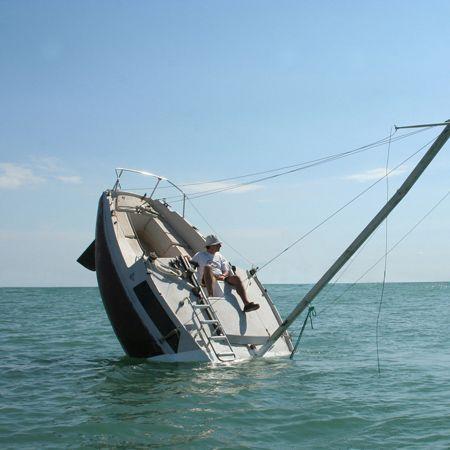

Around 70 per cent of the earth is covered in water, so whether you’re flying over it or just larking about on a boat trip, it pays to know a few things about how to survive when you’re on the wet stuff.
Make an SOS call
If you find yourself drifting on a boat and need to call for help, turn to channel 16 – that’s the one the coastguards will be listening to. Failing that, there should be a flare on board, but you may find yourself in a situation where these things are not readily to hand. Then, it’s worth memorising this one, key piece of Morse code.
The Morse code for SOS is three dots, three dashes and three dots (…—…) or in the case of flashing a light, the dots are short bursts and the dashes mean leaving the light on a little longer. Get a person’s attention and repeat this pattern at regular intervals. You may also want to memorise this morse code: (- .- .–. . / – …. . / — .- – -.-. ….) It says TAPE THE MATCH and it could save you having to rely on watching the goals on YouTube once safely back on shore.
Man overboard
Don’t just dive in after them. The best method is to throw a life preserver that’s tied to a rope and pull them in. Sometimes they will be panicking, so if you are going in after them make sure you have a life jacket on or at least be holding a life preserver. The key is to then relax that person as once calm the body’s natural buoyancy will keep their head above water.
Survive on a raft
Once you are on a life raft help should be on the way as modern versions contain an EPIRB (emergency position-indicating radio beacon) but that doesn’t mean it’s time to kick back and get a summer tan.
In fact, you are still at risk even when you are in the life raft as a combination of wet clothes and wind can rapidly cause hypothermia — exposure can kill faster than thirst or hunger. If you have a chance, put on as many clothes as possible before boarding. Depending on your location, you will run the risk of becoming dehydrated so try to limit your physical exertion and exposure to the sun. If you are getting too hot then don’t go swimming to cool off as there is a fair chance that your raft will drift faster than you can swim, and swimming will use up a lot of energy in the first place which you should be conserving at this point. It is better to wet your clothes with sea water.
Find water
Ironic, considering you’re surrounded by more of it than you’ll probably want to see for a while, but don’t drink sea water. And despite what you may have heard, drinking urine is really not advisable either. Consuming alcohol or smoking will lead to more rapid dehydration so leave the duty free behind and concentrate on getting drinking water. Having drinkable water is the most important thing as with that alone, you should be able to survive for 10-14 days. Without it you will probably manage nearer three days. If you don’t have good water, then don’t eat as eating uses up water in processing the food and sea sickness and food can lead to vomiting which will exacerbate your dehydration problem. To reduce your loss of water through perspiration, soak your clothes in the sea and wring them out before putting them on again. Desalination kits or solar still may be included in modern rafts. If you think that it might rain, set up a tarp or plastic container to catch as much of the water as possible and leave it out overnight so any unexpected rain won’t be missed. If you have a supply of water, start rationing right away. You really won’t need to drink much water the first day, no matter how thirsty you feel. Then try to limit your intake to 300ml to 500ml for a few days, eventually dropping it as low as 60ml to 150ml a day. Sleep and rest are the best ways of enduring periods of reduced water and food intake.
Am I near land?
At sea level you can only see 2.5miles in any direction due to the curvature of the planet. Look out for birds overhead at night as they usually fly close to shore. Cries of seabirds can be heard from a distance as can the sound of surf crashing on a shore. Remember that deep water is dark green or blue while lighter water indicates it’s shallower and possibly nearer land and look out for cloud formations as the Cumulus clouds will form over land.
Don’t get seasick
More likely, the biggest problem you will face on the water is that of general sea sickness. If you’re heading out on a party boat with a bevy of models (as MF does most weekends) the last thing you’d consider, is taking a little ginger with you —for a start, those freckly odd-bods don’t cope too well with the sun. But taking slices of the ginger root is a good, natural way to prevent motion sickness. If you’re prone to aquatic spewage then acupuncture wristbands also help — they don’t pierce the skin, rather just pressing on the pulse point of the wrist, and have a good record of working. Sitting in the middle of the boat will also lessen the rocking sensation.