

Internet searches for Trump deepfakes have soared by 90% over the last few months afterthe former president shared fake endorsement posts depicting images of Taylor Swift and her fans supporting the former president in the upcoming election. Every image was identified as AI-generated deepfakes, prompting a swift response from Swift, but it’s not the first time this has happened. Reportedly, over 4,000 celebrities have fallen victim to deepfakes, and the Middle East and Africa region has experienced a 450% increase in such cases.
The increasing threat of AI is projected to cost the global economy $40 billion (AED 147 billion) by 2027, but AIPRM has composed several expert tips for spotting deepfakes and protecting yourself from being yet another victim to fake yet convincing content.
Observe Facial Expressions and Movements
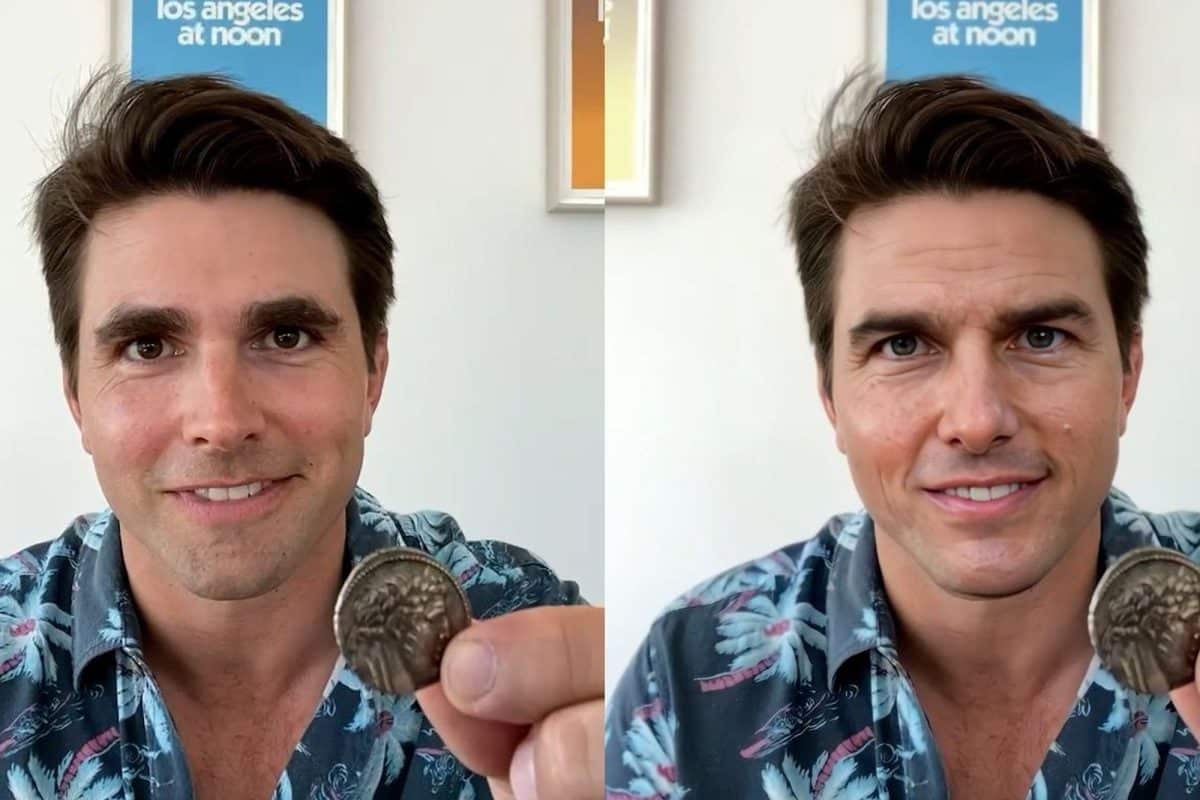
Chris Ume’s viral deepfake of Tom Cruise performing a coin trick in 2021 was so convincing that 78% of viewers could not distinguish it from the real thing. But a key factor in spotting such fabrication is to look at the shape of the face and ears, as ears are particularly difficult to replicate. Details like the uniformity of teeth, hair texture and facial structure are all the most exposing in terms of labeling deepfakes.
Another example is the viral video of president Barack Obama calling Donald Trump some not-so-nice things, which, if viewed distractedly, is pretty darn convincing.
Look for Digital Artifacts and Inconsistencies
Additional things to look out for is the blurriness or unnatural pixelation, which can be exposed through inconsistent lighting, shadows, reflections, hair/eyebrows/eyelashes that look melted, or even an extra finger.
Professors at the University of Washington created a game called Which Face is Real, where you can practice identifying AI generated faces; you’d be surprised at how difficult differentiating between real and fake can be.

Use Reverse Image and Video Search Tools
Uploading an image to Google Reverse Image Search can help identify if it’s AI-generated, manipulated, or being used out of context. And if there’s a video in question, services like InVID can surgically dissect videos to check the validity of this footage; if you were one of the first to view the Tom Cruise coin trick, InVID would’ve definitely come in handy.
Verify the Source and Context
Everyone’s favourite phrase nowadays is Fake News, but news that is genuinely is spreading like wildrfire across the internet, Elon Musk himself falling victim to a fabricated news headline. Considering that 30% of people rely on social media as a trusted news source, it is therefor paramount to examine the credibility of the sources behind the material you consume.
Google Fact Check Tools is another good way to sieve out misinformation and spare yourself the embarrassment of sharing fake news.
Check for Audio-Visual Synchronisation
Watch the lips closely, and if you do, usually you’ll be able to spot the differences from a human mouth to an AI generated one, as nearly a third of deepfake videos struggle to match sounds like M, B and P. Another example, if you look at animated films in the Pixar/Dreamworks style of digitalisation from just a few years ago, you’ll notice that the characters look odd when eating and chewing food. Often, the food merely evaporates when consumed, and the mouth/lips struggle to move in a believable fashion, as is the same for deepfakes.
As is evident in this Mark Zuckerberg video, where the biggest giveaway is how weird the mouth looks and how it’s not entirely synched with the accompanying audio.
“The World Economic Forum has flagged disinformation as a top risk for 2024, with deepfakes emerging as one of the most alarming uses of AI. If you come across a potential deepfake, the best course of action is to refrain from sharing it,” said AI expert at AIPRM, Christoph C. Cemper. “The power of a deepfake lies in its ability to spread, and its impact diminishes if it doesn’t disseminate widely.”
In the age of immediate information, one will undoubtedly find a bit of satisfaction in being the first to re-share and spread breaking news, and because of that, the need to be careful and skeptical is more paramount than ever. As Abraham Lincoln once said, “Don’t believe everything you read on the internet.”
