


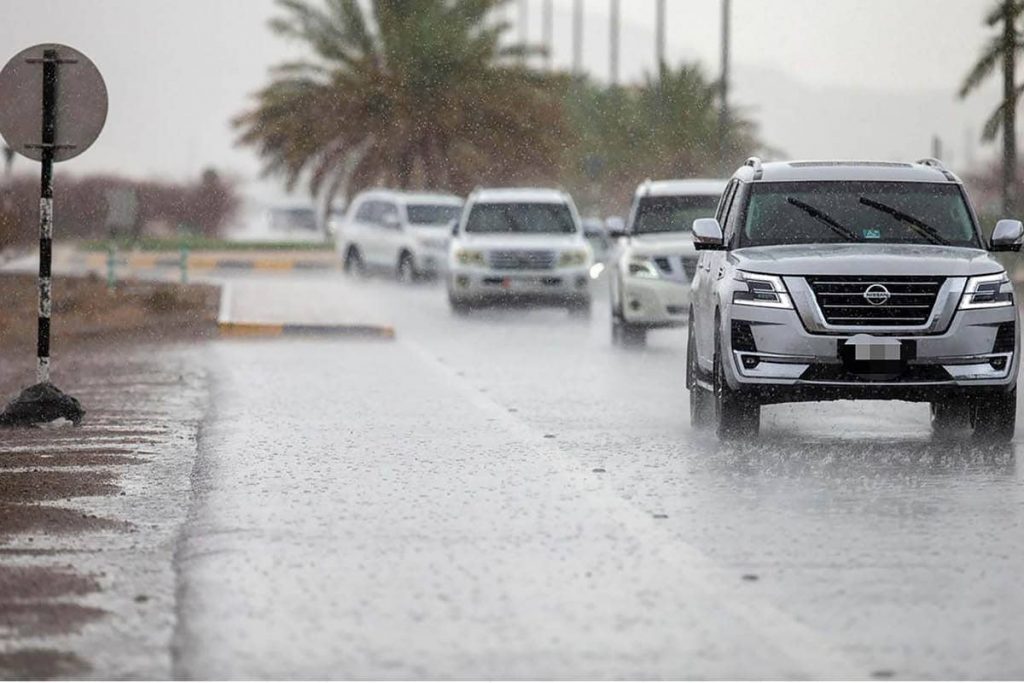
Rain is currently pouring down in Dubai and other parts of the United Arab Emirates this afternoon, with a particularly heavy stream hitting parts of the country, leading many to speculate how long this storm is set to last.
Precipitation forecasts for Dubai currently have rain set for Wednesday, Thursday, and Friday, so if you were hoping that rain was set to stop any minute now, science has other news for you.
In Abu Dhabi, rain is primarily set for Thursday, with Wednesday and Friday set to be cloudy.
In Sharjah, it is predicted to rain Wednesday, Thursday and Friday, with Saturday predicted to be cloudy.
Rain in Dubai is a particular is often a huge deal, as it is rare for a big storm to hit the region, and particularly long or hard rains can lead to flooding, so stay safe out there everyone!
Cloudseeding in the UAE: The incredible untold story of rain in the Emirates
It is often said that the next wars will be fought over water rather than oil. But what if scientists finally found a reliable way of making it rain? What if fresh water could be made to fall over arid desert lands? And what if that research was happening now, high above the mountains of the UAE? That would be pretty special, right?
A blurry monitor screen shows chief pilot Colin Bundy tightening his seat belt as he confirms his plane’s position over the radio. As the twin-engine King Air C90 pitches and shudders in the violent updraft from the surrounding cumulus cloud formation, Bundy’s image jolts as the camera operator sitting next to him momentarily loses his grip. Back at base, at Abu Dhabi’s National Centre of Meteorology and Seismology (NCMS), Omar Ahmed Al Yazeedi orders the crew to ignite their wing-mounted particle flares. It’s the beginning of yet another cloud-seeding mission, one of nearly 200 the NCMS flies across the United Arab Emirates every year in the hope of artificially increasing rainfall.
“In aviation, you try to avoid bad weather,” Al Yazeedi says. “We do the opposite; we fly directly into the heart of a thunderstorm.” The NCMS’s Director of Research, Development and Training recalls the first experiments conducted in the UAE over 10 years ago.
“On one occasion the hail was so intense that it smashed the cockpit windscreen. Our pilot managed to land safely but the plane had taken a battering; there were dents everywhere.”
The cloud seeding technology has been refined since those early attempts. Radar is used to determine the intensity of a storm and guide pilots away from the worst of the turbulence. “As a consequence, praise to God, so far we haven’t had a single accident,” says Al Yazeedi. Clearly, seeding clouds isn’t for the faint of heart. But do the rewards justify the dangers?
Read more here.