
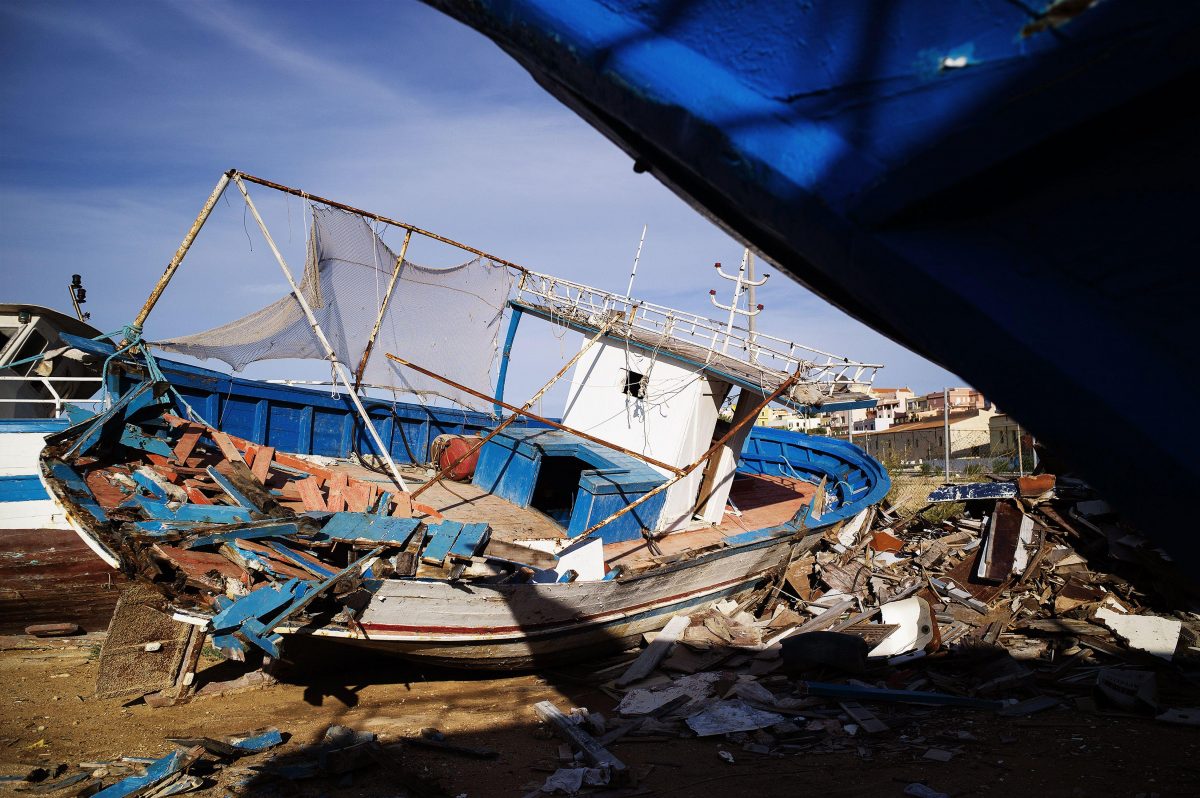

From the Esquire ME archive: December 2013
One night in 2009, on a boat from Libya to Lampedusa, when Hassan Ali thought he was about to die, he looked up. Up past the men with the AK-47s snarling down at him. Past the dead bodies and the men who were eating them. Past the abused women who sat, staring blankly and waiting obediently for death. He looked past it all and straight up at the sky and remembered when he was a boy, looking out of his bedroom window in Beled Hawo. He always wanted to be an astronaut, to be up there with the stars that danced and flirted with infinity, free of the violence and poverty in Somalia. If only he could escape Beled Hawo he might have a chance.
And now here he was, gazing into the darkness. Only now he wished more than anything he could be back home. In chasing freedom he’d become chattel – a slave. He’d witnessed rape, torture and worse. And all for somewhere he knew next to nothing about, at the tip of a country he knew didn’t want him.
But Hassan was one of the lucky ones. He made it to Lampedusa. Thousands of others don’t. So far this year, 13,078 illegal migrants have arrived at the small Italian island, which, at less than eight square miles, was hitherto known primarily as a Mediterranean holiday destination. Most of these people are swiftly thrown into a “welcome centre”, sometimes for months on end, after which around a third are sent home.
That’s if they make it: divers are still pulling bodies out of the sea near Lampedusa after a boat caught fire and capsized on October 3rd. Three hundred and sixty-four Africans died. Nine days later another thirty-eight men, women and children perished, mostly Syrians fleeing their civil war. Since 1999 over 200,000 people are estimated to have landed in Lampedusa. Up to 20,000 have died trying. Since the October 3rd disaster, two men, a Somali and a Libyan, have been detained for their role in the fateful voyage. Survivors have described horrific tales of rape and torture while struggling to stump-up enough cash for the trip.
Ready or not, Lampedusans have found themselves on the frontline of Europe’s immigration debate. Exact figures vary, but the EU estimates the number of illegal entries to Europe to be around a third of a million per year. Some people’s stories begin with violence, extreme poverty or persecution.
For Hassan, it began at afternoon prayers.
 BELED HAWO is a dusty border town in Somalia at the crossroads between Somalia, Ethiopia and Kenya. It’s currently held by Ethiopia-backed militia, but has been fought for before – and won – by Somalia’s deadly al-Qaeda affiliate, al-Shabaab. Hassan lived in a small apartment with his mother, father, younger sister and two elder brothers. Neither of his parents could find regular work and it was difficult for them to put their children through school. But thanks to money scrabbled together from friends and family living abroad, Hassan was sent to a local Islamic school called Dugsi. His oldest memory was of almost drowning in a local river. But far worse was to come when, aged ten, he walked into his local mosque after school to pray.
Gunfire suddenly rang outside. Hassan was alone. He could hear bullets fizzing past the building: some cracked into its whitewashed walls. In a panic, he decided to get out and run, dodging the crossfire that hissed and spat above his head. He turned onto his home street and rapped his fists against the front door. To his right, two men holding AK-47s saw him and opened fire. The front door opened. Hassan ran to his mother and jumped into her lap. It was five hours before the fighting eventually stopped.
Hassan’s childhood was not unlike those of millions of others in Somalia, a nation broken through years of civil war and terror. When, nine years later, he heard Somalis talk of their new lives in Europe after undertaking something called tahrib, he was hooked. Tahrib, it became clear, was a journey across land and sea to Lampedusa, from where he’d heard a new, prosperous life, without the constant threat of death, could be built. Hassan had found his way out of Beled Hawo. But it would take months more, and thousands of dollars, before he set foot on the island.
“RABBIT BEACH IS CLEARLY a big hit with travellers and it’s easy to see why, with its stunning turquoise water and white sand.” That’s Emma Shaw, TripAdvisor spokeswoman, speaking this February after Lampedusa’s top tourist spot was named best beach in the world. One of the Italian Pelagie Islands, alongside Linosa and Lampione, Lampedusa sits on a barren, isolated shard of cliffs and picturesque bays just seventy miles from Tunisia, placing it closer to Africa than Europe. It was once home to an ancient Roman garum (fish sauce) factory, and was mentioned by the Greek geographer Strabo as Lopadusa, meaning “rich of molluscs”.
During the Middle Ages the island switched hands frequently until, in 1860, the newly-formed Kingdom of Italy founded a penal colony on its scrubby shores. Still it remained a popular holiday destination thanks to its beaches and pretty villages. Loggerhead turtles swim to Lampedusa each year to lay eggs.
Today the scrub is gone, replaced by an ascetic, lunar landscape after deforestation and Allied bombing during World War Two. But the fishermen remain, picking sardines, anchovies, coral and sponges. And, arguably, so does the penal colony.
The “welcome centre” that greets the thousands of migrants who sail to Lampedusa each year was built to counter waves of immigration that have hit the island since the early 2000s, when violent Islamists began to take control of Somalia. It is struggling to cope.
A 2011 fire that gutted the Centre for First Aid and Welcome cut its capacity to 250. Over a thousand people now camp there instead, in a desiccated concrete shell that locals liken to a prison. Only recently did authorities allow migrant children to play in a special area for four hours each day. “We had to fight the police for it,” says Save The Children’s Viviana Valastro.
The number of people now arriving on a single boat is now “larger than the capacity of the centre,” says the UNHCR’s Barbara Molinario. Last month, a group of Syrian refugees went on hunger strike to protest their conditions at the centre.
So desperate is the situation in Lampedusa that it drew a July visit from Pope Francis, who prayed for migrants dead and alive. A speech in which Francis stressed a “globalisation of indifference” appeared to take aim at Europe’s populist politicians who’ve leapt on austerity to push increasingly xenophobic messages. Italy is more culpable than most.
In 2002, under a coalition led by then Prime Minister Silvio Berlusconi, the Bossi-Fini Law (named after Umberto Bossi and Gianfranco Fini, the neo-fascist and separatist politicians who drafted it) was introduced. Among other measures, the law allowed for the immediate expulsion of immigrants, arrest and detention of up to a year, residence contingent on work contracts, and the fingerprinting of immigrants. When asked if the latter clause was too harsh, the mayor of Treviso in northern Italy, Giancarlo Gentilini, replied: “What’s the problem? I think we should take prints of their feet and noses too.”
Would he have thought differently had he read Hassan’s tale?
 “ARE YOU MAD?” his parents questioned. It was 2009 and Hassan was nineteen. He had just told them he was about to set off on tahrib. “I told them everything,” Hassan recalls. “About how going on tahrib was the only way forward for me. They told me that if I thought it was an easy game, I should go ahead and do it. “It wasn’t until I called them on the boat that I knew they’d been joking.”
Somalia is the World’s Most Failed State, as the world’s press continues to remind us. It is limping from a civil war that began in 1991, and still hasn’t been declared over, to desperate poverty, the recycling of corrupt leaders, clan warfare and rampant Islamist groups along the way. Last year a famine killed a quarter of a million people. Al-Shabaab regularly detonates bombs in the capital Mogadishu and a fledgling government barely controls the turf outside its own presidential palace.
No wonder, then, that Somalia remains one of the world’s largest contributors of migrants to Europe. Over 41,000 left the country between January 2012 and July this year.
Few would be able to escape without mukhalas, tahrib’s “fixers”. These are shady characters who organise transit to Europe for Somalia’s desperate. Usually they’re petty criminals in a country where minor crimes goes unnoticed among bomb blasts, mass famine and economic meltdown. “The people who leave on the boats are told by their mukhalas that Europe is the only hope they have,” says Nur Hassan, a journalist in Mogadishu.
For Hassan that hope came at a price: $1,000 at first (which is relatively cheap: tahrib can cost up to $10,000), which he pooled from relatives and friends. He’d heard on the radio that the journey was riddled with danger, from crossing bone-dry desert with no food to facing-off bandits in Somalia’s badlands. But the country was still at war: those gunmen could return any moment and finish the job they’d started nine years back. Hassan kept his focus on Europe, blotting the doubts and fears from his mind.
His mukhala kept everyone waiting while he added as many people to the trip as possible, wildly overcrowding his boat and putting lives in danger from the off to make more money. Soon though, Hassan and ten others – four men and six women – set off towards Bosaso, a burning port city of 700,000 in Puntland, an autonomous hinterland state in Somalia’s northeast.
The mukhala had told everyone the ride from Bosaso to Egypt, the first leg of the trip, would be smooth and safe. But when a broken, battered old wreck arrived at port, Hassan knew they’d been conned. “Some people on that trip nearly suffocated to death on that boat,” he says. “The captain shouted a lot, telling people to keep quiet or they’d be beaten up. The boat was so full we had to be cautious no-one accidentally booted us off the edge.”
After eight treacherous days north up the Red Sea, and then across Egypt by land, they reached the Libyan border. Then things got worse. “We walked into a desert town. But then we were caught by fifteen or twenty armed men who we thought were the border guards. We men were tied up in the desert heat. It was so hot. The women were taken somewhere else not too far away. The guards told us that the girls would be tied up, beaten and raped. When, after two days, they demanded $300 each to leave, we found out they had been true to their word.”
The gang handed each traveller a mobile phone and told them to have relatives wire the money. Five full days passed until everyone had paid up. Their debt, however, was far from settled: another ten days were spent waiting in Libya’s western port city of Zuwarah before Hassan and the others managed to board a second boat, this time bound for Lampedusa. The ticket price: $800.
“And then the horror started.”
“WHEN YOU GROW UP on an island,” says the
Irish writer Roddy Doyle, “what matters is how
you stand up to the sea.” Riso is a fisherman from Lampedusa; he’s been standing up to the sea for decades.
But now he and his fellow islanders have bigger problems,
as they are the ones on the frontlines when mass tragedy occurs. “This is a political task,” he says at the island’s harbour, a tangle of rusting little boats that recent history seems to have skipped. “We are fishermen and workers, and we do workers’ work. Now the politicians must do their bit, because we can’t tolerate so much death all around us.”
Lampedusa’s natives have been praised for their magnanimity in l an impossible situation. The island’s mayor Giusi Nicolini, bombastic and full of sympathy, has been especially critical of Italian immigration policy. “Just how large does the cemetery on my island have to be?” she says. Thanks to Bossi-Fini, Lampedusan vessels have been told not to aid sinking migrant boats, though this hasn’t stopped locals performing daring rescues: last month sixty-one migrants were saved in an operation involving aeroplanes and ships. But the law trumps such acts of kindness. Even the survivors of the October 3rd catastrophe were placed under immediate investigation.
In truth, the problem is not just Lampedusa. Since the Arab Spring of 2011 the number of migrants coming to Europe from Africa and the Middle East has exploded. There are several other popular routes – Turkey, Malta and Spain are all migrant hubs too, and none of them have figured out how to deal with the situation. This has led to criticism of the European Union by many human rights organisations. Germany, for example, requires immigrants to apply for asylum in the country they entered first. If someone comes via Greece, the authorities just send them back. Spain has erected six-metre-high fences around its north African enclaves of Ceuta and Melilla. French interior minister Manuel Valls has said that it is “impossible” to integrate the Roma people. The European Court of Human Rights has called Greece’s asylum system “inadequate and degrading”.
There has been some movement. A task force for migration assistance in the Mediterranean has been formed by the EU, and is set to report to a summit later this month. Pledging $40 million to Italy to help it cope with the influx, an EU leaders’ statement said that “determined action should be taken in order to prevent the loss of lives at sea, and to avoid such human tragedies (as the October 3rd capsizing) happening again.” And Italy’s current prime minister, Enrico Letta, has voiced his determination to abolish Bossi-Fini, but his is a coalition that straddles awkward party lines: progress will, at best, be painfully slow.
Perhaps the biggest obstacle is Europe’s struggle to emerge from recession. The discourse has shifted in recent years from constructive policy-making to the appeasement of an angry electorate. This keeps the political parking meter ticking over while voters take time to forget tragedies like Lampedusa.
“The issue is about Europe and not Italy alone,” says author Annalisa Merelli, country and language editor of the Italian Global Voices. “We are just the gateway. ‘Fortress Europe’ is more than a warning: it’s full-blown fact.” In other words, the continent had better stand up to its sea, or it’ll face a new wave of tragedy.
 ON THE WAY TO LAMPEDUSA, Hassan’s boat ran out of drinking water and food. People began to die. Then, soon after, the ones who were left alive started eating the bodies. “I saw a man cutting a piece of meat from another man’s body,” he says. Eventually he and a handful of others reached Lampedusa, only to be arrested by the coast guard who took them to a detention centre. Three months later Hassan was granted asylum. Some haven’t even got theirs after almost five years. Hassan lived in Sicily and worked as a mechanic until, aged twenty-three, he recently returned to Beled Hawo to help his family with their money troubles. Things are better now, he says: there’s a stable(ish) government and al-Shabaab is being pushed back. But more will leave for Italy; more people will die. And he’ll still never be an astronaut.
By Sean Williams
Esquire, December 2013