
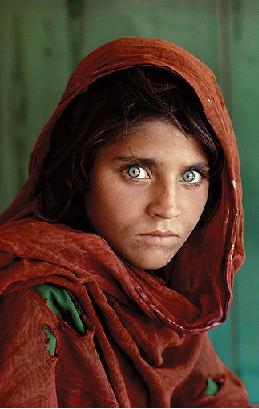

The Afghan Girl (pictured right) is without doubt your most famous work, gracing a particularly memorable cover of National Geographic in 1985. In honesty, is it a source of pride or mild irritation to be so universally recognised for one picture?
No, I’m very proud of the picture, and I see it as compliment. Whether I’m noted for one piece of work or the other, either way is fine with me.
When you took that particular photograph, did you have any idea of the kind of impact it would have?
Well, I knew it was going to be a powerful picture. It’s a powerful expression and an incredible set of eyes. But there was no way of knowing exactly how much influence it had; I never dreamed it would be so popular.
Was there a particular reason you singled out this 12-year-old out to shoot?
Her look… her eyes.
Are there any photos you can recall that have really left an impression on you? Ones that you wish you had taken?
Lots! The work of Henri Cartier-Bresson, a French photographer who always appeals to me. He’s made a lot of wonderful pictures that I would be very happy to have in my collection. I think it’s the highest mark of a good picture if you look at and think: ‘I would have loved to have taken that.’
Overall, would you say you prefer photographing people, as opposed to landscapes or geographical shots?
I’m more of a people person, definitely. I like human behaviour. We’re all the same, but we have variations in how we dress or adorn ourselves, and that fascinates me. How we present ourselves in different ways is intriguing…
With people shots, do you let them know beforehand that you’re going to photograph them or just snap away?
I prefer to shoot people unaware. When you make a portrait, obviously you have to stop and ask them. But I prefer to just walk down the street and shoot pictures, of anything and anyone that I find interesting.
Speaking of your experience on the ground when 9/11 occurred, you said it was a surreal feeling running towards something that others are running away from. When were you last truly afraid on a job?
I think the most dangerous times were in Afghanistan, in battles, being bombed… being in wars is no joke. You realise that things sometimes aren’t going the right way, you’re stuck at that point and are just hoping for the best. And yes, sometimes the outcome doesn’t look very promising. But there are so many different ways you could be killed at each moment, you can sometimes question yourself, asking: ‘why am I here and what am I doing?’ But you just survive and go back the next day.
What lengths will you go to get a shot?
I always try and work in a margin of safety. Taking risks is fine, but it has to be an intelligent, calculated risk.
A number of your photographs depict dead bodies of civillians, soldiers and various other horrors . Does seeing these things leave a mark, or do you eventually become a bit more jaded towards them?
You have to try and move on really. You don’t want to be debilitated, you have to find some way to move on, otherwise it can be very traumatic. It’s horrifying, and too much of that cannot be healthy. So yeah, you have to compartmentalise – otherwise you would just implode.
Do you remember the first dead body you saw?
Yeah – a car accident, I was covering for a newspaper. There were four or five young people who all died – it was absolutely horrific, really traumatising. All you can do is look through the camera, you don’t really look directly at it. It leaves an impact, a real effect on you, but you also just have to try and deal with it as best you can.
“Being in wars is no joke. You realise that things sometimes aren’t going the right way, you’re stuck at that point and are just hoping for the best. And yes, sometimes the outcome doesn’t look very promising”
Your current exhibition in this region is called 7 Princesses, centred around 20 Emirati women representing the seven Emirates. How did this come about?
I work with the Empty Quarter gallery, it’s owned by two women and we discussed the project, and I thought it would be a very good idea to collaborate and celebrate the lives of these women who are making their contribution to Emirati society. Its different geography, different landscapes – trying to show what this region is all about. The local women I photographed were great. Really cooperative, friendly, enthusiastic and playful. We went to places all over the desert, on top of buildings and so on. They were very willing participants in trying to make these concept pictures successful.
How does it compare to previous work you’ve done in this region?
I never really photographed in the UAE before actually. I’ve done a lot in Pakistan, India and other Muslim countries. But Dubai is such an ultra modern city, so it was an interesting challenge. I felt it was kind of an exploration of what the world will look like some day. This place is an incredible accomplishment, it really is remarkable what they’ve done considering this place was just sand not long ago! It’s a lot of effort, thought and planning – it’s an example of how with good planning, you can do an amazing job. It’s very visionary.
Has the rise in the standard of smartphones cameras affected the way photographers like you work? With such good camera technology available in everyone’s pockets, is there any impact on you profession?
It honestly doesn’t make a whole lot of difference for people working in photography, no. If I worked in breaking news, it might be a bit different. I think the fact there are better cameras in cell phones doesn’t necessarily mean someone will be able to take good photos, in the same way that owning a keyboard doesn’t mean you can necessarily write a good poem.
As a photographer who clearly takes his work very seriously, does today’s gratuitous ‘selfie’ generation annoy you?
No no no, We’ve been doing that for years – it’s fun! It’s a memory, you know? It’s great.
Finally, any tips for budding photographers on how to nail that perfect shot?
Practice. You need to, there are just too many elements needed for a good photo. Sometimes you get lucky, but to be consistent it’s just practice. You can’t get around that with anything, whether you play guitar, dance, piano – anything worth doing takes effort. If you want to be a photographer, you have to just photograph.
Steve McCurry’s ’7 Princesses’ exhibition is running from the 16 March to 16 April, at The Empty Quarter in DIFC