
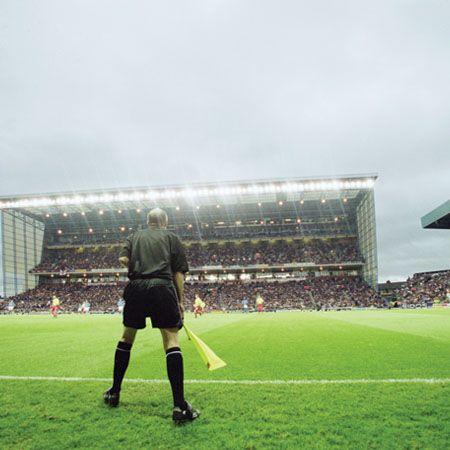

How a minor change to the rulebook revolutionised football
In 2005 the offside rule was slightly amended in its wording. It was a slight tweak that clarified what it meant for a player to be “interfering” with play. But what the fine-tuning actually did was to revolutionise the game itself.
In future there would be no more instances of a player collecting a pass and the flag going up because his teammate had wandered offside elsewhere. Indeed, that other player who was in an “offside” position could now continue to attack and even receive a pass to score, as long as it was not a pass played forward. This led to teams approaching games differently, and as a result the average number of offsides-per-match in the English Premier League has been falling.
“The liberalisation of the offside law means that defences can no longer be secure that a player behind them is out of the game, which in turn means that the offside trap as a general strategy is effectively neutered,” explains Jonathan Wilson, author of Inverting the Pyramid: The History of Football Tactics. “That means defences sit deeper, increasing the effective playing area and so creating space in which smaller players can express themselves. A decade ago it was believed midfielders had to be muscular giants to prosper: now some of the best players in the world (Xavi, Iniesta, Messi, Silva, Modric) are around 5’7”.”
For managers, it’s a mixed blessing. Tottenham Hotspur’s Harry Redknapp admitted he didn’t really understand the new rule, and described the changes as “a nightmare” but others saw the benefits and the impact on the game.
“It has tactically changed the way defenders act,” former Liverpool and Inter Milan manager Rafael Benitez tells Esquire. “The rule change can be used to your advantage offensively if you know how to use it, but it creates doubt in the minds of defenders, and any defensive mistake can be dangerous. Because of this doubt — and the difficulty in working with it to your advantage — one reaction has been that teams play deeper. Strikers are also learning to use this and forwards now can make runs from deeper positions to get behind the defence.”
Michael Cox, from tactics website zonalmarking.net concurs and adds that the additional presence of so many quick attackers has forced defenders deeper towards their own goal to deny the space behind it. “When that space is very small, midfielders are less likely to play the ball into it for onrushing forwards,” he explains. This has altered the playing setup, with many teams dispensing with the use of two strikers. “You used to have a Bergkamp dropping deep, and an Anelka going over the top, but now nearly everyone plays one upfront and that striker is becoming much more of a link-up man. You get players like Tevez, Rooney (a couple of seasons ago) and van Persie playing upfront alone, and they’re always going to come to the ball rather than try and beat the offside trap.”
One of the by-products of this is the increasing move away from the 4-4-2 formation towards the 4-2-3-1 line-up that better suits a stretched game. Football statisticians Opta noted that during the European qualification for the World Cup in 2010, 39 percent of the teams used the preferred 4-4-2, but during the recent qualifiers for Euro 2012 only 20.7 percent of the teams used it, with more countries preferring the 4-2-3-1 approach. Ultimately though, it’s the players themselves that need to adapt.
Defenders now have to step-up the standard of their play, rather than just stepping up and catching forwards offside, as the offside rule is no longer the “fifth defender”. Playing the offside trap, as teams such as George Graham’s Arsenal did so successfully in the late Eighties and early Nineties, would now be ineffective to the point of detrimental. And hence a minor change in the law has led to a major increase in the quality of football being played.