
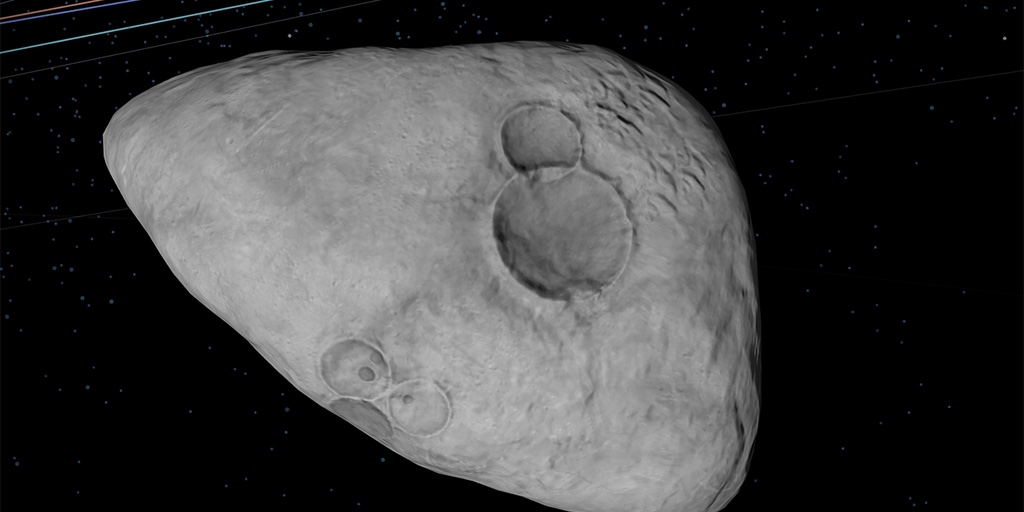
Have you made plans for Valentine’s Day, 2046 yet? Maybe keep your calendar open for now, as there’s a small change–very small–that an asteroid could ruin the festivities, according to Nasa.
Yep, NASA officials have tweeted some shocking news: a newly discovered asteroid could come very close to Earth in about 20 years. While there’s a slim chance it could collide with our planet (about 1-in-600), don’t worry too much! NASA assures us that this is still a “very small chance” of impact and that the risk level is expected to decrease as more observations of the meteor are made.
“Often when new objects are first discovered, it takes several weeks of data to reduce the uncertainties and adequately predict their orbits years into the future,” NASA’s Asteroid Watch tweeted. “Orbit analysts will continue to monitor asteroid 2023 DW and update predictions as more data comes in.”
This object, named 2023 DW, is estimated to be around 165 feet (50 meters) in diameter, which is roughly the length of an Olympic-sized swimming pool. On February 14, 2046, it’s expected to make a very close approach to Earth. Right now, the European Space Agency’s Near-Earth Object Coordination Centre predicts a 1-in-625 chance of a direct impact, but these odds are being updated daily as more information becomes available.
When a new object like this is first discovered, it can take several weeks to predict its orbit accurately. NASA is on the case, though! Orbit analysts will be keeping a close eye on 2023 DW and updating their predictions as more data comes in.

While a direct impact from this object wouldn’t be like the cataclysmic dinosaur-killing asteroid that hit Earth 66 million years ago, it could still cause severe damage if it landed close to a major city or populated area. In 2013, a smaller meteor exploded over Chelyabinsk, Russia, damaging thousands of buildings and injuring roughly 1,500 people. So, it’s still important to keep an eye on asteroids like this.
Luckily, NASA scientists are rapidly developing methods to protect Earth from potentially hazardous meteors like 2023 DW. Just last week, they published four studies confirming that their Double Asteroid Redirection Test (DART) mission successfully altered the trajectory of a meteor by slamming a spacecraft into it. Follow-up missions are already in the works to further perfect this planetary defense technique.