


Scientists in the UAE have made a rather amazing discovery—Umm Al Quwain in the UAE is a lot older than we thought it was. 500 years older, to be exact.
While the UAE just celebrated its golden jubilee, it turns out that UAQ has had around 14 of them, as new archaeological research on the island of Siniya shows that UAE is actually a staggering 700 years old.
The research found that there were two coastal settlements on Siniya, which is just opposite the town of Umm Al Quwain, also spelled Umm Al Qaiwain, and the oldest of which comes from the 13th or 14th century, the archaeologists found.
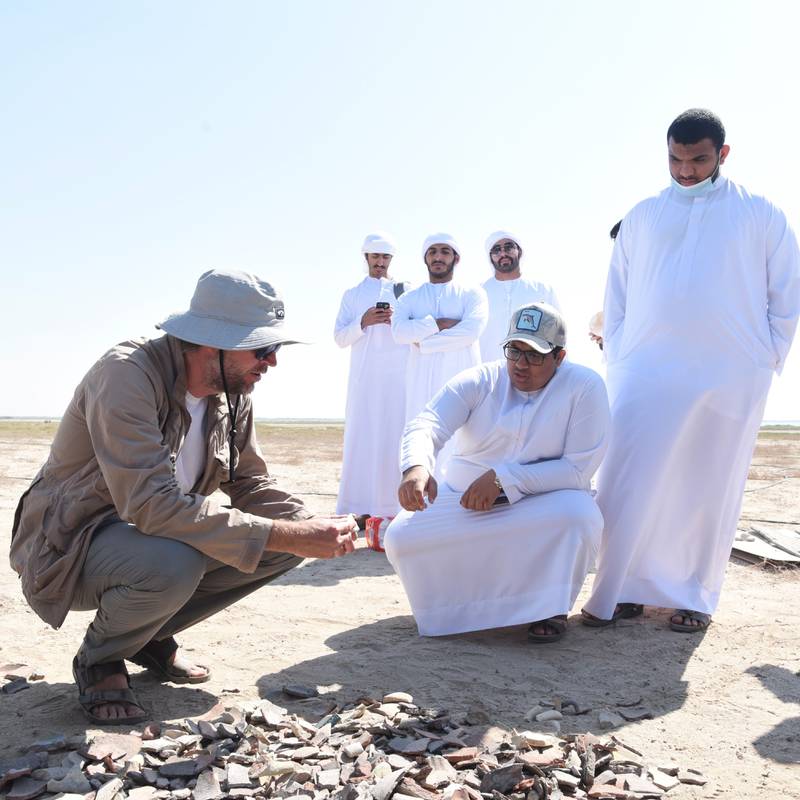
This is huge, because previously it was thought that the fort established by Shaikh Rashid bin Majid Al Mualla was the oldest settlement in the area, in 1768 to be exact. It turns out there is a deeper history we’re just now scratching the surface of.
It’s also astounding because the artifacts are from almost everywhere, including China.
“We are finding objects from India, Africa, China, Japan and America,” said Dr Timothy Power, associate professor of archaeology at UAE University.
“We tend to think of the premodern emirates as an underdeveloped place with people living close to subsistence level but that’s not at all the case,” said Dr Power to The National.
The research was directed by Shaikh Majid bin Saudi Al Mualla, Head of the Tourism and Archaeology Department of Umm Al Quwain.

“I am delighted by these discoveries,” Shaikh Majid said. “We knew that the Al Mu‘alla family first established itself in the area of present-day Umm Al Quwain around 250 years ago. These new finds on Siniya now add another 500 years to the history of our Emirate.”
If you haven’t heard of Siniya Island, it’s between UAQ and the Gulf coast of the UAE, protecting the Khor al-Beida lagoon, a mangrove-fringed lagoon that is the best surviving example of its type in the Northern Emirates.
Ancient Umm Al Quwain
This discovery doesn’t mean that there was no human settlements there more than 700 years ago. In fact, there is evidence that it was occupied for around 6,000 years, including sites from the Neolithic and Bronze Age periods.
There was even the site of ed-Dur, a port that traded with the Roman Empire 2,000 years ago.
The settlements they found had low mounds covered by pot sherds, representing the remains of collapsed stone buildings or oyster shell middens, or rubbish heaps.
They dated it using the presence of green-glazed pottery exported from China under the late Yuan and early Ming dynasties—yep, there was Chinese pottery in the UAE 700 years ago.
This settlement is contemporary with the peak of Julfar in Ra’s al-Khaimah, the leading pearling centre of the Lower Gulf during the later Middle Ages.
“This first settlement is the larger of the two recently identified on Siniya Island. It seems to have had an urbanised core of stone buildings surrounded by suburbs of palm-frond houses. A large oyster shell midden was found to the west of the settlement, pointing to the importance of the pre-modern pearling industry,” said a statement from the UAE’s state news agency.
“Occupation subsequently shifted to another area nearby, with this new second settlement then flourishing from the early 17th to early 19th century. The occupation can dated by the presence of blue-and-white porcelains exported from China during the late Ming and early Ching dynasties, including possible Kraak Ware and Batavian Ware. This settlement was probably established around the time Julfar declined, as part of a decentralisation of the early modern pearling industry,” the statement continued.
“Interestingly, the oyster shell middens next to the second settlement are much larger than those of the first. This may reflect the progressive erosion of the earlier middens. But it might alternatively reflect the tremendous growth of the pearling industry that began in the 18th century. This pearling boom was fundamentally important to the emergence of the Emirates.”
They even know how the second town was destroyed—it was 18th January 1820 by a naval squadron despatched to the Arabian Gulf by the British East India Company to deal with the issue of piracy. A rare coin of Shaikh Sultan b. Saqr al-Qasimi, the powerful ruler of Ras Al Khaimah, has been discovered on the site. He signed the General Maritime Treaty of 1820 that brought hostilities to a close and laid the foundation for the modern United Arab Emirates.
The ruins of the second town were described by a British naval survey in 1822, confirming the settlement. The notes said that it had been abandoned in favour of the present site of Umm Al Quwain town, situated on the mainland immediately opposite Siniya Island. This constitutes the third town, which prospered between the 19th and mid-20th century, before the focus of settlement once more shifted, this time to the extensive suburbs of the modern city.
“The three historic towns of Umm Al Quwain can now be shown to belong to a single occupational sequence lasting from the 13th or 14th century to the present day. This sequence is exceptional, since the archaeological remains of the historic towns of the Gulf coast of the Emirates have in virtually all cases been obscured by massive modern development,” said the statement.
The search is not over—archaeological excavation in the two towns will continue for the rest of the winter, and in time, will be open to the public. Don’t worry, we’ll let you know how to book tickets as