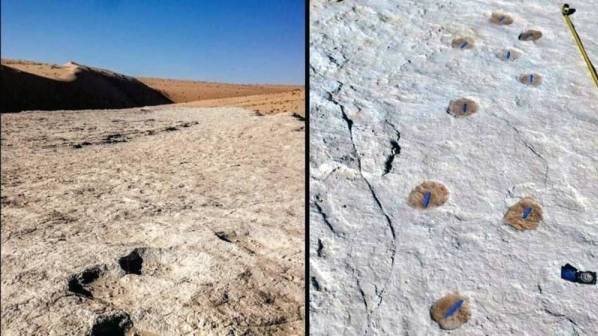
Saudi archaeologists have found the oldest proof of life in Saudi Arabia.
The Kingdom announced that it has found human and animal prints that date back 120,000 years ago, found in the Tobuk province in the north of the country.
The footprint fossils were found in a dry salt late, and were unveiled by the Ministry of Culture’s Heritage Commission in Riyadh. The find was made possible thanks to a partnership between Saudi Arabia and several international excavation teams.
The footprints include those of seven humans, 107 camels and 43 elephants. There were also tracks from predators.
Dr. Jasser Al Herbish, chief executive of the Heritage Commission, said: “The team identified footprint traces of seven humans, 107 camels, 43 elephants and other animal traces from ibex, deer and bovine families, which were moving in groups of adults and offspring.”
This archaeological discovery represents the first scientific evidence about the oldest existence of human life in Arabia and offers a rare glimpse into the natural environment and biodiversity in the region”, Al Herbish said.
Previously, the oldest evidence of ancient man in Saudi Arabia was the 85,000-year-old remains found in the Nefud desert, also in the Tabuk region.
This is turning out to be a big year for the Saudi Commision for Tourism and Heritage. Earlier this year, they found what just might be Saudi Arabia’s version of Stonehenge.

Esquire now has a newsletter – sign up to get it sent straight to your inbox.
Want up-to-the-minute entertainment news and features? Just hit ‘Like’ on our Esquire Facebook page and ‘Follow’ on our @esquiremiddleeast Instagram and Twitter account.
.jpg)