A team of particularly cheery astronomers and astrophysicists have spotted signs in space that point towards Andromeda, a nearby galaxy, one day devouring our Milky Way galaxy.
There’s a lot of things to worry us in life; the fear your plane might crash, fear you may not make your rent, fear the in-laws are staying over. So why not add another fear to haunt you at night as you’re just about to fall asleep? According to Australian National University’s Research School of Astronomy and Astrophysics, a galaxy set to devour ours whole is flying towards us.
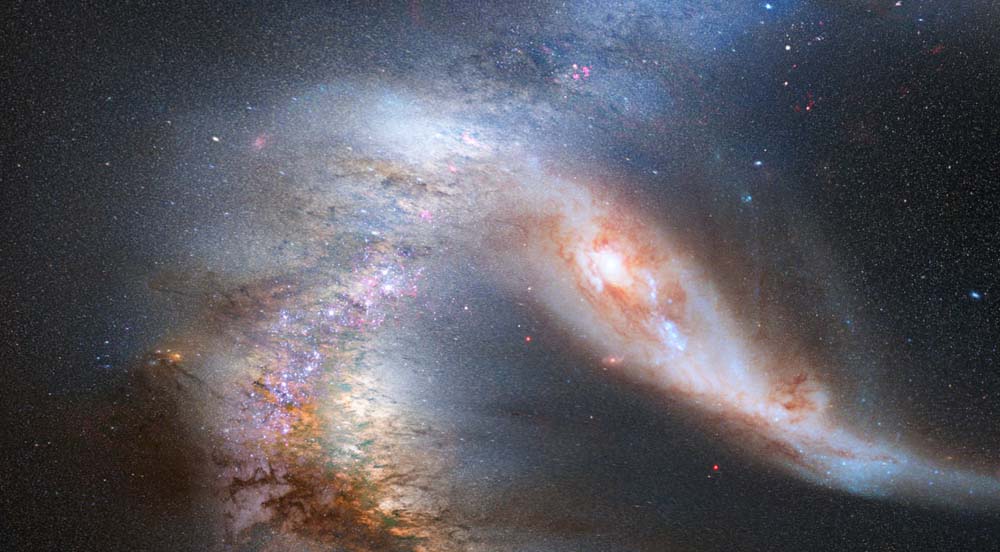
The Andromeda Galaxy, otherwise known as NGC 224, which is far catchier, is the nearest major galaxy to the Milky Way. It’s far larger than our own, over twice the size with four times as many stars. Given its impressive size, it has a long history of gobbling up other smaller galaxies in its path. To our horror, the Milky Way is also on the menu.
The Andromeda Galaxy

Looking at ‘left-overs’ of other cannibalised galaxies, researchers have gained better insight on the eventual death of the Milky Way and the way in which Andromeda may do it.
“By tracing the faint remains of these smaller galaxies with embedded star clusters, we’ve been able to recreate the way Andromeda drew them in and ultimately enveloped them at the different times,” said Dr Mackey from the Australian National University’s Research School of Astronomy and Astrophysics.
The complexity of Andromeda and its magnitude points heavily towards it eating up many galaxies over several million years, many of which were still larger than the Milky Way. Thankfully though, this galactic doomsday is more than four billion years away.
“The Milky Way is on a collision course with Andromeda in about four billion years. So knowing what kind of a monster our galaxy is up against is useful in finding out the Milky Way’s ultimate fate,” said Dr Mackey.
The Milky Way – our home galaxy

This information may seem useless to us, but to scientists, observations of other galaxies is incredibly useful to understanding our own and our place in the universe.
“One of our main motivations in studying astronomy is to understand our place in the Universe. A way of learning about our galaxy is to study others that are similar to it, and try to understand how these systems formed and evolved.
“Sometimes this can actually be easier than looking at the Milky Way, because we live inside it and that can make certain types of observations quite difficult.” Explains Professor Lewis from the Sydney Institute for Astronomy and University of Sydney School of Physics, who co-led the study with Dr Mackey.
The troubling fate of destroyed galaxies, as well as the patterns of Andromeda can be used to learn more about the evolution of our own galaxy, though probably not in any of our lifetimes.
Read the full report here.