I’m going to let you peek behind the curtain a little bit. Last year when I tabled the idea of doing an ‘influencer issue’ my team’s collective eyeroll around the meeting room was so pronounced that it was practically audible.
With a healthy dose of scepticism — as I expect all journalists to have — we spent the next hour throwing about ideas and shaping the narrative of what we wanted to say about the power of influence and the various guises it comes in.
By the end of it, we had an all-out battle plan involving multiple collaborations with some of the world’s foremost digital content creators; we worked with the Gulf’s most popular social media influencers; and even published a manual on ‘how to be an influencer’.
The goal was to get as many eyeballs on the project, across every platform and, the thing is, it worked.
More than 28 million people saw the project, with millions of views, streams, likes, uplikes, retweets and, even, actual magazine copy sales *gasp*.
Endless motivational pep talks will tell you that if at first you don’t succeed, try again. But what if you do succeed?
Conventional wisdom would be to keep on keepin’ on — but since when have we been conventional? For this, our second ‘Influencer issue’, our answer was to adapt and evolve.
Two recent events have reminded me of both the positive and negative sides of influence. Firstly, the death of Karl Lagerfeld, who for decades as creative director of Chanel and Fendi inspired an entire industry with his creativity and a relentless drive to achieve perfection. It was never about him, and fashion as a whole benefitted. His legacy will be as one of the most celebrated designers of all-time. That, right there, is influence done right.
As a counter to that, Netflix released its Fyre documentary — you’ve probably seen it — based around the organisation of a sham, luxury music festival on an island in the Bahamas filled with beautiful Insta-stars. It is a tale of just how far people can be led astray by blindly following those whose substance is as deep as their Instagram filter.
In light of these events, we wanted this issue to be less about scalability, and more about responsibility.
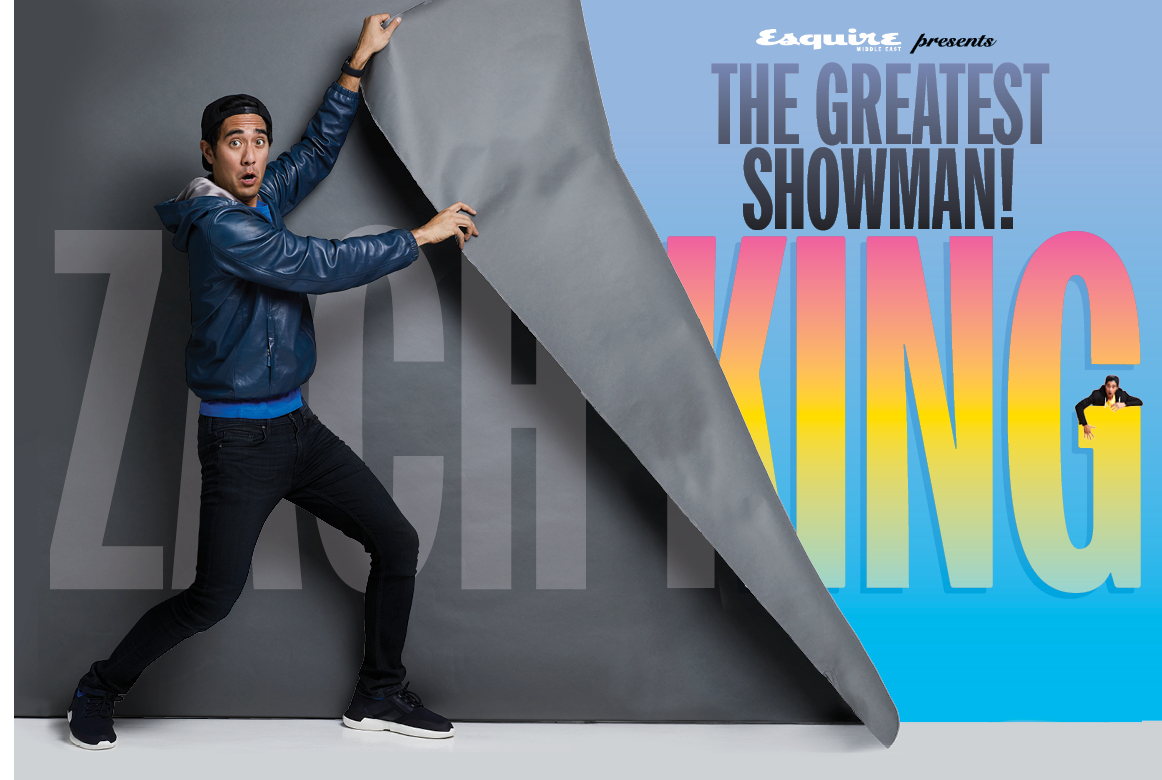
Leading the charge is our cover star, Zach King. You might not recognise his name, but you’ll almost certainly have seen his work — nearly 30 million people do monthly. Known for his fun six-second videos that are digitally edited to look as if he is doing magic, King has created a huge audience thanks to painstaking making digitally-digestible content that ultimately — and this is the important part — is made to entertain an audience, and not his ego.
For our collaboration with King, we wanted to take the spirit of his “digital sleight of hand” and adapt it into a static photo shoot. Check out
‘The Greatest Showman’ for one of my favourite shoots we’ve ever done.

We also profile a set of the Gulf region’s main social media influencers in the feature ‘The Social Crowd’. Our criteria was not based on size of audience (which you can buy), but on selecting people who are using their position as authorities to better those around them (which you can’t buy).
Again addressing the counter-balance, in ‘Power of Attorney’ we profile the lawyer defending disgraced Hollywood producer Harvey Weinstein in his upcoming trial for (alleged) sexual assualt, to show that in the wrong hands influence can have a very negative effect.
We also look at the game-changing impact that Instagram has had on the fashion industry; follow the struggles of Turkey’s only female professional boxer; and suggest tips on how you can improve the way you work, eat, shop and dress — because that, right there, is influence done right.