“What do you get when you combine the finest talent in aerospace engineering, Formula E auto racing, and high-power battery development?
The answer is sitting in a hangar bay tucked toward the back of a rural airfield, Gloucestershire Airport, two hours west of London.
Propped on a waist-high platform, it’s a humble-looking 12-foot carbon-fibre airplane chassis possessing an outsized ambition.”
And that is all Rolls want us to know about this mega project.
Introducing ACCEL from Rolls-Royce on Vimeo.
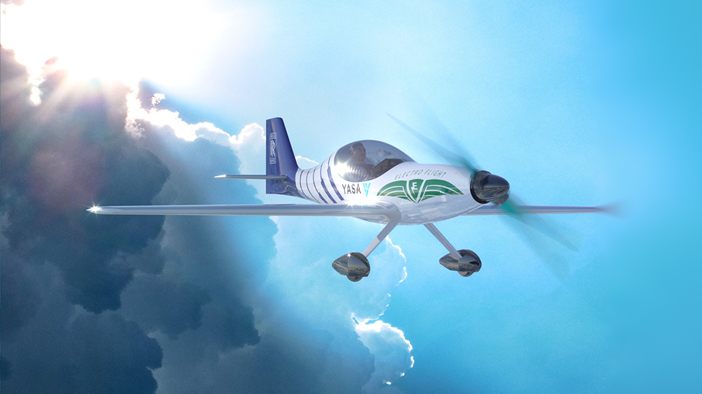
Not to be mistaken with the carmaker, Rolls Royce’s aerospace business unit is planning on building the world’s fastest electric plane.
Now, the legendary company – which more famously builds cars and engines for business and civil aviation jets – is collaborating with the British government on a zero-emissions plane that is expected to make history with a target speed of 300+ MPH. That’s pretty damn (not sure about you but we can’t say ‘damn) fast.
A quick search reveals that the current record was set in 2017 by an all-electric Siemens aircraft that reached maximum speeds of only 210 mph.
The company is no stranger to groundbreaking ideas.
In 1931, the British racing seaplane Supermarine S6B, equipped with a Rolls-Royce “R” engine, won both the coveted Schneider Trophy and set the speed record of its day. Matheu Parr, manager of the Accel project for Rolls-Royce, is motivated by this victory because of the way it set the company, then an upstart in aerospace, on a new path to becoming the world’s pre-eminent engine manufacturer and power supplier.
Rolls said in an intro to the Accel that “a team of British engineers, designers, and data specialists recruited from across Rolls-Royce and beyond have set out to make history.”
The name Accel stands for “Accelerating the Electrification of Flight.”
However, to see the plane or even test it out, the world is going to have to wait until 2020.