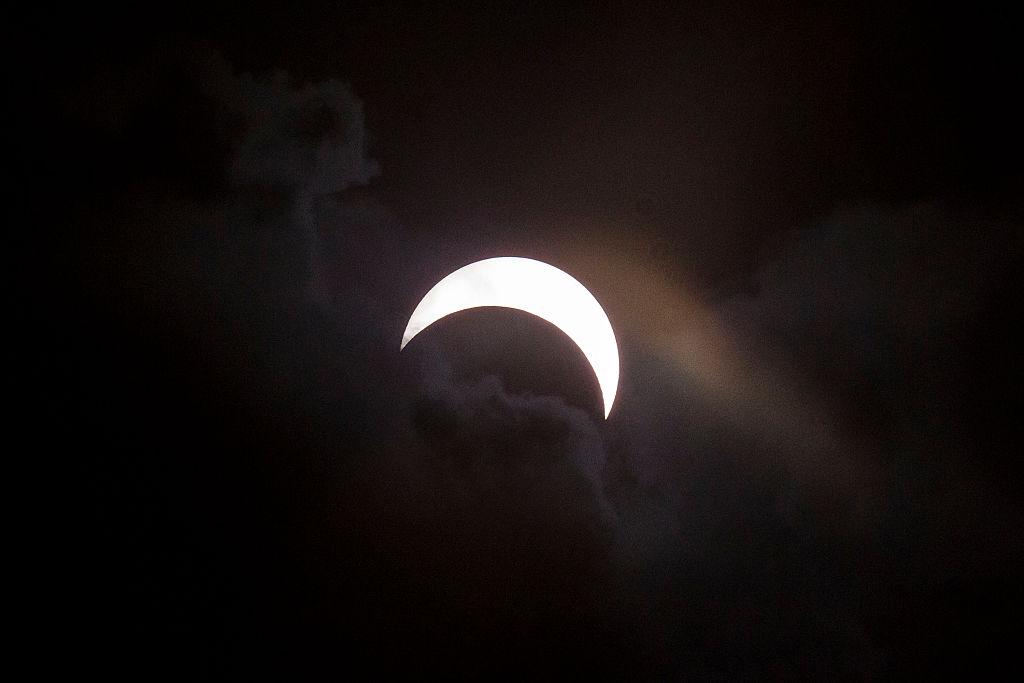

Today, August 21, 2017, all of North America will be treated to an eclipse of the sun. Anyone located within the vicinity of the eclipse’s ‘path of totality’ (the path of about 270 km or 168 miles wide that the moon’s shadow traces on Earth during a total solar eclipse) will be able to see one of nature’s rarest sights – a total solar eclipse.
This path, where the moon will completely cover the sun, will stretch across the US from Oregon to South Carolina. Americans outside this path will still be able to see a partial solar eclipse in which the moon will cover only part of the sun’s disk.
Despite the fact that many people associate the eclipse with doomsday and the end of times, there’s good reason to be excited about the upcoming solar eclipse. And although parts of South and East Asia, Europe, Africa and Australia may have experienced a partial lunar eclipse earlier this month, for me, it’s solar or nothing.
For those of you who fell asleep during science class, a solar eclipse is an event in which the moon passes between the sun and Earth and blocks all or part of the sun for a brief period of time. For this eclipse, the longest period when the moon completely blocks the sun from any given location along the path of totality will be about two minutes and 40 seconds.
Although this is obviously the star of the show, it’s also worth paying attention in the build-up to the darkness as around the point that the sun is three-quarters covered, you’ll start to notice that the shadows around you are getting sharper. The reason being that the Sun’s disk is literally shrinking and a smaller light source produces sharper shadows. Science.
The last time America saw a total eclipse was in 1979, with this year’s eclipse expected to be the most watched ever.
On 26 February 1979, Frank Reynolds promised ABC Coverage of the 2017 Solar Eclipse, 38 years later, @ABC kept it's promise. it's doing it. pic.twitter.com/hDBVct1Qxm
— Network7 (@Network7Archive) August 19, 2017
How to watch it:
Unfortunately for those of us in the Middle East we won’t actually be able to witness the solar eclipse in person; however, NASA have set up a variety of ways for you to watch the stream live over the internet. This is the first time that the solar eclipse will be streamed live online, with footage being delivered from the vantage point of helium-filled balloons. If all goes to plan you should be able to watch the natural phenomenon at the following links at around 8pm GST Monday: